
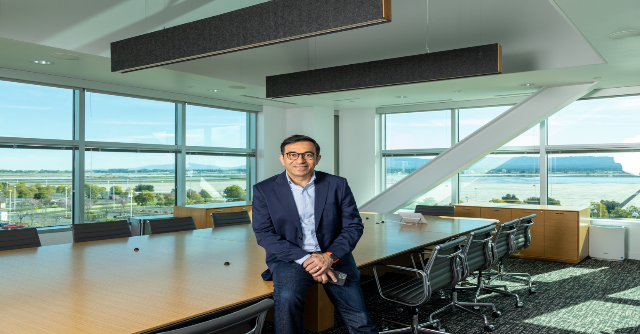
New Delhi, Dec. 16 -- Informatica has been at the heart of enterprise data management for more than three decades. Under the leadership of CEO Amit Walia, the company has undergone one of the most significant transformations in its history, shifting from an on-premises legacy to a cloud-first, AI-driven platform business, and most recently becoming part of Salesforce. In this interview with TechCircle, Walia reflects on that journey, the role of AI and data governance, and why India has emerged as a critical innovation hub for the company.
Edited excerpts:
Informatica has gone through several major transitions-from being one of the early players in data management in 1993, to being public, then private, and again public, and now becoming part of Salesforce. How would you describe that journey, and how has the transition been so far? Informatica is a more than 30-year-old company that has always been rooted in data management. While the core mission has remained the same, the world of data management has evolved dramatically over the years. Three decades ago, it was relatively simple; today, it is a massive, highly complex market. We serve enterprise customers across multiple categories of data management and operate on a truly global scale. Our customers include some of the world's largest banks, healthcare and pharmaceutical companies, retailers, and government organisations. Historically, Informatica was an on-premises software company. We went public, then private, and when I took over as CEO, we embarked on a fundamental transformation to become a cloud-only company. Our core platform today includes the Intelligent Data Management Cloud (IDMC). All of our products, like data integration, data quality, data catalog, master data management, and more, are built on this unified platform. The entire platform operates on a consumption-based pricing model, allowing customers to pay based on how much they use. Along the way, we took the company public again at the end of 2021. More recently, Salesforce approached us to acquire Informatica. We closed that transaction just a couple of weeks ago. How did Informatica move from entirely on-prem to a cloud native company? In the early stages of our transformation, we supported both on-premises and cloud offerings. But as you can imagine, the world was rapidly moving to the cloud. Application software had moved there, infrastructure had moved there, while we were still maintaining significant on-premises capabilities. The decision ultimately came down to this: our customers were getting real innovation from us in the cloud, while on-premises was increasingly about incremental or legacy innovation. The cloud also gave us the advantage of a single, unified platform. Customers could easily use multiple products together, which is far more complex in an on-premises environment with disparate product sets. We rewrote our cloud products entirely from the ground up, focusing on simplicity, modern user experience, and intuitive interfaces, so both technical users and business users could work with the platform. That created significant value for our customers and allowed us to innovate much faster. Another important factor was AI. We began our AI journey in 2018 with our offering Claire. AI thrives in a cloud-native environment, and the innovation it enables is dramatically more powerful there. Finally, we made the decision to move our cloud platform to a consumption-based pricing model. This allowed customers to pay based on what they actually use, which we believed was both economically efficient and highly customer-friendly. This year, we have guided and are on track to reach nearly $1 billion in cloud ARR. In other words, in just six to seven years, we built a billion-dollar cloud business. What were the challenges that you encountered while undertaking this migration? I wouldn't describe this as a migration at the outset. When we began the journey in 2020, what I announced was a cloud-first strategy, meaning we would innovate faster in the cloud. For the next two to three years, through 2021 and 2022, we deliberately accelerated innovation on the cloud while significantly slowing innovation on our on-premises products. By 2022, our cloud-native products were not only at parity with our on-premises offerings, but in many cases had significantly more capabilities. Starting in early 2023, we completed the shift to become a cloud-only company. We stopped selling on-premises products altogether and sold only cloud solutions. For our existing on-premises customers, we would continue to support those products. At the same time, we formally began helping customers modernise and move from on-premises Informatica products to our cloud platform. Today, while we don't disclose exact numbers, thousands of customers have already modernised their on-premises deployments to Informatica Cloud. If I were to give a directional view, over the next 24 months, we expect that close to 85% of our on-premises customer base will have transitioned to the cloud. In hindsight, it can look straightforward, but at the time, it was a very hard transformation. We had to clearly communicate the vision to both customers and employees. We had to reskill and retrain our workforce for the cloud, invest in brand-building around the new platform, and hire entirely new kinds of talent. Beyond building the product, we also had to transform our go-to-market motion. Our sales teams had to move from selling on-premises software to selling cloud solutions, and then further adapt to selling consumption-based offerings, which is fundamentally different again. How big is Informatica's footprint in India? India is our largest center and, more importantly, our innovation hub. Every function is represented here, like engineering, customer support and success, sales enablement, marketing, finance, and HR. All of our AI engineering happens in India. Claire, our AI engine, including Claire GPT and the recently launched Claire agents, has been built entirely here. This is where the core innovation that drives Informatica's growth comes from. India is also a fast-growing market for us. We serve a wide range of Indian customers, which gives me the opportunity to meet clients while I'm here. In addition, many of our global partners-such as Deloitte, Accenture, and Cognizant-have significant operations in India, so these visits also allow us to do joint planning with them. From a company perspective, we've been in India for over 22 years. Our largest presence is in Bengaluru, with additional centers in Hyderabad and Chennai, including teams that joined us through acquisitions. About 60-65% of our India workforce is in engineering, followed by customer experience functions such as support and professional services. Globally, we have around 5,500 employees, of which roughly 2,400 are based in India, making it more than 50% of our total workforce. In many ways, we think of India as our second headquarters. Tell us about the $8 billion acquisition by Salesforce and what lies ahead. For me, the conversation around Informatica becoming part of Salesforce came down to two simple questions: is it good for our customers, and is it good for our employees? The answer was a clear yes on both counts. From Salesforce's perspective, they are an applications company and do not operate in data management. As they looked to accelerate their AI strategy, it became clear that data management is foundational to that future. When they evaluated the market, they saw Informatica as both the innovation leader and the market-share leader. That is what led them to approach us. From our side, this was compelling because it creates significant upside for both employees and customers. Being part of Salesforce allows us to scale much faster, reach thousands more customers, and operate with the level of scale that AI innovation truly requires. Our teams can continue to focus on innovation with even less disruption, which ultimately benefits the customers who rely on us. We announced the acquisition at the end of May and closed it recently in November. Even during the period before closing, as two independent companies, we began planning together.
Published by HT Digital Content Services with permission from TechCircle.