
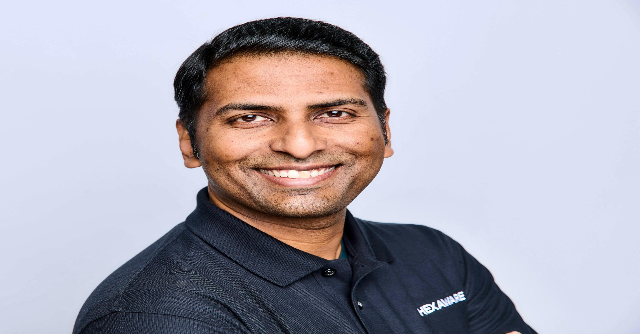
New Delhi, Dec. 9 -- Agentic AI has emerged as the breakout technology of 2025. But IT consulting and services firm Hexaware Technologies began playing with crude agents as early as 2020. By the end of 2024, the company had already deployed agentic AI solutions for its clients as well as internally. "Generative AI is like the brain; it does the thinking. But thinking alone isn't enough. Once you think, what do you actually do with it? That's where agentic technology comes in. Agents are the hands, legs, and muscles that give AI mobility and the ability to act. Generative AI thinks; agentic AI takes that thought and turns it into action," said Satyajith M, the chief technology officer at the Navi Mumbai headquartered organisation, in an interview with TechCircle. Despite the lure of agentic AI, Satyajith insists that the decision to deploy the technology or leverage simpler LLM solutions is driven entirely by the use case and the outcome it is driving. For Hexaware, the outcome is judged across several parameters. "The starting point is always establishing a baseline: existing execution time, current quality of output, and the typical human error rate. Even when humans perform a task, it's never 100% accurate; there are mistakes and inconsistencies. We first understand what that baseline looks like." Once that is clear, the focus shifts to improving the core metrics like accelerating timelines, reducing defects, and increasing volume and velocity. Governance framework
As the industry continues to adopt agentic AI, CXOs are now faced with the new challenge of managing and governing a 'hybrid workforce'. One that comprises human workers and autonomous systems, also called digital workers. Hexaware is no different. "Today, a lot of our attention is on the governance of digital agents. We already have mature processes for tracking, managing, and interacting with humans in traditional workflows. Now, we are building and evolving similar frameworks for how autonomous systems should be managed and governed," Satyajith said. Just like decades of software development still have not entirely eliminated bugs or vulnerabilities, autonomous agents too will continue to reveal unexpected behaviours, he added. Hexaware has been able to catch some of these issues early and put guardrails in place. For example, in initial experiments, the company discovered that one agent could end up talking endlessly to another agent, with no natural stopping point. This kind of loop can create a catastrophic impact, like unnecessary token consumption, performance degradation, and other system issues. "Once we identified it, we built in safeguards: exit conditions, interaction trackers, and rules to prevent two agents from talking indefinitely. These learnings will keep evolving, but over time, we believe such protections will eventually become industry standards," said Satyajith. Hexaware also recently released the second version of the internal AI Use Policy and governance guidelines. Without revealing too much about the policy, Satyajith said that one of the key tenets is protecting employee privacy. "We treat every prompt entered into our systems as if it contains personally identifiable information (PII). The systems perform PII reduction, where if an employee enters anything sensitive, the system automatically strips out that information. Only the fact that a sensitive element existed gets flagged, never the full content. This gives employees the confidence to interact freely with AI without worrying about their personal data being exposed," he added. The policy also revamped how the company handles AI-generated code. The review workflow for machine-generated code is entirely different from traditional code review. Notably, in August, Hexaware partnered with AI coding platform Replit to enable secure, governed Vibe Coding to support building production-grade applications using natural language. Finally, as demand grows for new AI-powered products and capabilities, Hexaware has created a structured evaluation and prioritization mechanism. "It helps us decide what the company should adopt at an enterprise level, what individual units can approve, and what may only be allowed at a project level," he said. Plans to grow tech team Hexaware has a 154-member team focused on exploring new technologies, evaluating what can be adopted enterprise-wide. Beyond this central group, every vertical and horizontal has large teams undergoing continuous training to stay abreast with emerging tech, said Satyajith. Hiring-both lateral and fresh-is ongoing, though the company typically shares those details only in quarterly results. To be sure, in February, Hexaware came back to the stock market with an Rs.8,750 crore IPO, after being delisted in 2020. This was the biggest IPO by an Indian IT services firm, surpassing TCS's Rs.4,713 crore issue in 2004.
Published by HT Digital Content Services with permission from TechCircle.