
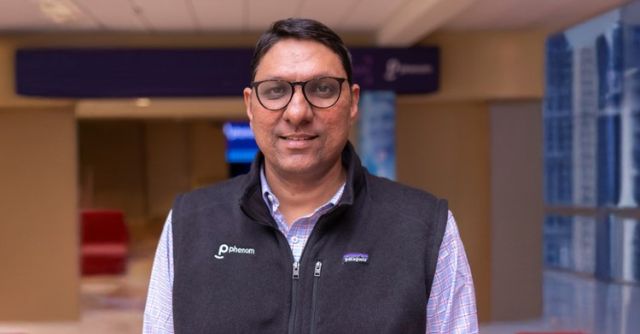
New Delhi, Dec. 18 -- Artificial intelligence is fundamentally changing how Indian companies hire, deploy and retain talent, but fears of large-scale job losses are overstated, according to Hari Bayireddi, President, COO and co-founder of HR technology firm Phenom.
"AI will not replace jobs; it will replace parts of jobs," Bayireddi said in an interaction with TechCircle on the sidelines of IAMPHENOM India 2025. Drawing a parallel with the disappearance of STD booths, he said technology eliminated specific roles but expanded the underlying function. "Communication didn't disappear-it multiplied. The same will happen with work."
Bayireddi described AI as a shift larger than the internet, pushing HR from a transactional, effort-led function to a strategic, outcome-driven one. In hiring and internal mobility, AI is increasingly automating repetitive, low-impact tasks, allowing HR teams to focus on higher-value work such as candidate engagement, cultural fit and long-term workforce planning.
From effort to outcomes
Indian enterprises, long known for execution intensity, are now being forced to move towards outcome-based models as AI bridges long-standing information gaps. "Effort is no longer the metric. Impact and outcomes are," Bayireddi said.
Phenom's approach centres on what it calls Applied AI for HR, which combines automation with intelligence. Resume screening, compliance checks and scheduling can be automated, significantly reducing hiring timelines. "Low-impact work gets automated. High-impact work actually increases," he said, referring to activities such as persuasion, assessment and retention-focused conversations.
However, translating AI's promise into real HR outcomes remains challenging. Upskilling is the biggest hurdle, particularly as automation affects different roles at different speeds. "Every company has its own culture and business model. HR has to help people transition from one level of work to another, and that's not easy," Bayireddi said.
Guardrails and trust
As AI assumes a larger role in HR decision support, concerns around bias, transparency and fairness are growing. Bayireddi acknowledged these risks, stressing the importance of governance and human oversight.
"Enterprise AI adoption is still only around 5% because risks need to be mitigated," he said. Unlike consumer AI, HR systems require deeper scrutiny around data quality, compliance and explainability. "HR is people-centric. Emotion and empathy still matter. AI must support human judgment, not replace it."
New AI tools for India's workforce realities
At IAMPHENOM India 2025 in Bengaluru, Phenom announced a suite of applied AI innovations for HR, built on its Phenom X+ Ontologies and tailored to Indian regulatory and workforce conditions. One of the key launches was an AI-driven candidate fraud detection agent, designed to flag resume falsification, identity mismatches and AI-assisted interview responses in real time without slowing hiring decisions-an increasing concern in India's high-volume recruitment market.
The company also unveiled enterprise talent optimisation and work redesign capabilities, which analyse work at the task level and map strategic initiatives directly to roles and skills. The system identifies tasks that can be automated or AI-augmented while linking reskilling efforts to measurable business outcomes.
For India's vast frontline workforce, Phenom introduced AI-powered workforce lifecycle and shift scheduling tools, enabling compliant scheduling, internal mobility and redeployment for seasonal and part-time roles. A voice-based screening agent was also launched to conduct role-specific interviews at scale across frontline, knowledge and executive roles. "These tools are designed to close the gap between workforce data, strategy and execution," Bayireddi said.
Why India matters
India is emerging as a strategic growth market for Phenom, driven by rapid AI adoption and sustained economic momentum. Bayireddi pointed to India's position as the largest user base of ChatGPT globally-accounting for roughly 13% of app usage-as evidence of how quickly AI tools are being adopted.
"AI today is like English was earlier-something everyone has to learn," he said, citing the success of UPI as proof that advanced digital technologies can scale across income levels and geographies.
Phenom employs around 1,000 people globally and is expanding in line with business growth. In India, the company works closely with private-sector banks and BFSI firms, where large hiring volumes, regulatory compliance and cross-verification create complex HR challenges. "Our focus is simple: reduce effort, increase speed and improve quality," Bayireddi said.
Preparing for jobs that don't yet exist
Looking ahead, Bayireddi warned that while enterprises are currently focused on efficiency gains and job rationalisation, far less attention is being paid to emerging roles. "Most organisations don't know what the new jobs will be. That's a bigger risk than optimising existing ones," he said.
Bayireddi further estimates that nearly 30% of the workforce will require reskilling as AI adoption accelerates. The company is working with Indian enterprises on career pathing, internal mobility and workforce planning to prepare for this transition. "India has succeeded by adapting-learning English, computers and new ways of working," Bayireddi said. "If that spirit continues, AI will be a net positive for the country."
Published by HT Digital Content Services with permission from TechCircle.