
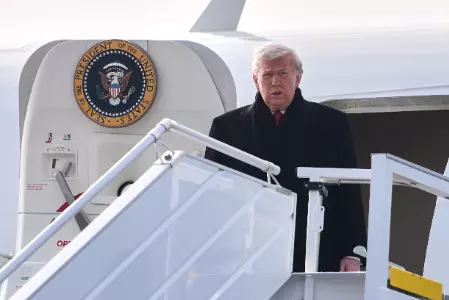
Davos, Jan. 21 -- US President Donald Trump on Wednesday renewed his push for Washington to acquire Greenland, ruling out the use of military force but insisting that only the United States is capable of securing the Arctic territory, remarks that immediately sharpened tensions with Europe and triggered a political response in Brussels that now threatens to derail a key EU-US trade deal.
Speaking during a 70-minute address at the World Economic Forum (WEF) annual meeting in Davos, Switzerland, followed by a 20-minute question-and-answer session, Trump described Greenland as strategically crucial, located between the United States, Russia and China. While he said the US "needs it for strategic reasons", he also repeatedly referred to the island as "a piece of ice", calling it "cold and poorly located", language that drew strong reactions in Europe as the dispute escalated into a broader standoff over trade and tariffs.
"People thought I would use force. I don't have to use force. I don't want to use force. I won't use force," Trump said, framing his bid as a security imperative rather than a territorial grab. He argued that Denmark, which administers Greenland, could not protect the island on its own and insisted that the US could not take on responsibility "on lease", implying that outright control would be necessary.
Trump also called for immediate negotiations with Denmark to secure a deal over Greenland, portraying Copenhagen as ungrateful for American support over decades. "We fought for beautiful Denmark. What I'm asking for is a piece of ice, cold and poorly located. It is a very small ask compared to what we have given them for many, many decades. We were stupid to give it back," he said, staking historical claims to justify renewed US demands.
The comments came against the backdrop of rising geopolitical competition in the Arctic, where Greenland's position is increasingly viewed as critical for military logistics and security planning. Trump said many European countries have territories and argued there was "nothing wrong" with the US seeking a similar arrangement.
In another pointed warning, Trump suggested there would be consequences for those who oppose him. "You can say yes, or you can say no, and we will remember," he said, referring to countries rejecting the US plan.
Trump's Greenland remarks were closely followed in Europe by renewed tariff threats. The US President has previously warned of a 10 per cent tariff on European countries opposing his plan to take control of Greenland. In parallel, he has threatened to hit six EU countries, including major economies France and Germany, with tariffs for not supporting his demand.
The pressure prompted an immediate political move in Brussels. EU lawmakers agreed to delay ratification of a key trade agreement with the United States after Trump's latest threats, a step that does not formally kill the deal but signals a harder line by the European Parliament toward the White House.
The European Parliament had been preparing to vote in the coming weeks on legislative proposals that would remove tariffs on US industrial goods, a central element of an agreement struck in July after months of negotiations during which Washington slapped 15 per cent tariffs on EU goods. Another component would extend zero duties for US lobster imports, first agreed in 2020. Both measures require approval from the European Parliament and EU governments.
However, lawmakers said Trump's latest approach had fundamentally altered the political basis for moving forward. Bernd Lange, chair of the European Parliament's trade committee, told a news conference that the latest tariff threats had "broken" the July agreement and said the deal would be put on hold "until further notice."
The trade committee had been scheduled to set its position through votes on January 26-27, but those votes have now been postponed.
While some lawmakers had already criticised the trade arrangement as uneven, the Greenland dispute intensified opposition. Critics argued that the EU would be cutting most import duties while the US maintained a broad tariff rate of 15 per cent. Even so, many in the Parliament had appeared prepared to accept it with safeguards, including an 18-month sunset clause and protections to respond if US imports surged. Trump's threats and territorial rhetoric changed that calculus.
"It is an extremely powerful lever-I don't think companies would agree to give up the European market," Valerie Hayer, president of the centrist Renew group, told journalists, describing the delay as a signal likely to unnerve American businesses.
EU leaders are now set to hold an emergency summit in Brussels on Thursday evening to discuss the US threats over Denmark's autonomous territory. The 27-nation bloc is weighing how hard to respond if Trump follows through, including formally freezing the trade deal and reviving retaliatory measures.
One option under consideration is imposing 93 billion euros ($108 billion) in tariffs on the United States, a package agreed at the height of last year's EU-US trade standoff. That retaliation plan had been suspended to avoid an all-out trade war and is currently paused until February 6.
Beyond tariffs, French President Emmanuel Macron is also pushing to activate the EU's "anti-coercion" trade instrument, a powerful mechanism designed to respond when a foreign country uses trade pressure to influence EU decisions.
In Davos, Trump widened his criticism beyond Greenland, launching attacks on NATO allies and European governments on tariffs, the environment and immigration. He said Europe was "not heading in the right direction", while declaring the US economy "booming".
"The USA is the economic engine of the planet," Trump said, presenting American growth as a driver of global prosperity. "When America booms, the entire world booms."
Trump claimed that tariff revenue was being used "judiciously" for the country and said Washington was "raising taxes on foreign nations to recover damages they have caused to us," adding that the United States has made "some great trade deals."
He opened his remarks by greeting "so many friends" and "a few enemies" and told the Davos audience that Americans were happy with his election. "Two years ago, we were a dead country, but now we are alive again," he said.
On Ukraine, Trump said he was "reasonably close" to a deal to stop the Russia-Ukraine war, even though he previously thought it would be easy to settle "in a matter of hours". He said Russian President Vladimir Putin and Ukrainian President Volodymyr Zelenskyy would be "stupid" not to end the war, while adding, "I know they are not stupid."
Trump also spoke about Venezuela, describing it as "an amazing place" that had been ruined by wrong policies. He claimed that after hostilities ended, the country approached the US for a deal and would make more money "in the next six months" than it had in the last "six years".
On energy and climate policy, Trump mocked environmental campaigners and suggested China profits by selling windmills "to stupid people in Europe." "Windmills kill birds, destroy landscapes, and stupid people buy them," he said, claiming that he did not see windmills in China.
He also took aim at Canada, saying it receives "a lot of freebies" from the US and "should be grateful".
In healthcare remarks, Trump said it took him an average of "three minutes" to persuade countries to raise prescription drug prices, telling them, "You have been screwing us for 30 years."
Published by HT Digital Content Services with permission from Millennium Post.