
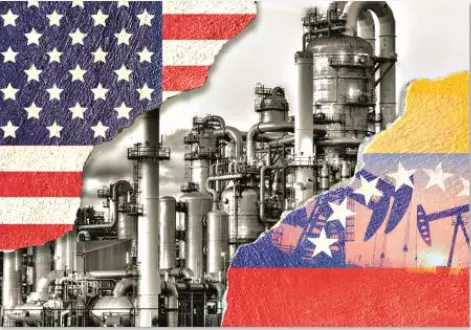
New Delhi, Jan. 13 -- The January 3, 2026, capture of Venezuelan President Nicolas Maduro by U.S. Special Forces stands as one of the most audacious applications of hard power in the 21st century. Washington's official justifications-narco‑terrorism, democratic restoration, the rule of law-form a familiar script. Yet the deeper force animating this episode, as it has animated much of modern history, is oil. Oil is not merely another traded commodity. It is the metabolic fuel of industrial civilisation. Control over oil translates into control over factories and fleets, transport and fertilisers, food systems and armies-and, ultimately, political power itself.
Operation "Absolute Resolve" cannot be understood by reading headlines alone. It belongs to a long, lubricated history in which crude oil has functioned as both the engine of modern life and the quiet architect of geopolitical order. The logic that underpinned the 2026 raid on Caracas is a direct descendant of the 1916 Sykes-Picot Agreement. The disintegration of the Ottoman Empire after World War I was not simply the result of military defeat; it was, more fundamentally, a repartition of hydrocarbon geography. Britain secured Iraq and Kuwait; France took Syria; and a web of Gulf sheikhdoms was folded into British protectorates. The borders drawn at Sykes-Picot did not reflect ethnic or religious realities. They traced oil‑bearing basins, pipeline routes, and maritime access.
The Middle East was thus carved into spheres of influence not by cultural logic, but by accommodation of the interests of the "Seven Sisters"-the Anglo‑American oil cartels that emerged as de facto sovereigns of the region: Anglo‑Persian Oil Company (later BP), Royal Dutch Shell, Standard Oil of New Jersey (later Exxon), Standard Oil of California (later Chevron), Gulf Oil, and Texaco. These firms did not merely extract oil; they structured markets, dictated prices, and shaped foreign policy itself.
That logic did not end with the First World War. It resurfaced, with devastating clarity, in the Second. Japan's attack on Pearl Harbour in December 1941-often explained through imperial ambition or racialised militarism-was, at its core, a response to energy strangulation. By 1940, Japan imported more than 90 per cent of its oil, nearly four‑fifths of it from the United States. When Washington imposed a full oil embargo following Japan's southward expansion into Indochina, Tokyo faced an ultimatum without words: retreat from empire or watch its navy and air force grind to a halt within eighteen months. Pearl Harbour was not an irrational outburst; it was a pre‑emptive gamble to neutralise the U.S. Pacific Fleet long enough for Japan to seize the oil fields of the Dutch East Indies and secure its sea lanes. The Pacific War, like so many conflicts before and after, was ignited not by ideology alone but by the brutal arithmetic of fuel, fleets, and survival.
The postwar order merely shifted the terrain of this struggle. The formation of OPEC in 1960 marked a revolutionary attempt by oil‑producing states to reclaim sovereignty over their "black gold" from Western conglomerates. It also set a precedent: nations sitting atop vast reserves that sought independent control over pricing or distribution would invite "regime stabilisation," sanctions, or outright intervention. In this light, Venezuela's fate is not an aberration. It is continuity. What unfolded in Caracas in 2026 belongs to the same lineage as Iran in 1953, Iraq in 1991 and 2003, Libya in 2011.
The West learned an important lesson after OPEC's rise. Producers might control supply, but they need not control markets. Over time, supplies were diversified, strategic reserves were built, shipping and insurance were consolidated, and finance-most notably the U.S. dollar-was weaponised. Oil would trade in dollars, and dollars would flow through the American financial system. Any attempt to challenge that architecture would encounter resistance. The rhetoric would vary-democracy, weapons of mass destruction, human rights, narco‑terrorism-but the message would remain blunt: defy the energy order, align with rivals, challenge the dollar, and removal becomes your fate. Under President Trump, only the batting style has changed, not the rules of the game.
For Washington, Maduro was not merely a socialist adversary. He was a structural leak in America's backyard. The United States could not tolerate the consolidation of a triad-Russia, China, and Saudi Arabia-playing oil politics in the Western Hemisphere. China had locked in long‑term contracts for Venezuelan crude, effectively turning Caracas into an energy outpost of America's principal rival. Much of this trade was conducted in yuan, a direct challenge to the dollar's monopoly in global oil markets. The threat was twofold: to U.S. energy hegemony and to the financial architecture that underwrites American power. Worse still, it was unfolding barely 1,400 miles from Miami.
By reasserting control over Venezuelan production, the United States aims to weaken the price‑setting power of the OPEC+ alliance led by Riyadh and Moscow. President Trump's oft‑stated ambition of driving oil prices toward $50 a barrel depends on "unleashing" Venezuela's stalled output. Redirecting Venezuelan heavy, sour crude toward U.S. Gulf Coast refineries-designed precisely for such grades-reduces American dependence on Middle Eastern supplies, softens global prices, and enhances Washington's leverage. In the politics of energy, might still makes right; the language of a rules‑based order is invoked when convenient and discarded when not.
The timing is not accidental. The world currently sits amid a supply glut. The IEA and major investment banks have already lowered their forecasts, expecting Brent crude to settle in the mid‑$50s by 2026. For years, Venezuela's 800,000‑plus barrels per day flowed largely to Chinese refineries. If that stream is redirected, the geopolitical ripple effects will be felt far beyond Caracas. Lower prices may lift global growth and deliver political dividends elsewhere. Venezuela's suffering-and the audacity of neo‑colonial intervention-may fade into background noise, resurfacing only in occasional United Nations debates and law‑journal symposia.
There is also a colder, longer view. While the United States is currently a top producer thanks to shale, shale is finite and depletes quickly. Venezuela's heavy crude, expensive to refine though it is, represents a century‑scale reserve. By forcibly removing Maduro and installing a compliant transitional regime, Washington has effectively re‑internalised the world's largest proven oil reserves into its economic sphere. In doing so, it blocks Russia's leverage through debt and denies China a cornerstone of its long‑term energy security.
The abduction of Nicolas Maduro is therefore not an isolated act of justice. It is a strategic seizure in a world where energy remains the ultimate currency. As long as modern life depends on hydrocarbons, the sovereignty of oil‑rich nations will remain secondary to the security calculations of superpowers. The United States has signalled, with unusual clarity, that in the race for the remaining resources of the 21st century, it is willing to bypass diplomacy for direct control of the taps. Whether this produces an era of cheaper energy or a prolonged cycle of instability will define the years ahead. As long as oil remains the bloodstream of global power, history will continue to be written in barrels, pipelines, and sanctions-not in speeches.
Views expressed are personal. The writer is an Ex-IPS officer, and he writes regularly on policy and economy
Published by HT Digital Content Services with permission from Millennium Post.