
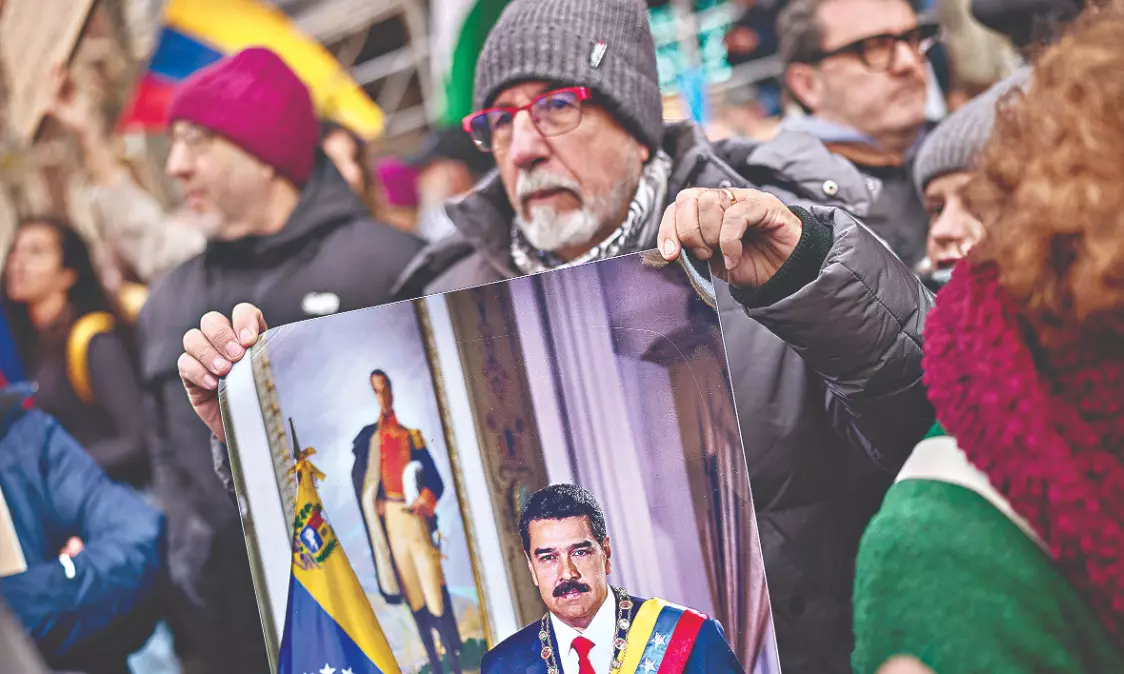
NEW YORK/New Delhi, Jan. 4 -- The United Nations Security Council will meet in emergency session on Monday as the political and security crisis in Venezuela deepened following the arrest of President Nicolas Maduro and his wife in a United States military operation, triggering sharp global reactions, a leadership vacuum in Caracas, and concerns over regional stability. India expressed deep concern over the developments, called for a peaceful and dialogue-based resolution, and said it was closely monitoring the situation to ensure stability and the safety of Indian nationals. Venezuela's Supreme Court named Vice-President Delcy Rodriguez as interim president. Meanwhile, US President Donald Trump defended the arrests and said Washington would run Venezuela during a transition, remarks that drew criticism from several countries and raised questions over international law and sovereignty.
The emergency meeting of the United Nations Security Council is scheduled for 10 am New York local time on Monday under the agenda "Threats to international peace and security." The Council presidency said the meeting was convened following requests from member states after the US military operation in Caracas. Somalia holds the rotating presidency of the 15-member Council for January, which includes five permanent and ten non-permanent members.
Colombian President Gustavo Petro was the first leader to publicly call for an emergency session. In a post on X, Petro said Colombia rejected what it described as aggression against Venezuela's sovereignty and against Latin America. He said internal conflicts must be resolved peacefully by the people concerned, citing the principle of self-determination that underpins the United Nations system.
UN Secretary General Antonio Guterres has also voiced his concern. The secretary general is "deeply alarmed by the recent escalation in Venezuela, culminating with today's United States military action in the country, which has potential worrying implications for the region", a statement issued by his spokesperson said on Saturday.
Guterres said that independently of the situation in Venezuela, "these developments constitute a dangerous precedent" and said he is "deeply concerned that the rules of international law have not been respected".
The United States carried out the operation in the early hours of Saturday, extracting Nicolas Maduro and his wife, Cilia Flores, from a military base in Caracas. They were flown to New York to face US charges related to drug trafficking and weapons. Washington has long accused Maduro of involvement in narcotics networks, allegations he has consistently denied. The US administration said the raid followed months of military pressure that included targeting Venezuelan oil tankers and vessels Washington alleged were linked to drug cartels.
President Donald Trump defended the operation and said the United States would oversee Venezuela during a transition of power. Speaking to reporters, Trump said the action was aimed at curbing the flow of dangerous drugs into the US. He also spoke openly about oil, saying American companies would invest billions of dollars to repair Venezuela's broken oil infrastructure and restart production. Trump said the US would sell oil to other countries because Venezuela could not produce much due to poor infrastructure.
"It's about oil," Trump said in a briefing a day after the raid. He said large US oil companies would go to Venezuela, fix infrastructure, and help generate revenue. He added that the US would sell oil to other countries in larger quantities.
Analysts, however, said the action was unlikely to have a major impact on global oil markets. Venezuela holds about 18 per cent of the world's proven oil reserves, the largest share globally, but extracts only around 1 per cent. The country's reserves are largely heavy crude, which requires advanced refining facilities. Years of underinvestment, technical constraints, and a US embargo that restricted exports have limited production. Analysts said these factors meant the disruption would not affect global supply in a significant way. In Caracas, the arrests triggered a leadership crisis. Venezuela's Supreme Court named Vice-President Delcy Rodriguez as interim president. Rodriguez demanded Maduro's immediate release and called him the country's rightful leader. Appearing on state television flanked by senior civilian and military officials, she described the US action as brutal aggression and said there was only one president of Venezuela.
Rodriguez said she did not intend to assume power until the Supreme Court formally ordered her to do so. Under Venezuelan law, the vice-president would take over in such circumstances. State television aired pro-Maduro programming and showed supporters gathering on the streets of Caracas to protest the arrests.
Trump offered a different account of contacts with Rodriguez. He said she had spoken to US Secretary of State Marco Rubio and was willing to do what Washington believed was necessary to help Venezuela. "I think she was quite gracious," Trump said, adding that the US could not risk someone taking over who did not have the good of the Venezuelan people in mind. Rodriguez's public statements after the raid, however, sharply criticised the US action and rejected any suggestion of cooperation.
The arrests brought an abrupt end to 12 years of Maduro's rule. He took office in 2013 after the death of Hugo Chavez, whose presidency began in 1999 and ushered in a self-described socialist revolution aimed at uplifting the poor. Chavez's tenure reshaped Venezuelan politics and society, and his legacy has remained central to the ruling party's identity.
International reactions were swift and divided. Brazilian President Luiz Inacio Lula da Silva said the US attacks and the capture of Maduro amounted to a flagrant violation of international law. China called on Washington to release Maduro and his wife and urged dialogue to resolve the crisis. A Chinese foreign ministry spokesperson said the US action seriously violated international law and Venezuela's sovereignty and threatened peace and security in Latin America and the Caribbean. Russia also urged the United States to release the Venezuelan president. Several Latin American countries criticised the operation, warning that it set a dangerous precedent for unilateral military action in the region.
India reacted with caution and concern. The Ministry of External Affairs said recent developments in Venezuela were a matter of deep concern and that New Delhi was closely monitoring the evolving situation. India reaffirmed its support for the well-being and safety of the Venezuelan people and called on all concerned parties to address issues peacefully through dialogue to ensure regional stability.
The MEA said the Indian embassy in Caracas was in touch with members of the Indian community and would continue to provide assistance. On Saturday night, India advised its nationals to avoid all non-essential travel to Venezuela. Indians in the country were urged to exercise extreme caution, restrict their movements, and remain in contact with the embassy. There are around 50 non-resident Indians and about 30 persons of Indian origin in Venezuela, according to the embassy. India and Venezuela share long-standing ties, particularly in the energy sector. A major push to bilateral relations came during Hugo Chavez's state visit to India in March 2005. India's ONGC Videsh Limited has a joint venture with Venezuela's state oil company, Corporacion Venezolana del Petroleo. The venture, Petrolera Indovenezolana SA, operates in the San Cristobal field. ONGC Videsh holds a 40 per cent stake, with an investment of about $200 million, according to the Indian embassy. Rodriguez has personal links with India as well. She visited New Delhi in February last year to attend India Energy Week. Born on May 18, 1969, she is the daughter of left-wing activist Jorge Antonio Rodriguez, who founded the Socialist League in the 1970s and died in police custody in 1976. His death had a deep impact on Venezuela's left-wing movement, including on a young Maduro.
In the United States, reactions also came from within. New York Mayor Zohran Mamdani condemned the military action, calling the unilateral strike on a sovereign nation an act of war and a violation of federal and international law. In a social media post, Mamdani said he had conveyed his opposition directly to President Trump and criticised Washington's intervention in Venezuela. Trump, meanwhile, shared details of the operation's execution. He posted a photograph on his Truth Social platform showing Maduro handcuffed and blindfolded aboard a US naval vessel in the Caribbean. From there, Maduro and his wife were flown to New York. Trump said he followed the operation live from his Mar-a-Lago estate, likening it to watching a television show. The US administration framed the operation as a success against narco-terrorism. Maduro had a $50 million US bounty on his head. The stated goal was to disrupt drug trafficking networks. Critics, however, questioned how oil featured so prominently in Trump's remarks after the raid.
Venezuela's opposition also reacted. Opposition leader and Nobel Peace laureate Maria Corina Machado declared on social media that Venezuela's hour of freedom had arrived. She called on the opposition candidate from the 2024 election to immediately assume the presidency. Trump dismissed expectations that Machado herself would lead, saying she did not have support or respect in Venezuela.
As the Security Council prepares to meet, diplomats said the focus would be on the legality of the US action, the risks of escalation, and the path forward for Venezuela's political future. The emergency session is expected to see sharp exchanges, with some members backing Washington's stated goals and others warning against unilateral intervention.
For India and other countries with citizens and economic interests in Venezuela, the priority remains safety and stability. New Delhi's call for dialogue reflects a broader concern that the crisis could deepen regional tensions. With competing claims of legitimacy in Caracas and strong words from Washington, the coming days are likely to test diplomatic efforts at the United Nations and beyond.with agency inputs
Published by HT Digital Content Services with permission from Millennium Post.