
New Delhi, Feb. 2 -- The Union Budget 2026-27, presented on 1st February by Smt Nirmala Sitharaman, is a budget that deliberately avoids headline-hunting populism and instead focuses on economic fundamentals. At a time when global geopolitics is unstable, supply chains are being weaponised, and protectionism is quietly returning, this budget sends a clear message: India's growth cannot rest on slogans alone-it must be built on infrastructure, manufacturing depth, skills, and strategic capacity. Predictably, the opposition found the budget "boring"; perhaps because there was little to cut ribbons over and much to actually build.
A central pillar of the budget is the continued and consistent push on infrastructure. Unlike earlier eras of stop-start spending, the government has maintained capital expenditure as a long-term strategy. Last year, the Centre's infrastructure outlay stood at around Rs 11.2 lakh crore. For 2026-27, this has been raised to approximately Rs 12.5 lakh crore-an increase of nearly 15 per cent. This sustained investment reflects a clear understanding that infrastructure is not a cost but a multiplier, particularly in uncertain global conditions. The focus has also matured: from highways alone to multimodal logistics, inland waterways, freight corridors, and urban infrastructure that directly support manufacturing and trade competitiveness.
The budget places strong emphasis on inland waterways, recognising them as cost-efficient and environmentally sustainable logistics channels. High-speed rail corridors and a new East-West freight corridor aim to reduce congestion and logistics costs-long-standing bottlenecks for Indian industry. The creation of a ship repair ecosystem at Patna and Varanasi is a smart example of aligning infrastructure with local geography and skills, reviving economic activity along the Ganga corridor. Provisions for sea-plane connectivity, tourism clusters, and five new tourism centres in the Northeast further reflect an intent to integrate infrastructure with services-led employment generation.
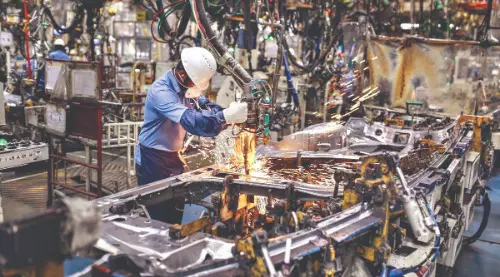
Manufacturing, however, remains the real political and economic statement of this budget. At a time when some critics still romanticise a consumption-only growth model, the government has chosen the harder path-building industrial capacity. A big push has been announced for bio-pharma, rare earths, semiconductors, and electronic component manufacturing. The proposed rare earth corridor and semiconductor ecosystem are not aspirational slogans but strategic necessities, especially after recent global supply shocks exposed India's vulnerabilities. Reviving legacy industrial zones and expanding industrial clusters-now exceeding 200-signals an intent to rebuild India's manufacturing muscle rather than merely assemble imported parts.
MSMEs sit at the heart of this strategy. A Rs 10,000 crore fund has been announced to address their credit and working capital constraints, complemented by common facility centres to improve access to technology and testing. The renewed focus on artisans, handicrafts, handloom, and Khadi reflects an understanding that traditional sectors, when supported with modern design and market access, can generate large-scale employment.
Manufacturing-led growth is ultimately about jobs, and MSMEs are best placed to deliver them-something the opposition rarely addresses beyond election-time rhetoric.
Urbanisation is another area where the budget shows realism. With nearly 45 per cent of India now urbanised, attention has rightly shifted to tier-2 and tier-3 cities. The concept of City Economic Regions moves beyond the narrow lens of municipal boundaries and encourages regional planning.
An allocation of over Rs 5,000 crore over five years, structured as performance-linked support, aims to promote PPP models in sanitation, water, infrastructure, decarbonisation, and pollution control. These may not be glamorous announcements, but they address the everyday challenges that actually determine urban quality of life.
Technology and inclusion also find space in the budget. The use of AI in agriculture, combined with a strong push for women's empowerment through SHGs and cooperative frameworks, reflects a future-oriented approach. The proposal to establish entrepreneurship hostels for girls in every district is a quietly transformative idea-one that invests in aspiration, mobility, and independence rather than short-term subsidies.
Defence spending is another area where the budget makes its priorities clear. Defence allocation has been increased by nearly 15 per cent, making it one of the highest expenditures this year.
Of this, around Rs 2 lakh crore has been specifically earmarked for force modernisation. In the backdrop of Operation Sindur and growing global uncertainties, this focus is both timely and necessary. Modern warfare is no longer defined only by numbers but by technology-AI-enabled systems, drones, cyber capabilities, and advanced surveillance now act as decisive force multipliers.
Strengthening the armed forces with modern equipment and indigenous technology is essential not just for national security but also for building a robust defence manufacturing ecosystem.
On sustainability, the allocation of nearly Rs 10,000 crore for Carbon Capture, Utilisation and Storage (CCUS) is a significant intervention. Decarbonisation is one of the biggest challenges India and the world face, and this provision can catalyse new technologies and industrial solutions while aligning growth with climate commitments.
Overall, the Union Budget 2026-27 is a mature, purposeful document. It stays focused on basics, resists populist temptation, and prepares India for a future where self-reliance in manufacturing, strong supply chains, skilled employment, and strategic capacity will matter far more than applause lines in Parliament.
As new trade agreements with the EU, UK, and others come into force, India appears better positioned to leverage exports, technology transfer, and global integration. The opposition may complain about the absence of theatrics, but budgets are meant to build economies-not hashtags.
Published by HT Digital Content Services with permission from Millennium Post.