
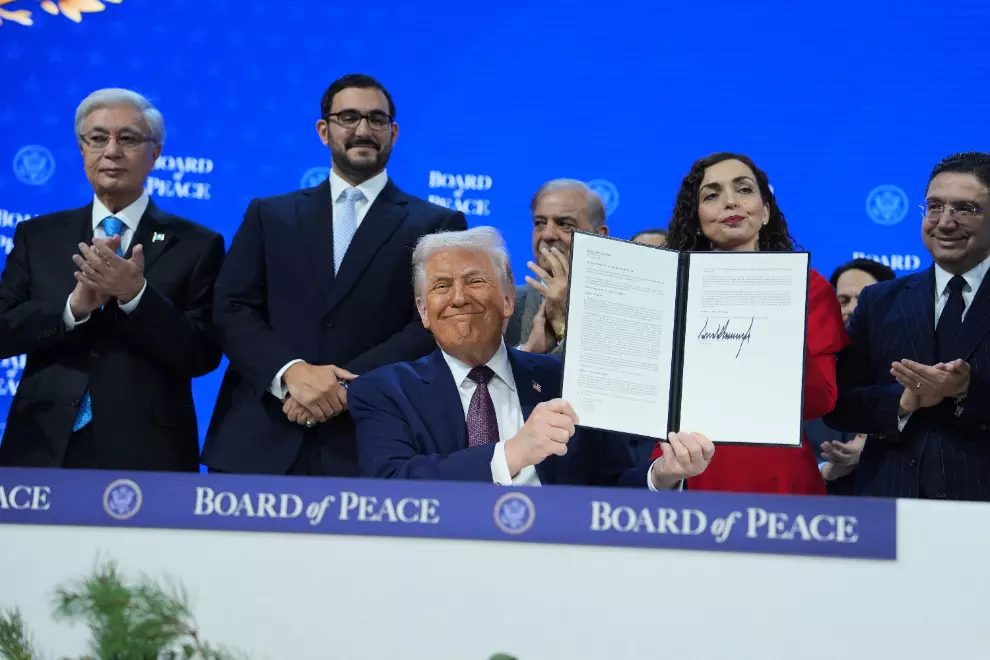
Davos/New Delhi, Jan. 22 -- US President Donald Trump on Thursday formally inaugurated what his administration is calling the "Board of Peace" at the World Economic Forum in Davos, unveiling an ambitious new international body that the White House says will provide strategic oversight for Gaza's transition from conflict to development, even as several key US allies stayed away and major invitees including India remained non-committal.
Trump launched the initiative on the margins of the annual WEF meeting in the Swiss mountain resort, describing it as an effort meant to extend beyond US leadership. "This isn't the United States, this is for the world," he said. "I think we can spread it out to other things as we succeed in Gaza." He said "everybody" wanted to be part of the mechanism and claimed 59 countries were involved in peace efforts linked to the initiative, though participation remained mixed.
India was among the countries not present at the ceremony. Prime Minister Narendra Modi was invited to join the board, but New Delhi has not taken a final call, according to people familiar with the matter. Officials indicated India is weighing "various aspects" because the proposal involves sensitive diplomatic issues. India has consistently backed a two-State solution to the Palestine question, supporting Israel and Palestine living side by side in peace and security within recognised borders.
The Board of Peace was initially conceived as a small group of world leaders overseeing the ceasefire and future arrangements for Gaza, but it has expanded into a more ambitious structure that Washington is projecting as a new peace, governance and funding mechanism. The board's charter describes it as "an international organisation that seeks to promote stability, restore dependable and lawful governance, and secure enduring peace in areas affected or threatened by conflict." It also says durable peace requires pragmatic judgment, "common sense" solutions and the courage to depart from approaches and institutions that, according to the charter, have "too often failed." The language has led to questions in some capitals about whether the body could overlap with United Nations roles. Trump has spoken about the board potentially replacing some UN functions. But in remarks on the sidelines of the Davos forum, he said the initiative would work alongside the UN. "We'll do it in conjunction with the United Nations," Trump said, while also criticising the organisation for what he described as an inadequate response to certain conflicts.
The list of countries that have accepted Trump's invitation to join includes Argentina, Albania, Armenia, Azerbaijan, Bahrain, Belarus, Belgium, Bulgaria, Egypt, Hungary, Indonesia, Israel, Jordan, Kazakhstan, Kosovo, Morocco, Mongolia, Pakistan, Qatar, Saudi Arabia, Turkey, the United Arab Emirates, Uzbekistan and Vietnam. Several countries either declined to participate or have not yet confirmed their positions. Those opting out, at least for now, include France, Norway, Sweden, Slovenia, the United Kingdom, Germany, Denmark and Italy. Meanwhile, a separate group of invited nations remains undecided, including Cambodia, China, Croatia, Cyprus, Greece, Paraguay, Russia, Singapore, Thailand and Ukraine, with Canada and the European Union's executive arm also yet to commit.
Britain's foreign secretary Yvette Cooper said the UK would not sign on "because this is about a legal treaty that raises much broader issues." She also raised concerns about Russia's potential participation, saying Britain was uneasy about "President Putin being part of something which is talking about peace" while there had been no sign of commitment to peace in Ukraine. France, while supporting broader Gaza peace efforts, declined after warning that the board could be used to replace the UN.
Washington has linked the Board of Peace to Trump's 20-point Gaza ceasefire plan, describing the board as central to providing "strategic oversight," mobilising international resources and ensuring accountability as Gaza moves "from conflict to peace and development." The plan includes turning Gaza into a deradicalised, terror-free zone that does not threaten neighbouring states and redeveloping the devastated territory "for the benefit of the people of the strip."
To implement the plan, the White House last week announced a founding executive board to operationalise the Board of Peace's vision. Trump will serve as founding chairman of an Executive Council whose members include US Secretary of State Marco Rubio, former British prime minister Tony Blair, US special envoy to the Middle East Steve Witkoff, businessman and Trump's son-in-law Jared Kushner, World Bank Group President Ajay Banga, Apollo Global Management CEO Marc Rowan, and Robert Gabriel, described as a US deputy national security adviser. The executive board will oversee another administrative group called the National Committee for the Administration of Gaza.
Trump maintained that the initiative had gained wide backing. However, while he said 59 countries were involved, reports noted that heads of state, top diplomats and other officials from only 19 countries plus the US attended the Davos event. A governance roadmap for Gaza was also highlighted at the ceremony. Ali Shaath, described as the head of a new future technocratic government in Gaza, announced that the Rafah border crossing between Gaza and Egypt would open in both directions next week. The announcement came after Israel said in early December it would reopen the crossing but had not yet done so. Shaath, an engineer and former Palestinian Authority official from Gaza, is overseeing the Palestinian committee tasked with governing the territory under US supervision.
A major uncertainty remains Hamas' future role. Gaza's more than two million Palestinians continue to suffer a humanitarian crisis after more than two years of war, and violence has not fully stopped. For the ceasefire to hold, disarming Hamas remains a key issue. The militant group, which has controlled Gaza since 2007, has refused to disarm, even as Israel has insisted disarmament is non-negotiable. Trump again warned Hamas to disarm or face "dire consequences," while claiming the war "is really coming to an end," adding that remaining flare-ups were "little fires" compared to what preceded the truce.
Russia has not committed. Putin said Moscow was consulting with "strategic partners" before taking a decision. The Kremlin said he planned to discuss a proposal to send $1 billion to the Board of Peace for humanitarian purposes during talks with Palestinian President Mahmoud Abbas in Moscow, provided Russia could use assets that the US had previously blocked. The charter also contains a financial component. According to one account, countries can serve three-year terms, while permanent membership can be secured by paying a $1 billion fee toward a peace-building fund.
An Arab diplomat in a European capital said Middle Eastern governments coordinated their responses to Trump's invitation and that the acceptance was "preliminary", crafted to align strictly with the Gaza plan as mandated by the UN Security Council. Speaking anonymously, the diplomat said the board's charter contradicted the UN mission in parts and predicted that other major powers were unlikely to support the body in its current form.with agency inputs
Published by HT Digital Content Services with permission from Millennium Post.