
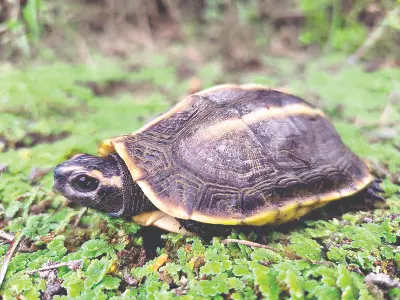
Kolkata, Feb. 3 -- A collaborative study by scientists from India and the Republic of Korea has found that the Tricarinate Hill Turtle (Melanochelys tricarinata) is facing severe threats from intensifying anthropogenic pressures and widespread habitat degradation, highlighting the need for integrated, species- and site-specific conservation planning.
The Tricarinate Hill Turtle is a small to medium-sized freshwater turtle endemic to the Indian subcontinent. It is characterised by a highly domed carapace with three longitudinal keels, a small olive-to-dark coloured head with a narrow snout, and robust, scaly limbs adapted for terrestrial movement. Primarily terrestrial, the species inhabits forested areas and grasslands of the Ganges and Brahmaputra plains, as well as moist deciduous and wet evergreen forests in the Himalayan foothills, generally up to elevations of 300 metres. The species was classified as 'Endangered' in the 2020 IUCN assessment.
Imon Abedin of the Dibru-Saikhowa Conservation Society, Tinsukia, said: "The primary driver of population decline is widespread loss and degradation of forest habitats across its range. In addition, anthropogenic pressures pose serious challenges". It was added that the species is exploited for subsistence consumption and the Asian pet trade. Market surveys and seizure reports have recorded substantial numbers in illegal trade channels.
Arunima Singh of the Turtle Survival Alliance Foundation, Lucknow, said the species is also exploited for decorative curio masks sold in tourist and handicraft markets across South and parts of Southeast Asia. The study - the first complete mitogenome analysis of the species - projects a decline in suitable habitat within the IUCN-defined range by 31.159 to 39.565 per cent under future climate scenarios, with the most severe losses expected during 2061-2080. Declines are also projected within protected areas. At present, only 176,117 sq km, or 38.19 per cent of the IUCN-delineated range, is considered suitable habitat.
Shantanu Kundu of Pukyong National University, Busan, said: "The study revealed low habitat connectivity, with a projected decline of 18.301 to 21.077 per cent across future periods compared to current conditions."
Researchers said the findings have wider implications for freshwater turtle conservation globally amid accelerating climate change.
Published by HT Digital Content Services with permission from Millennium Post.