
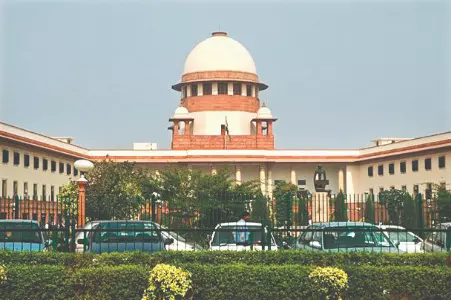
New Delhi, Feb. 5 -- Observing that idea of a welfare state casts duty upon the government to ensure the social and economic well-being of its citizens, the Supreme Court on Thursday said role of the State is not limited to maintaining law and order, but extends to improving living standards for individuals.
A bench of Justices Sanjay Karol and Prashant Kumar Mishra said one of the most persistent threats to this objective that has become a permanent "bad penny", is inflation, which steadily erodes purchasing power.
The top court said in this context, dearness allowance emerges as a practical instrument of protection in the hands of the welfare state, which protects its employees from the adverse effects of rising prices.
"The idea of a welfare state casts a positive duty upon the State to ensure the social and economic well-being of its citizens. The role of the State is as such not limited to maintaining law and order or facilitating markets, but extends to creating or easing the way for conditions in which individuals can live with security, dignity, and a reasonable standard of living," the bench said.
The observations of the apex court came in a judgement in which it directed the West Bengal government to pay dearness allowance (DA) to government employees for the 2008-2019 period, saying it is a legally-enforceable right.
Emphasising that DA is designed to neutralise the impact of inflation, the top court said when the cost of essential goods increases, salaries that do not account for the same and remain in a bygone era, often fail to meet the basic needs, leading to a decline in living standards.
"By way of periodic adjustment to salaries in response to changes in the cost of living, the State attempts to ensure that employment continues to provide economic security. This reflects a core concern of the welfare state that its employees should not be pushed into hardship due to economic forces beyond their control. Put differently, Dearness Allowance is not an additional benefit but a means to maintain a minimum standard of living," the bench said.
The apex court said the importance of preserving a reasonable standard of living is closely tied to the constitutional idea of dignity.
Human dignity does not mean mere physical survival, it said adding that access to food, clothing, healthcare, shelter and the ability to participate meaningfully in social life are crucial aspects.
"Dignity is compromised when individuals are unable to meet these basic needs. This link is recognized in our Constitution under Article 21, which guarantees the right to life and personal liberty. Judicial interpretation has consistently held that the right to life includes the right to live with human dignity, encompassing livelihood, adequate nutrition, shelter, and basic amenities. This right, under Article 21, would lose its substantive meaning without a minimum standard of living," the bench said.
The court said the strongest justification for DA in India, though statutory in nature, lies in its constitutional grounding, especially in the Directive Principles of State Policy.
"DA gives practical effect to the above-mentioned stipulations of the Constitution providing a barrier against salaries being compromised in value beyond sustenance. It is, as such, a tool for the realization of lived economic reality, ensuring that the promise of a living wage retains its substance. "Dearness Allowance represents a clear intersection of principles of welfare state and those enshrined by the constitutional vision. By protecting standards of living, it furthers the right to live with dignity under Article 21 and advances the goals articulated in the Preamble thereby being a concrete expression of the State's constitutional responsibility," the bench said. With agency inputs
Published by HT Digital Content Services with permission from Millennium Post.