
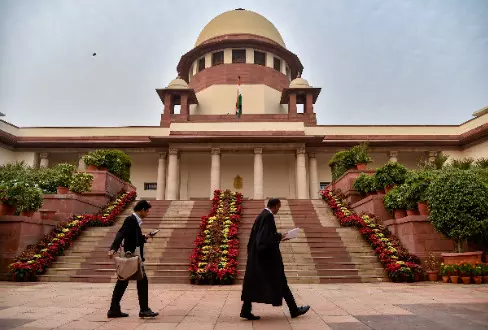
New Delhi, Dec. 28 -- The Supreme Court is set for a busy Monday as it takes up two separate matters of national significance, one concerning environmental protection of the Aravalli hills and the other involving the suspension of a life sentence in the Unnao rape case. According to the cause list, both matters are likely to be heard by a three-judge vacation bench headed by Chief Justice of India Surya Kant, along with Justices J K Maheshwari and Augustine George Masih.
In the first matter, the top court has taken suo motu cognisance of a controversy surrounding the definition of the Aravalli hills and ranges that it had earlier approved. The case, titled "In Re: Definition of Aravalli Hills and Ranges and Ancillary Issues", arises from concerns over the interpretation and implementation of directions aimed at protecting the Aravalli range, considered the world's oldest mountain system.
On November 20, the court accepted a uniform scientific definition of the Aravalli hills and ranges and imposed a ban on the grant of fresh mining leases in identified areas across Delhi, Haryana, Rajasthan and Gujarat until expert reports are finalised. The definition was based on recommendations made by a committee constituted by the Ministry of Environment, Forest and Climate Change.
As per the committee, an "Aravalli Hill" is any landform located in designated Aravalli districts that has an elevation of 100 metres or more above the local relief. The definition also includes the entire landform within the area enclosed by the lowest contour, along with supporting slopes and associated features, regardless of gradient. An "Aravalli Range", the panel said, would consist of two or more such hills located within 500 metres of each other, measured from the outermost boundary of their lowest contour lines. The area between such hills, along with associated landforms like hillocks and slopes, would also be treated as part of the range.
These directions were part of a detailed 29-page judgment delivered in a suo motu proceeding linked to the long-running environmental litigation in the T N Godavarman Thirumulpad case. Accepting the panel's recommendations, the bench led by then Chief Justice D Y Chandrachud, with Justice B R Gavai authoring the judgement, said the court was also approving restrictions on mining in core or inviolate areas, with limited exceptions carved out in the committee's report.
"We further accept the recommendations with regard to the prohibition of mining in core or inviolate areas with exception as carved out of the committee's report," Justice Gavai wrote. The court also endorsed proposals for sustainable mining and measures to prevent illegal mining in the Aravalli landscape.
Authorities were directed to identify areas where mining may be permitted and those that are ecologically sensitive, conservation critical or require restoration, where mining would either be barred or allowed only in exceptional, scientifically justified circumstances. Until a Management Plan for Sustainable Mining is finalised by the environment ministry through the Indian Council of Forestry Research and Education, the court ordered that no new mining leases should be granted. Existing mines were allowed to continue operations, but only in strict compliance with the committee's recommendations.
Describing the Aravallis as a green barrier that checks the eastward spread of the Thar desert and sustains rich biodiversity, the court underlined that a clear and scientific definition was necessary to regulate land use and mining activity while ensuring conservation.
On the same day, the apex court is also scheduled to hear an appeal filed by the Central Bureau of Investigation challenging a recent order of the Delhi High Court that suspended the life sentence of expelled BJP MLA Kuldeep Singh Sengar in the Unnao rape case. A separate petition by advocates Anjale Patel and Pooja Shilpkar, seeking a stay on the high court order, is also listed.
The high court, on December 23, suspended Sengar's life imprisonment after noting that he had already spent seven years and five months in jail. The suspension will remain in force during the pendency of his appeal against the December 2019 trial court verdict that convicted him of kidnapping and raping a minor. However, Sengar will continue to remain in custody as he is also serving a 10-year sentence in the custodial death case of the survivor's father, in which he has not been granted bail.
In its appeal, the CBI argued that the high court erred in holding that Sengar, who was an MLA at the time of the offence, was not a public servant for the purpose of prosecution under the Protection of Children from Sexual Offences Act. Referring to the apex court's ruling in the L K Advani case, the agency said that anyone holding public office, including MPs and MLAs, is deemed a public servant. "The high court failed to consider that a sitting MLA, by virtue of holding a constitutional office, is vested with public trust and authority over the electorate and that such a position carries heightened responsibility arising from duties owed to the state and society," the CBI submitted. It added that the court had also failed to adopt a purposive interpretation that advances the object of the POCSO Act.
While granting suspension of sentence, the high court imposed strict conditions, including a personal bond of Rs 15 lakh with three sureties of the same amount. Sengar was also barred from entering a five-kilometre radius around the survivor's residence in Delhi and from threatening her or her mother, with any violation liable to result in cancellation of bail. The rape case and related matters were transferred from Uttar Pradesh to Delhi in August 2019 on the directions of the Supreme Court.
Published by HT Digital Content Services with permission from Millennium Post.