
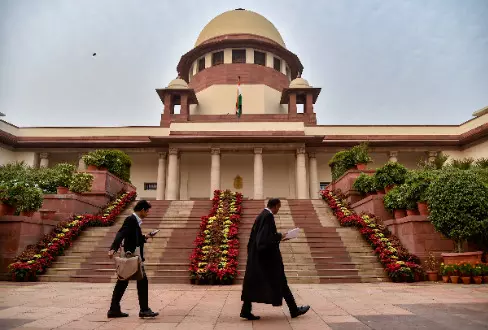
New Delhi, Jan. 13 -- The Supreme Court on Tuesday delivered a split verdict on the constitutional validity of Section 17A of the Prevention of Corruption Act, a provision introduced through the 2018 amendment that requires prior approval before any probe can be initiated against a public servant in corruption cases linked to official decision-making.
A two-judge bench comprising Justices BV Nagarathna and KV Viswanathan differed sharply on whether the section violates the Constitution, prompting the court to direct that the matter be placed before Chief Justice of India Surya Kant for constituting an appropriate larger bench to deliver a final ruling.
Section 17A, inserted in July 2018, bars any "enquiry or inquiry or investigation" against a public servant for a recommendation made or decision taken in discharge of official functions unless prior approval is granted by the competent authority of the Central or State government, or the authority competent to remove the official. The law contains an exception where a person is arrested on the spot while accepting or attempting to accept an undue advantage. It also requires the authority to communicate its decision within three months, extendable by one more month with recorded reasons.
Justice Nagarathna held the provision to be unconstitutional and said it must be struck down, warning that it undermines the anti-corruption framework. "Section 17A is unconstitutional and it ought to be struck down. No prior approval is required to be taken," she observed, adding that the sanction requirement is "contrary to the object of the Act" and "forecloses inquiry and protects the corrupt." She also said the provision attempts to revive protections that had earlier been invalidated by the top court in Vineet Narain and Subramanian Swamy judgments.
Justice Viswanathan, however, upheld the constitutional validity of Section 17A, while reading it down to remove executive control over the approval process. He held that the question of sanction should be decided by an independent body, directing that the approval must be determined by the Lok Pal or the Lokayukta, as applicable. "Section 17A is constitutionally valid subject to the condition that the sanction must be decided by the Lok Pal or the Lok Ayukta of the State," he held.
Rejecting the plea to invalidate the law outright, Justice Viswanathan cautioned that striking it down would be "throwing the baby out with the bath water," and warned that without safeguards against frivolous cases, "policy paralysis" could set in. He added that "the possibility of abuse is no ground to strike down Section 17A," and noted that removing it could create a screening imbalance between complaints routed through the Lok Pal and those filed directly through police channels.
The ruling arose from a public interest litigation filed by the NGO Centre for Public Interest Litigation (CPIL), with advocate Prashant Bhushan arguing that the prior approval requirement reintroduces a protection already struck down by the Supreme Court. Solicitor General Tushar Mehta, appearing for the Union, defended the provision as narrowly tailored to protect bona fide decision-making and prevent vexatious complaints. Judgment in the matter had been reserved on August 6, 2025.
Published by HT Digital Content Services with permission from Millennium Post.