
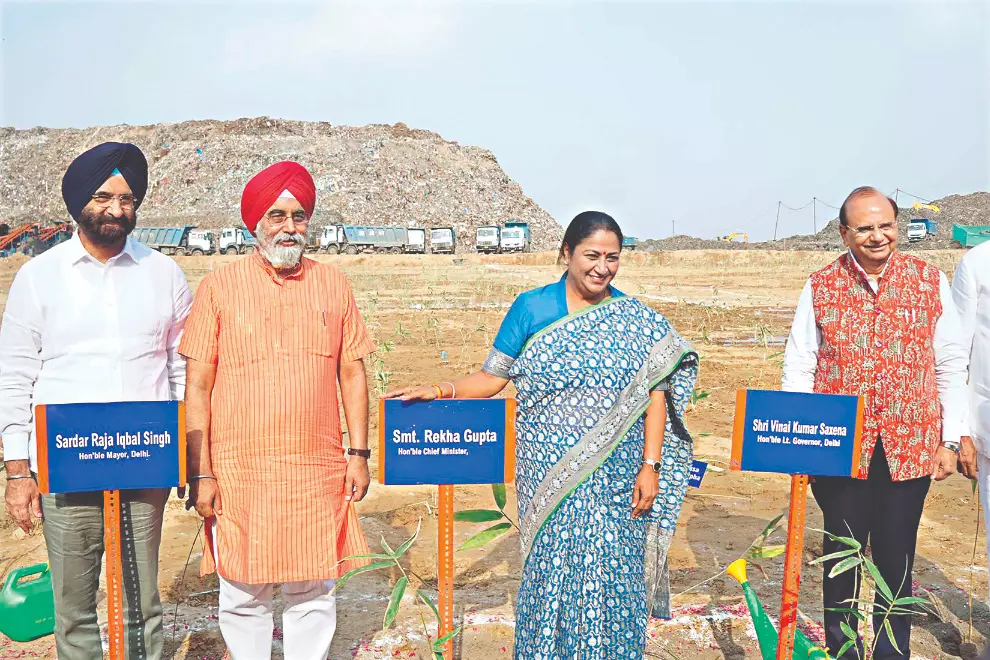
New Delhi, Feb. 12 -- One year of Rekha government reshaping capital's identity
"Environment is not politics for us. It is a moral responsibility. Instead of symbolic slogans, we have implemented concrete solutions such as e-mobility, bio-decomposers, waste-to-energy projects and new dust control equipment." - Rekha Gupta, Chief Minister, Delhi
For years, Delhi's winter mornings were filled with thick smog and pollution, which was mostly discussed in debates with temporary measures such as Odd Even and Red Light On Engine Off. This long-standing conundrum has finally begun to find answers, as the CM Rekha Gupta-led Delhi Government has shown over the past year that when the intent is clear, policies deliver results on the ground.
The Delhi government has treated air pollution not as a seasonal crisis, but as a structural challenge. Further, long-term and practical solutions have been adopted to ensure lasting impact.
Dust Control to Durable Roads
Reinventing Road Cleanliness Across Delhi
Pollution is not confined to the air alone. It is also present in the dust that settles on roads and the waste scattered across the city. Keeping this in mind, the Delhi government strengthened cleanliness and infrastructure across the city.
A special grant of Rs.500 crore was provided to MCD to strengthen waste management, along with a continued annual grant of Rs.300 crore. Looking ahead, an investment of Rs.2,300 crore over the next 10 years will facilitate the procurement of 70 MRS machines designed to operate on roads narrower than 60 feet. Additionally, 1,000-litre picker machines will be introduced to further enhance the city's sanitation and cleanliness infrastructure, making urban maintenance more efficient and effective.
Further to control road dust and ensure pothole-free roads, the Wall-to-Wall Carpeting campaign is moving forward at full pace. In the next financial year, with a budget of Rs.6,000 crore, 3,300 km of road network will be made dust-free and pothole-free. This will set a new benchmark for cleanliness, safety and smooth mobility.
Rs.1,816 Crore Mega Yamuna Rejuvenation
Cleaning the Yamuna is no longer just an announcement. It has become a result-driven mission. Projects worth Rs.1,816 crore covering 19 major initiatives have been launched. Under the river revival campaign, 20 lakh metric tons of silt have been removed from the Yamuna bed till September, and work is ongoing.
Cleaning of the Najafgarh drain is also being done using the advanced Amphibious Classic-4 Watermaster machine, which has improved speed and efficiency.
Currently, 80 percent of Delhi's population is connected to the sewer network. Thirty-seven Sewage Treatment Plants are treating 80 to 100 percent of sewage. A strict treated water standard of 10 mg/l has been implemented to ensure a cleaner Yamuna.
E-Mobility and Clean Energy Push
The Rekha Government has taken strong steps to promote green and sustainable public transport and mitigate vehicle emissions, which are a major source of pollution. Currently, more than 4,000 electric buses are running on city roads. Notably, the target is to expand the DTC fleet to 7,500 e-buses by 2026 and further scale it up to 14,000 e-buses by 2028.
To strengthen last-mile connectivity, 1,823 e-autos have been deployed at 44 metro stations. The metro network is also being expanded to 500 kilometers. These steps are not just transport reforms but are long-term structural improvements for better air quality.
From Surveillance to Swift Action on Pollution Sources
To tackle air pollution effectively, the Delhi Government has implemented the Air Pollution Control Plan 2025. Under this plan, 100 Vayu Rakshak (Air Guardians) equipped with 35 GPS and CCTV have been deployed across the city. These Vayu Rakshak monitor dust pollution and vehicle emissions in real time and ensure quick action.
Strengthening its commitment to pollution control, the government has deployed 200 additional truck-mounted anti-smog guns for the PWD at a cost of Rs.58.8 crore. Combined with the resources already available with the MCD and other concerned departments, the total number of truck-mounted anti-smog guns operating across the capital has now reached 406. These machines are actively deployed on major roads and construction sites, effectively suppressing dust particles and contributing to cleaner, healthier air.In addition, 280 water sprinklers have been stationed across Delhi's roads to ensure regular water spraying, further reinforcing efforts to curb dust pollution.
Besides, more than 650 mist spray systems are active at 13 hotspots to improve air quality in the city. Additionally, mist spray systems have also been installed at metro stations to further improve air quality and control dust levels. To prevent open biomass burning, 10,000 electric heaters have been distributed to security guards during this winter season to control pollution at the ground level.
Round-the-Clock Data-Driven Air Monitoring across Delhi
Delhi's air is now monitored and improved based on accurate data. The city has 46 Continuous Ambient Air Quality Monitoring Stations, forming the largest air monitoring network in the country.
These advanced stations provide hourly data on PM 2.5 and PM 10 and update other key parameters every five minutes. Real-time public data and transparent policy-making form the core of Delhi's new environmental model. Action against pollution is now scientific, continuous and data-driven.
Waste to Energy: A Scientific Cleanliness Model
A new waste-to-energy plant with a capacity of 3,000 metric tons is being developed at Narela Bawana, along with further expansion plans. The capacity of the Okhla plant is also being increased to strengthen waste processing capabilities. In addition, a modern E-Waste Eco Park is being developed at Holambi Kalan to ensure the scientific and environmentally safe disposal of electronic waste.
From Ridge Area to Solar Energy: Green Delhi Delight
The Delhi government has taken strong steps to promote environmental protection and clean energy. 4,200 hectares of ridge area have been notified as forest area to strengthen green cover. Besides, urban forests are also being developed using the Miyawaki technique. Under the agri-voltaic model, solar panels are now allowed on agricultural land, giving farmers an opportunity for additional income.
Residential solar systems of 3 kilowatt or more are eligible for a subsidy of up to Rs.1,08,000. This encourages citizens to adopt clean and affordable energy. These initiatives are helping Delhi move toward becoming environmentally secure, self-reliant, and future-ready.
Strict Enforcement with Smart Technology
The Rekha government has ensured strict compliance with Pollution Under Control Certificate (PUCC) norms and strengthened enforcement across the city. Advanced Automatic Number Plate Recognition (ANPR) cameras are being used to identify vehicles that violate pollution standards, enabling swift and targeted action. This approach goes beyond routine monitoring and reflects focused, result-oriented leadership committed to cleaner air.
Way Forward to Viksit Delhi
The CM Rekha Gupta-led government has moved pollution out of politics and placed it firmly in the domain of policy and science. Technology, strict enforcement, public participation, and long-term investment form the four pillars of this model.
This one year is not just a record of achievements. It signals the direction in which Delhi is moving. A city where the air is clean, the river is pure, the roads are dust-free, energy is green, and future generations proudly say, this is a clean, green,n and breathable Delhi.
Published by HT Digital Content Services with permission from Millennium Post.