
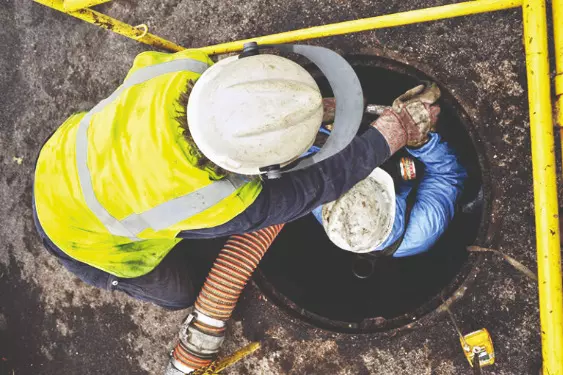
New delhi, Dec. 15 -- Providing protective gear and testing the air inside manholes before workers enter them are among the safety protocols that have to be followed before labourers are engaged for sewage maintenance in Delhi.
In a recently released SOP, the Public Works Department (PWD) has listed out directions to be followed for repairing roads and manhole cleaning to protect the public and workers involved. The SOP places the onus on contractors to ensure all prescribed safety measures are implemented.
The manholes need to be ventilated, and the area must be cordoned off. The contractor must provide workers with appropriate personal protective equipment, including helmets, gloves, safety harnesses and breathing apparatus (if required), the official said.
According to the SOP, respirators or air purifying systems should be used if there are risks of hazardous gases or low oxygen levels inside the manhole. Before workers enter the manhole, the air should be tested for combustible gases like methane and toxic gases such as hydrogen sulphide or carbon monoxide.
"Continuous air monitoring should be maintained, and if gas concentrations exceed safe limits, work should be halted, and additional ventilation or protective measures should be implemented," they said.
Oxygen levels should be at least 19.5 per cent inside the manhole, and documentation of all gas readings should be done, the guidelines said.
"A permit-to-work system should be implemented to ensure that every work task is authorised by a designated safety officer or supervisor. The permit should include all safety protocols, emergency procedures, and gas testing results," the guidelines said.
The SOP mandates that work in manholes should only be carried out by personnel who have been specifically trained in confined space entry and rescue procedures, with the contractor ensuring that a competent safety officer is present for supervision.
It provides for the establishment of effective communication systems to maintain contact between workers inside the manhole and those outside.
This can include two-way radios or other reliable communication devices, it said, adding that adequate lighting should be provided inside the manhole to ensure that workers can see clearly to reduce the risk of accidents.
The SOP mandates risk assessments before work, briefing workers on hazards, two-person manhole entry, and insurance coverage of at least Rs 1 crore; maintenance van operations across PWD zones must also follow uniform safety protocols.
Published by HT Digital Content Services with permission from Millennium Post.