
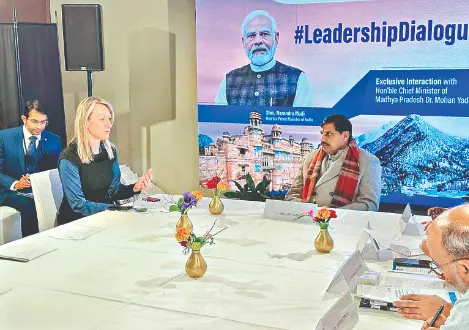
New Delhi, Jan. 22 -- When India speaks of its next phase of growth-green, digital, inclusive and globally connected-Madhya Pradesh is no longer a quiet participant. It is emerging as a decisive architect. That message came through clearly at the World Economic Forum 2026 in Davos, where Chief Minister Dr. Mohan Yadav positioned the state as a serious contender in global conversations on energy transition, investment, technology and human development. At the heart of Madhya Pradesh's pitch is a simple but ambitious idea: development must be sustainable, scalable and equitable. The state has consciously integrated renewable energy into the mainstream of governance-no longer treating it as an add-on, but as the backbone of industrial growth, urbanisation and job creation. Solar power, energy storage and grid stability are being aligned with industrial corridors, logistics parks and emerging digital infrastructure, ensuring that clean energy directly fuels economic expansion.
This approach reflects the larger national direction under Narendra Modi, where climate responsibility and economic ambition are not seen as competing priorities. In Madhya Pradesh, that vision is translating into on-ground readiness-policy stability, inter-state coordination on power and water, and risk-mitigation frameworks that make large-scale renewable projects viable for global investors. But the Davos narrative went beyond energy alone. The state is positioning itself as a multi-sector growth engine-where green power supports data centres, where artificial intelligence improves governance, where tourism becomes an investment opportunity, and where ease of doing business is backed by infrastructure rather than slogans. From meetings with global technology leaders to discussions with international investors, Madhya Pradesh projected confidence rooted in preparation. Its advantages-land availability, surplus power, skilled labour, logistics connectivity and policy responsiveness-were presented not as static strengths, but as components of an integrated growth ecosystem.
Equally significant is the state's focus on people-centric development. Agriculture, farmer prosperity, tribal livelihoods, skills and employment remain central to its growth model. Organic farming, food processing, textiles and allied industries are being linked to global markets, ensuring that growth travels from industrial zones to rural landscapes.
Davos also marked Madhya Pradesh's expanding global engagement at the sub-national level-through dialogues on tourism with island economies, clean manufacturing with Europe, sports partnerships with global institutions, and cultural diplomacy rooted in yoga and heritage.
The message was unambiguous: Madhya Pradesh is not waiting for opportunity; it is preparing for scale. As India advances towards becoming the world's third-largest economy, the state is aligning policy, infrastructure and ambition to ensure it is not merely part of the journey-but one of its drivers.
Green Energy as the Foundation of Growth
Madhya Pradesh's green energy strategy is built on integration, not isolation. Renewable power is no longer confined to standalone projects-it is being woven into industrial planning, urban expansion and digital infrastructure.
At Davos, the Chief Minister articulated a clear roadmap: clean, affordable and reliable energy must underpin economic growth. Large-scale solar projects, energy storage systems and improved grid coordination are enabling the state to offer uninterrupted power to both industries and households. Inter-state cooperation on water and power management has further strengthened stability-an often-overlooked factor in investor confidence.
Union Minister Prahlad Joshi highlighted Madhya Pradesh as a reform-oriented state where coordination across land, labour and energy policies has reduced project risks. This alignment has allowed renewable energy to move beyond capacity creation towards long-term sustainability.
Equally important is the state's openness to blended finance and technology partnerships. By encouraging private investment through clear frameworks and predictable policies, Madhya Pradesh is positioning itself as a preferred destination for utility-scale renewable projects.
The green energy push is not only about carbon reduction. It is about cost competitiveness, energy security and employment. As global industries look to decarbonise supply chains, states that can offer clean power at scale will command a strategic advantage. Madhya Pradesh is preparing precisely for that moment.
Tourism Reimagined as an Investment Opportunity
Tourism in Madhya Pradesh is being repositioned-from destination marketing to development strategy. At Davos, the state showcased a vision where heritage, wildlife, spirituality and culture are integrated with modern infrastructure and global investment.
From UNESCO-recognised monuments and world-class wildlife reserves to emerging spiritual and eco-tourism circuits, the state offers depth as well as diversity. What sets the new approach apart is its investor orientation-clear policies, land availability, surplus utilities and improving air, rail and road connectivity.
Tourism is also being linked to employment generation, local entrepreneurship and cultural preservation. Medical tourism, wellness retreats and experiential travel are opening new avenues for global partnerships.
By combining the ethos of "Atithi Devo Bhava" with innovation and connectivity, Madhya Pradesh is inviting investors not merely to build hotels-but to co-create destinations.
Investment Climate and Ease of Doing Business
Madhya Pradesh's investment pitch rests on execution. At the "Invest in India: Madhya Pradesh" roundtable, the state presented itself as a ready platform-where approvals are streamlined and infrastructure is in place.
Opportunities span automobiles, renewable energy, pharmaceuticals, textiles, IT-ITeS, food processing and logistics. Industries that generate employment are being prioritised, with customised support extended through high-level investment facilitation mechanisms.
What distinguishes the state is follow-through. A significant share of investment commitments from recent summits has already moved to implementation-signalling administrative capacity, not just intent.
For global investors seeking scale with stability, Madhya Pradesh is emerging as a credible alternative beyond traditional industrial clusters.
Prosperity from the Farm
While global attention at Davos often gravitates towards technology and finance, Madhya Pradesh used the platform to underline a quieter but equally strategic priority: agriculture-led prosperity. The state is positioning farming not as a subsistence activity, but as a modern, value-driven sector linked to food processing, exports and rural employment.
Chief Minister Dr. Mohan Yadav announced that 2026 has been dedicated to farmers' prosperity, signalling a policy focus that goes beyond minimum support prices to long-term income security. With one of India's largest agricultural bases, Madhya Pradesh is leveraging its strengths in organic farming, horticulture, dairy, fisheries and allied sectors.
The emphasis is on moving up the value chain. Food processing parks, cold-chain logistics and agri-export infrastructure are being aligned with crop diversification strategies, particularly in cotton, millets, pulses and oilseeds. Organic produce and natural farming are being promoted not only for sustainability, but also to access premium domestic and global markets.
Technology is acting as an enabler rather than a disruptor-through digital platforms that improve access to markets, advisory services and finance, while reducing information asymmetry for farmers. Skill development programmes are also being tailored to rural youth, linking agriculture with entrepreneurship and small-scale industry.
By integrating agriculture with industry, logistics and exports, Madhya Pradesh is working towards a model where rural growth fuels the wider economy. The approach reflects a broader belief: that India's next phase of development will be incomplete unless farmers and rural communities are active stakeholders in growth, not passive beneficiaries.
Global Partnerships, Sports and Cultural Diplomacy
Davos also highlighted Madhya Pradesh's expanding global engagement. Dialogues with leaders from Europe, Southeast Asia and island economies reflected a sub-national diplomacy focused on outcomes. Sports development emerged as a new growth frontier, with discussions on football academies, training infrastructure and sports tourism involving global institutions like Manchester United. The objective is not just events, but long-term youth development and global branding. Cultural diplomacy is equally central. Yoga, heritage and consciousness-based tourism are being promoted as bridges between tradition and modern wellness economies. Proposed international conferences and cultural exchanges underline the state's soft-power strategy.
From clean manufacturing partnerships with Switzerland to tourism cooperation with the Maldives, Madhya Pradesh is translating global dialogue into sector-specific opportunity.
Published by HT Digital Content Services with permission from Millennium Post.