
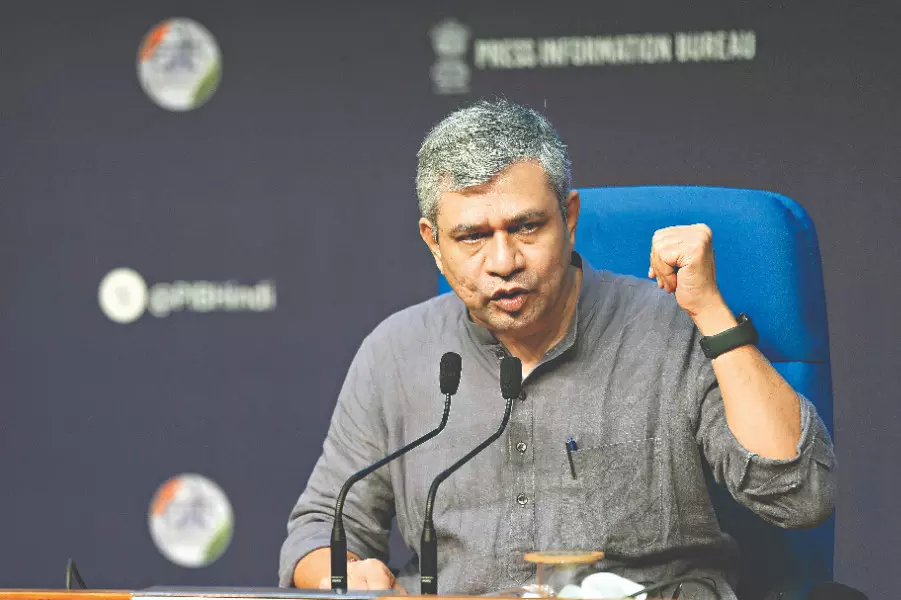
New Delhi, Feb. 3 -- The government is in discussions with mobile phone makers, IT firms and other electronics manufacturing companies for the next version of the production linked incentive (PLI) scheme before getting approval from the Cabinet, Union Electronics and IT Minister Ashwini Vaishnaw said.
The minister said that the new budget reforms, including the Rs 40,000-crore component scheme and AI data centre tax holiday, will propel employment generation across the electronics, AI, and GCC sectors significantly past the current level of over one crore jobs.
Asked about the government's plan for the mobile PLI scheme, which is going to end in March, and which the FY27 budget did not explicitly address, the minister assured that the government is constantly in talks with manufacturers, and "as and when things get finalised, we will take it to the cabinet and get the things approved".
"We keep moving as we go. For example, in the case of semiconductors, there was a lot of work which was already done for the budget. Same in the case of mobile and IT hardware, and all the manufacturers, we are constantly in talks with them. As and when things get finalised, we will take it to the cabinet and get the things approved," the minister said.
Vaishnaw said that the Union Budget 2026-27 has set a roadmap for the government vision for the 'Viksit Bharat 2047' that entails an economy which is resilient, atmanirbhar (self-reliant), and supports robust employment- led growth across sectors.
He said that the electronics component manufacturing scheme has already approved 46 units and that "many more are in the pipeline".
The Ministry of Electronics and IT has approved a total of 46 applications till January, entailing a total investment of Rs 54,567 crore and promising to generate direct employment for about 51,000 people.
The number of applications has touched nearly 260, far exceeding the original expectations, Vaishnaw noted.
Measures such as the five-year income tax exemption for foreign suppliers of capital equipment in bonded zones are significant reforms that will help grow the electronics manufacturing industry in a very big way in India, he said.
In the annual budget for the next financial year, the government has proposed raising safe harbour limits to Rs 2,000 crore and unified IT taxes, a move that the industry says will lower compliance burdens and litigation risks for software exporters and GCCs (global capability centres).
Simultaneously, ISM 2.0 and cloud tax holidays have underlined India's intent to strengthen the country's proposition as a preferred destination for global digital infrastructure investments.
"Today between electronics manufacturing, IT services and GCC and the connected industries, employment is of the order of one crore plus. These four reforms which have been announced will significantly improve employment in the electronics and IT and AI-based services," Vaishnaw said.
To a question on his projection for jobs growth, given that manufacturing, GCCs and AI are on a roll, the minister said: "I would not be surprised if it (the number) is 1.5 crore in the coming two years itself because all the component manufacturing units are getting set up now".
Electronics manufacturing has grown six times over the last decade, the minister noted. Electronics exports have grown eight times and electronics items are now the third-largest exported items out of India, the minister said.
"With the excellent success of electronics component manufacturing scheme in which we have already approved 46 units, and many more are in the pipeline, this increased allocation will create a very deep-rooted electronic component manufacturing ecosystem in a country, which means, we will be able to meet our own demand significantly and will become the global manufacturer for many components," he said.
The electronics manufacturing segment employs about 25 lakh people today.
"With the electronics component manufacturing, we will see much higher employment potential in electronics manufacturing," according to Vaishnaw.
On semiconductors, the minister noted that India has embarked on a totally new chapter focused on foundational and strategic priorities, and realising what had been a "dream for six decades".
He promised that the next chapter would be all about building a self-reliant ecosystem, focusing on equipment and materials used for manufacturing semiconductors, as well as the design ecosystem.
Published by HT Digital Content Services with permission from Millennium Post.