
Panaji, Jan. 28 -- The global gas trade is quietly undergoing a fundamental change-one that will redefine how countries like India secure energy in the years ahead. As major producers begin retaining richer hydrocarbons for domestic use and export only leaner gas, ONGC is moving early to lock in supplies, ships and strategy. From building its own LNG carriers to eyeing nuclear power and deepwater exploration, the state-run energy major is preparing for a future where control over molecules and movement may matter as much as production itself.
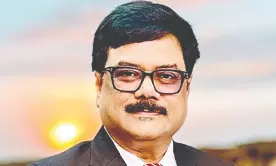
Arunangshu Sarkar, Director (Strategy) at ONGC, said the company is preparing for a significant shift in its LNG supply profile from Qatar beginning in 2028, when the Gulf producer is expected to start supplying lean gas-primarily methane-instead of the richer gas it currently provides.
At present, LNG cargoes from Qatar contain heavier hydrocarbons such as ethane (C2), which add value for downstream processing. However, Qatar plans to increasingly retain these heavier components for domestic petrochemical expansion. Sarkar said this trend is visible across the Middle East, with producers gradually limiting exports of richer gas components in favour of domestic consumption.
Anticipating this structural change, ONGC has decided to develop its own LNG shipping capability rather than rely entirely on third-party carriers. The move aligns with the government's broader push to strengthen domestic shipping and logistics infrastructure. As part of this strategy, ONGC has floated tenders and finalised two joint ventures-one with Mitsui O.S.K. Lines (MOL) and another with NYK Line-which were recently formalised in Osaka. Under the arrangements, two LNG carriers, each with a capacity of about 50,000 cubic metres, will be constructed.
ONGC's LNG requirement is around 600 kilotonnes per annum. Each carrier is expected to undertake about 12 voyages annually, which together would be sufficient to meet the company's full LNG needs. Sarkar said the vessels are expected to become operational in sync with Qatar's transition to lean gas supply in 2028. The ships will be owned by the joint ventures and chartered to ONGC, with funding structured through a mix of equity and debt. Sarkar said the cost per vessel is not expected to be exceptionally high.
Placing the company's strategy in a broader national context, Sarkar highlighted India's gas consumption outlook. India currently consumes about 70 billion cubic metres (BCM) of natural gas annually, with roughly half supplied through domestic production and the remainder imported as LNG. Lower LNG prices would benefit India as the government aims to raise the share of natural gas in the energy mix from around 6 per cent to 15 per cent by 2030.
Sarkar acknowledged that the target is ambitious, particularly given the continued availability of cheaper fuels such as coal. However, he said global LNG capacity additions of nearly 47-50 million metric tonnes per annum by 2026-27 could soften prices. Lower prices, he said, could support fuel switching from coal to gas.
Clarifying ONGC's role in the LPG segment, Sarkar said the company is not directly engaged in the LPG business. However, heavier hydrocarbons extracted at ONGC's processing terminals at Uran and Hazira are processed into LPG, natural gasoline and other by-products, which are sold commercially.
On production performance, Sarkar said production targets are fixed by "external agencies" using standard formulas that may not fully capture operational realities. Despite this, ONGC exceeded last year's oil and gas production by around 1-1.2 per cent. He noted that Indian oil and gas fields face a natural decline rate of about 7-8 per cent annually, requiring sustained effort to maintain output. ONGC's operational growth effort of 8.2 per cent offsets this decline and enables marginal net growth.
Exploration, particularly in deepwater, remains central to ONGC's long-term strategy. Sarkar said nearly one million square kilometres of previously restricted exploration acreage, including deepwater blocks, has recently been opened. While individual deepwater wells can cost over Rs 1,000 crore, ONGC plans to pursue exploration aggressively, warning that production would decline sharply without continuous exploration. On downstream operations, Sarkar said India's refining capacity of 258 million metric tonnes per annum is projected to rise to 313 MMTPA by 2030, with further expansion still under evaluation. Refineries are operating above nameplate capacity, supported by low crude prices and healthy margins. Discussions on the proposed Andhra Pradesh refinery are ongoing, though no update is available.
On ONGC Petro Additions Limited (OPaL), Sarkar said ONGC invested about Rs 18,000 crore to stabilise the company by reducing debt and improving operations. OPaL is now a subsidiary, with plans to induct strategic partners through a global tender process, subject to approvals.
Addressing overseas assets, Sarkar said around Rs 500 crore in dividends remain stuck, particularly in Venezuela, due to legal challenges, with no progress on recovery so far. ONGC is also evaluating Small Modular Reactors (SMRs) of 50-55 MW as captive power sources following enabling legislation passed in December.
Offshore wind projects are under study, though high costs and infrastructure challenges have delayed execution.
Published by HT Digital Content Services with permission from Millennium Post.