
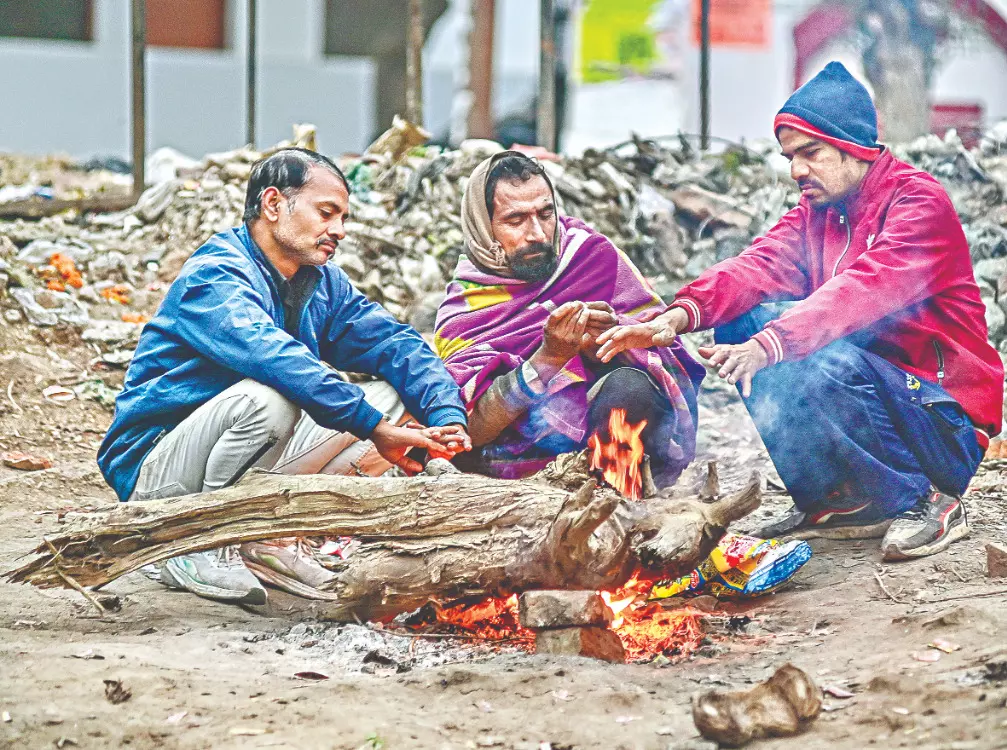
New Delhi, Jan. 4 -- Winter conditions intensified across large parts of north India on Sunday, pulling down temperatures in the national capital, reducing visibility due to fog in parts of Rajasthan, and keeping Kashmir locked in sub-zero cold, according to the India Meteorological Department.
In Delhi, daytime temperatures dipped below normal levels. The IMD said the maximum temperature was recorded at 17.3 degrees Celsius, about two degrees lower than the seasonal average. The minimum temperature stood at 7.4 degrees Celsius, marginally above normal by 0.5 degrees. A cold wave is expected to persist at isolated places in the city until January 6.
Station-wise readings showed variations across the capital. Ridge recorded a minimum of 8.9 degrees Celsius, while Lodhi Road logged 7.6 degrees, Safdarjung 7.4 degrees, Palam 6.8 degrees and Ayanagar 6.6 degrees. Maximum temperatures ranged from 17.8 degrees Celsius at Ridge to 16.3 degrees in Palam, with Lodhi Road and Ayanagar recording 17 degrees and 16.7 degrees respectively. Relative humidity in the city stood at 73 per cent at 5.30 pm.
Air quality remained a concern. Data from the Central Pollution Control Board showed Delhi's Air Quality Index at 307 at 4 pm, placing it in the 'very poor' category. Under the AQI scale, readings between 301 and 400 are classified as very poor.
In Rajasthan, dense to moderate fog was reported at several locations during the morning hours. Fatehpur in Sikar district emerged as the coldest spot in the state, recording a minimum temperature of 1.1 degrees Celsius. Sirohi, Pali and Churu each logged a low of 4.4 degrees, while Vanasthali recorded 4 degrees. Lunkaransar and Sikar registered minimum temperatures of 2.8 degrees and 2.5 degrees respectively. The state capital, Jaipur, saw the mercury drop to 8.8 degrees Celsius. The IMD said cold wave conditions prevailed at isolated places in eastern Rajasthan.
Colder conditions were more pronounced in Kashmir, where minimum temperatures fell further across the valley. Srinagar recorded a low of minus 3.2 degrees Celsius, compared with minus 1.5 degrees a night earlier. Tourist hub Gulmarg remained the coldest for the second consecutive night at minus 6.5 degrees Celsius, while Pahalgam recorded minus 5 degrees. Qazigund, Kupwara and Kokernag registered minimum temperatures of minus 4 degrees, minus 2.5 degrees and minus 1.6 degrees respectively.
Kashmir is currently passing through Chilla-e-Kalan, the harshest 40-day winter phase, when night temperatures often plunge well below freezing. Despite the cold, the plains of the valley have not received snowfall so far this season.
Looking ahead, the IMD has forecast light rain or snow at isolated places in higher reaches of north and central Kashmir and in Himachal Pradesh on January 5 and 6. Similar conditions are expected at isolated locations in Uttarakhand on January 6, with ground frost likely on January 5 and 6. The weather office also predicted a gradual fall of two to four degrees Celsius in minimum temperatures over central and east India during the next three days, followed by no major change for four days thereafter. Minimum temperatures are expected to rise in Gujarat over the next five days, while no significant change is forecast for the remaining parts of the country.
Published by HT Digital Content Services with permission from Millennium Post.