
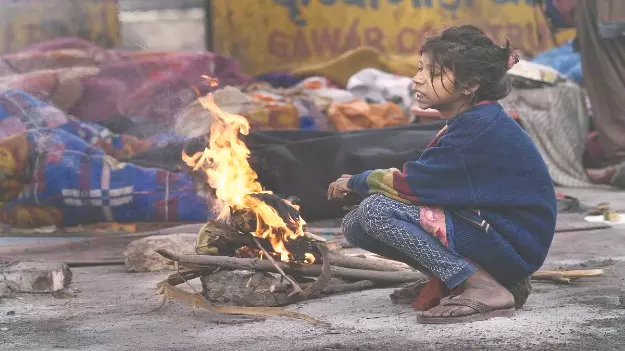
New Delhi, Jan. 8 -- The winter chill deepened on Thursday across northern states, as fringes of Dal Lake and several other water bodies froze in Jammu and Kashmir, and mercury plunged further in Uttar Pradesh.
Icy cold wave conditions continued in most parts of Himachal Pradesh as well, with sub-zero temperatures in 13 districts and near-zero in four, officials said.
In Jammu and Kashmir, several places, including Srinagar, experienced the coldest night of the season as cold conditions tightened their grip in Kashmir with a significant fall in the minimum temperature in most parts.
The bone-chilling cold conditions led to the freezing of the fringes of several water bodies, including the famous Dal Lake here.
Srinagar recorded a low of minus 5.1 degrees Celsius on Wednesday night, down 3.5 degrees from minus 1.6 degrees Celsius on Tuesday night, officials said.
They said it was the season's coldest night in the city, and the minimum temperature was 3.2 degrees below the season's normal.
The tourist resort of Sonamarg in central Kashmir's Ganderbal district was the coldest recorded place in Jammu and Kashmir as it shivered at a low of minus 9.8 degrees Celsius, they said.
The night temperature in Gulmarg in north Kashmir's Baramulla district settled at a low of minus 9.2 degrees Celsius, down from minus 7.6 degrees Celsius, they said.
It was the lowest night temperature at the resort so far this winter, they added.
Kashmir valley is currently in the midst of 'Chilla-i-Kalan', a 40-day period of extreme cold, during which night temperatures often drop several degrees below the freezing point, and chances of snowfall are the highest.
The plains of the valley, however, have not received any snowfall so far this season.
The India Meteorological Department (IMD) has said the weather is likely to remain dry but cloudy till January 20.
It said the night temperatures would witness a significant fall in the valley till January 10.
In Himachal Pradesh, Kukumseri was the coldest with a minimum temperature of minus 11.2 degrees Celsius, while Tabo recorded a low of minus 8.9 degrees.
Out of 34 stations, 13 recorded a minimum temperature below zero degrees, while data from seven stations was not available. The mercury stayed between 3 and 7 degrees Celsius at the remaining 10 stations.
The local Meteorological station issued a yellow warning of dense fog at isolated places in Una, Hamirpur, Bilaspur, Kangra, Mandi, Solan and Sirmaur, from January 9 to 12.
The weather office predicted dry weather in the state for the next four days and a gradual increase of two to four degrees in minimum temperature during the next three to four days.
Dense fog engulfed the lower hills during the early morning hours, while thick ground frost occurred at several places, resulting in freezing of water pipes in the upper Shimla area and other mid and higher hills.
Cold conditions continued to grip Uttar Pradesh on Thursday, as dense to very dense fog enveloped several districts, while temperatures remained significantly below normal across large parts of the state, the IMD said.
According to the Meteorological Centre, the maximum temperature in the state capital was recorded at 16.9 degrees Celsius, 3.5 degrees below normal, while the minimum settled at 6.4 degrees Celsius, 1.2 degrees below normal.
The IMD said shallow to moderate fog is likely in Lucknow and adjoining areas during forenoon hours on Friday, followed by clear skies later in the day.
The maximum and minimum temperatures are expected to be around 19 degrees Celsius and 7 degrees Celsius, respectively. A warning for dense to very dense fog during morning hours has been issued.
In a press note, the IMD said the prevailing fog and cold conditions are due to cold and dry north-westerly winds blowing into the state from snow-bound hilly regions, coupled with delayed sunshine caused by dense fog. Owing to these conditions, several districts witnessed 'cold day' and 'severe cold day' conditions on Thursday.
The IMD said there are indications of gradual improvement in cold and fog conditions till January 11 due to the influence of a western disturbance concentrated over north Punjab. The department expects a gradual reduction in fog density and a rise in temperatures, leading to short-term relief from the ongoing cold spell.
Published by HT Digital Content Services with permission from Millennium Post.