
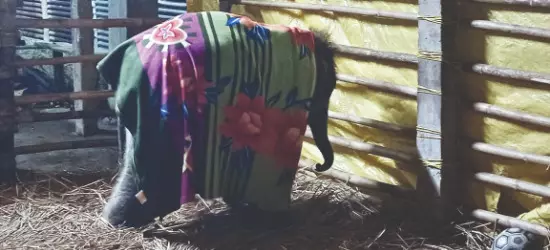
Alipurduar, Dec. 22 -- As winter tightens its grip on North Bengal, night-time temperatures in the Dooars have been dropping to around 12degC since mid-December. The Jaldapara Forest Division has introduced special arrangements to protect the orphaned elephant calf 'Lucky' and 25 resident leopards at the South Khayerbari Leopard Rehabilitation Centre from the harsh cold.
Three-month-old female elephant calf Lucky was rescued at the age of just 10 days old from the Mechi River along the India-Nepal border during the devastating floods in October. Initially sheltered in the Kurseong Forest Division, the calf was later shifted to Holong Central Pilkhana in Jaldapara National Park owing to her fragile health condition. Chief Minister Mamata Banerjee later named the rescued calf 'Lucky'.
Although Lucky's condition has stabilised under the care of two experienced mahouts and veterinarians, forest officials remain cautious due to her low immunity, as she was deprived of her mother's milk.
As part of the winter care plan, Lucky's shelter has been enclosed with thick plastic tarpaulin to block cold winds. She is covered with heavy blankets at night, and a raised bed made of layered jute sacks has been prepared to prevent exposure to the cold ground. Bedding materials are replaced daily following strict hygiene norms. Her treatment and overall health are being monitored by senior veterinarian Utpal Sharma. Divisional Forest Officer (DFO) Parveen Kaswan said, "An orphaned elephant calf requires the same level of care as a human infant. Since Lucky has no mother, we are taking every possible precaution to ensure her well-being during winter."
Similar precautions have been extended to the 25 leopards housed at South Khayerbari, most of which were rescued from human settlements. To counter the cold cement floors of the iron-mesh enclosures, sturdy sal-wood platforms measuring 7 ft by 4 ft have been installed in each cage. The enclosures are wrapped with tarpaulin every afternoon, and if temperatures drop further, fires will be lit nearby to provide additional warmth. Forest officials said such measures are essential as animals in captivity cannot seek natural shelter. Environmentalists have welcomed the initiative, terming it a humane and timely step towards wildlife welfare.
Published by HT Digital Content Services with permission from Millennium Post.