
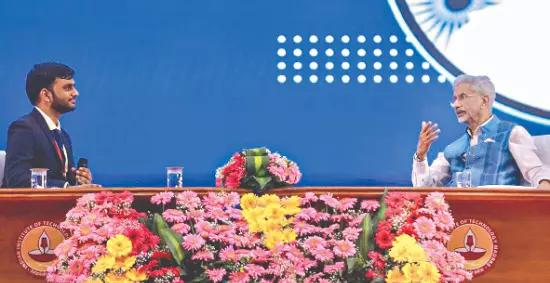
CHENNAI, Jan. 2 -- External Affairs Minister S Jaishankar on Friday said India has every right to defend its people when it comes to "bad neighbours" and asserted that a neighbouring country cannot ask New Delhi to share water if it continues to spread terrorism in the country.
At the same time, he said with "good neighbours", India invests, helps and shares, whether it was vaccines during COVID-19 pandemic, fuel and food support during the Ukraine conflict, or the USD 4 billion assistance to Sri Lanka during its financial crisis.
Without naming Pakistan, Jaishankar said India has every right to defend its people when it comes to "bad neighbours" and nobody can tell the country how to exercise that right.
"...people make it sound as diplomacy is rocket science. It is common sense..now, what do you do in common sense with a neighbour? If you have a neighbour who is good to you or at least who is not harmful to you, your natural instinct is to be kind, is to help that neighbour. If the neighbour has a problem, you would like to contribute in some way. If nothing else, you will say hello...you will try to build friendships, bonding, etc. And that's what we do as a country," he said in a fireside chat at IIT Madras here.
"So, when you look around our neighbourhood, wherever actually there is a sense of good neighbourliness, I think you have seen India invests, India helps, India shares. Now, when you have bad neighbours, and if a country decides that they will deliberately, persistently, unrepentantly continue with terrorism, we have a right to defend our people against terrorism. We will exercise that right. How we exercise that right is up to us.
"You know, nobody can tell us what we should do or not. We will do whatever we have to do to defend ourselves. That's a common sense proposition," he said.
He said many years ago, we (India and Pakistan) agreed to a water sharing arrangement, "...but if you had decades of terrorism, there is no good neighbourliness. If there is no good neighbourliness, you don't get the benefits of that good neighbourliness. You cannot say Please share water with me, but I will continue terrorism with you. That is not reconcilable."
The External Affairs Minister said it is important to communicate with other countries to avoid a situation where India's intentions are misread. "How to prevent people from misreading you is to communicate. If you communicate well, clearly and honestly, other countries and other people respect it and accept it. A lot of people across the world are proud of their culture, tradition and heritage. I see no reason why we should not be," he said. He pointed out that there are "really very few" ancient civilisations that have survived to become major modern nation states, and India is one of them. Jaishankar noted that he was in Bangladesh just two days ago to represent India at the funeral of former prime minister Khaleda Zia.
"But more broadly, our approach to the neighbourhood is guided by common sense. With good neighbours, India invests, helps and shares - whether it was vaccines during COVID, fuel and food support during the Ukraine conflict, or the USD 4 billion assistance to Sri Lanka during its financial crisis," he said.
He said countries have advanced by growing at home and then engaging abroad, leveraging the international environment in a way that contributes to the growth and also gains from it. "When we say 'Vasudhaiva Kutumbakam', the term is we have never considered the world as an inimical or hostile place from which we have to defensively protect ourselves. We have limitations on our resources. With limited resources, how do you have maximum impact? That is actually the problem that has to be solved," he underlined. "What we try to do in Indian foreign policy and diplomacy today is solve that problem. We try to do that partly using our competitiveness and strengths and leveraging other institutions and possibilities," he added.
Meanwhile, in an open letter addressed to S Jaishankar, Mir Yar Baloch, a prominent Baloch leader and human rights activist, claimed that Beijing could deploy military troops in Pakistan's Balochistan region within the coming months. The letter outlined long-standing grievances of the Baloch people, alleging decades of repression under Pakistani control, including state-sponsored violence and serious human rights abuses.
Mir Baloch recalled that Baloch nationalist leaders had declared independence from Pakistan in May 2025 and announced plans for the "2026 Balochistan Global Diplomatic Week", scheduled for the first week of 2026, which he said was aimed at enabling Balochistan to engage directly with governments and institutions worldwide. In a New Year message to Jaishankar, he praised the Indian government led by Narendra Modi for what he described as decisive actions taken in 2025 through Operation Sindoor, saying the operation dismantled Pakistan-backed terrorism hubs after the April 22 Pahalgam terror attack and reflected India's resolve on regional security and justice.
Extending greetings for 2026, Mir Baloch said he was conveying congratulations "on behalf of the six crore patriotic citizens of the Republic of Balochistan" to the people of India, its Parliament, media and civil society. He also pointed to historical and cultural links between the two regions, citing the Hinglaj Mata Temple as a symbol of shared heritage. Reiterating support for India in promoting cooperation across peace, trade, defence, security and energy, he cautioned that the expanding Pakistan-China partnership and the advancement of the China-Pakistan Economic Corridor to its final phases posed serious risks. Any deployment of Chinese troops in Balochistan without the consent of the region's estimated 60 million Baloch people, he warned, would carry far-reaching regional consequences for both Balochistan and India. China and Pakistan have repeatedly rejected allegations of military expansion linked to the corridor, maintaining that the initiative is purely economic, while India has consistently opposed the project, arguing that it passes through Pakistan-occupied Jammu and Kashmir and raises sovereignty and security concerns.
Published by HT Digital Content Services with permission from Millennium Post.