
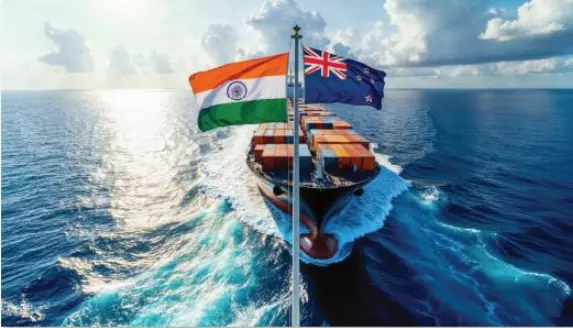
New Delhi, Dec. 22 -- India and New Zealand have concluded negotiations on a wide-ranging free trade agreement that is set to reshape bilateral economic ties by expanding market access, easing the movement of skilled professionals and anchoring a foreign direct investment commitment of $20 billion over the next fifteen years. The pact, which both governments expect to sign and bring into force within seven to eight months, is projected to double trade in goods and services to $5 billion within five years and introduce significant tariff liberalisation while protecting politically sensitive sectors.
Prime Minister Narendra Modi and New Zealand Prime Minister Christopher Luxon announced the completion of talks following a phone conversation on Monday. Negotiations began during Luxon's visit to India in March 2025 and were wrapped up within nine months. Officials said the rapid conclusion reflected the shared intent to expand economic cooperation and deliver new opportunities for businesses, farmers, students and young professionals in both countries.
A major component of the agreement is Wellington's pledge to facilitate investments worth $20 billion into India over fifteen years, in line with the model India adopted in its recent pact with the European Free Trade Association. According to the commerce ministry, these funds will support manufacturing, infrastructure, services and innovation under the Make in India programme. Commerce and Industry Minister Piyush Goyal said the investment commitment is backed by a rebalancing mechanism that allows suspension of benefits if targets are not met. He noted that only FDI is included in the commitment and not foreign portfolio investment, adding that long-term capital will aid job creation and domestic production. For New Zealand, which has historically invested modestly in India, the commitment of roughly Rs 1.80 lakh crore marks a substantial scale-up.
On the trade side, India will grant duty-free access to 54.11 per cent of New Zealand exports from the first day of implementation, based on 2024 data.
Over the next ten years, the share of New Zealand exports receiving zero-duty treatment is set to rise to 79 per cent. Goods entering India duty-free immediately will include sheep meat, wool, coal and more than 95 per cent of forestry and wood products. Duties on seafood such as mussels and salmon will be phased out over seven years, while tariffs on several iron, steel and aluminium scrap items will be removed within ten years or sooner, a step sought by Indian industry to reduce input costs and support manufacturing.
India has offered duty concessions on selected agricultural products such as apples, kiwifruit, manuka honey and albumins, but only under tariff-rate quotas paired with minimum import prices. The commerce ministry said these guardrails are intended to protect domestic growers. For apples, New Zealand currently exports 23,602 tonnes to India at a 50 per cent duty. Under the FTA, India will allow 32,500 tonnes in the first year at a 25 per cent duty and a minimum import price of $1.25 per kg, with the quota rising to 45,000 tonnes by the sixth year. Imports beyond the quota will continue to be charged 50 per cent duty. The ministry noted that the initial quota level is lower than existing import volumes.
For kiwifruit, where India currently imposes a 33 per cent duty and New Zealand exported 5,840 tonnes last year, India will allow a quota of 6,250 tonnes in the first year, increasing to 15,000 tonnes by the sixth year. Within the quota, imports will eventually carry no duty but will be subject to a minimum import price of $1.80 per kg. Concessions on avocados and persimmons will be phased in over a decade.
India has kept a number of sensitive products outside the scope of tariff concessions. These include dairy items such as milk, cream, whey, yoghurt and cheese, along with onions, chana, peas, corn, almonds, sugar, artificial honey, several fats and oils, arms and ammunition, gems and jewellery, copper products and aluminium articles.
In the services sector, New Zealand will open a temporary employment entry pathway for Indian professionals in skilled occupations, providing up to 5,000 visas each year with stays of up to three years. The pathway covers AYUSH practitioners, yoga instructors, Indian chefs and music teachers, as well as workers across IT, engineering, healthcare, education and construction. Officials said this will strengthen workforce mobility and support services trade.
The agreement includes provisions for stronger regulatory cooperation to reduce non-tariff barriers, streamline customs procedures and align sanitary, phytosanitary and technical standards. India's pharmaceutical and medical device sectors are expected to benefit from New Zealand's decision to accept inspection reports from comparable regulators such as the US FDA, the EU's EMA and the UK's MHRA, which will cut duplicative inspections, lower compliance costs and speed up product approvals.
New Zealand will also establish an Agri-Technology Action Plan focused on kiwifruit, apples and honey. The plan will support Indian farmers through improved planting material, Centres of Excellence, grower training, technical support for orchard management, post-harvest techniques, supply chain improvements and food safety systems. Wellington has committed to amending its laws to enable the registration of India's wines and spirits under Geographical Indications. Cooperation will extend to AYUSH, culture, fisheries, audiovisual tourism, forestry, horticulture and traditional knowledge systems.
Goyal noted that this is the seventh trade agreement finalised by the current government, following pacts with the UAE, Australia, the UK, the EFTA bloc, Oman and Mauritius. He said India has now secured FTAs with three members of the Five Eyes grouping. Talks with the United States are in an advanced stage, and negotiations with Canada are set to resume.
Bilateral merchandise trade between India and New Zealand stood at $1.3 billion in 2024-25, while total trade in goods and services reached $2.4
billion in 2024. Services trade accounted for $1.24 billion, led by travel, IT and business services. Commerce Secretary Rajesh Agrawal said that although only five formal rounds of negotiations were held, both sides remained in constant contact to complete the agreement.
Published by HT Digital Content Services with permission from Millennium Post.