
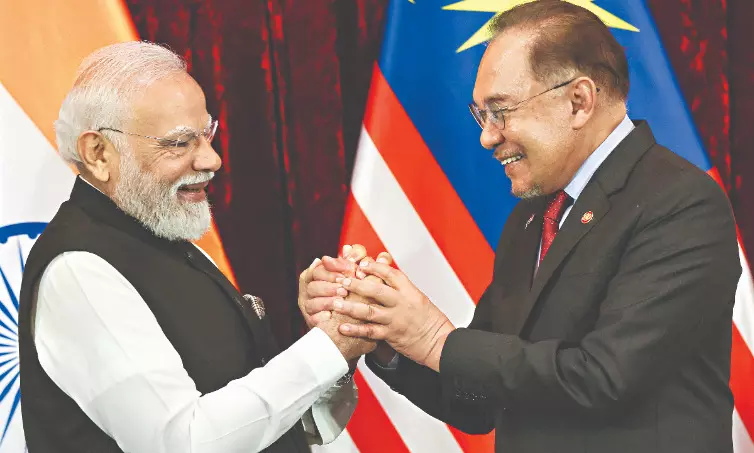
Kuala Lumpur, Feb. 8 -- In a significant elevation of bilateral ties, India and Malaysia on Sunday rolled out an ambitious roadmap to deepen cooperation across trade, investment, defence, energy, advanced manufacturing, digital technologies and semiconductors, even as both sides projected a united front on counter-terrorism, maritime security and reform of global institutions. After wide-ranging talks in Kuala Lumpur, Prime Minister Narendra Modi and Malaysian Prime Minister Anwar Ibrahim announced 11 new agreements and documents, including a framework pact to expand collaboration in the semiconductor sector, signalling a broader strategic alignment that blends economic ambition with security cooperation in the Indo-Pacific.
In a comprehensive lead statement, Modi described the relationship as "special" and rooted in centuries of maritime, cultural and economic links, while underlining that both countries share a common stake in a stable, rules-based Indo-Pacific. He reiterated India's uncompromising stance on terrorism, stating, "Our message on terrorism is clear, no double standards, no compromise," a position that was later echoed in a strongly worded joint statement condemning terrorism in all its forms, including cross-border terrorism, and calling for "zero tolerance."
The talks covered a wide spectrum of issues, from energy and digital cooperation to multilateral diplomacy. Modi confirmed that India will establish a new Indian Consulate General in Malaysia, a move aimed at strengthening people-to-people ties, consular services and economic engagement. Both leaders also welcomed efforts to promote the use of local currencies, the Indian rupee and Malaysian ringgit, for bilateral trade settlement, a step they said could reduce transaction costs and deepen financial integration. Ibrahim described this decision as "remarkable", adding that Malaysia stood to benefit from India's rapid economic expansion, which he called "one spectacular rise in the international eco and trade scene."
Security and defence figured prominently in the discussions. Modi said cooperation in counter-terrorism, intelligence sharing and maritime security will be strengthened, alongside a further expansion of defence ties. The joint statement noted that both countries will work together to counter radicalisation and violent extremism, prevent the financing of terrorism, and curb the misuse of new and emerging technologies for terrorist purposes. They also reaffirmed their commitment to collaborate within multilateral platforms such as the United Nations and the Financial Action Task Force.
On the regional front, Modi underscored India's consistent support for ASEAN centrality in the Indo-Pacific. "The Indo-Pacific region is emerging as the world's growth engine. We, along with ASEAN, are committed to development, peace, and stability throughout the Indo-Pacific region," he said. He added that with Malaysia's support, India would further expand its engagement with the 10-nation bloc and pressed for the expedited review of the ASEAN-India Trade in Goods Agreement, known as ITIGA.
Both leaders agreed that reform of global institutions is necessary to reflect contemporary geopolitical realities. Malaysia extended its support for India's permanent membership in a reformed UN Security Council, a position India welcomed. The joint statement said the two countries "pledged to work together to enhance multilateralism" and make international organisations, including the UNSC, "more representative."
Economic engagement formed the other pillar of the visit. Ahead of and alongside the official talks, Modi held separate meetings with four prominent Malaysian industry leaders, signalling a push to translate political alignment into concrete investment flows. He met Tengku Muhammad Taufik, President and Group CEO of PETRONAS, where discussions focused on strengthening energy partnerships and exploring opportunities in renewables and clean fuels, including green hydrogen and green ammonia. PETRONAS, which has had a three-decade presence in India across LNG, petrochemicals and emerging green energy solutions, was seen as a key partner in India's energy transition.
Modi also interacted with Vincent Tan Chee Yioun, founder of Berjaya Corporation Berhad, who expressed interest in deepening his company's footprint in India's services and consumer sectors. Amirul Feisal Wan Zahir, Managing Director of Khazanah Nasional Berhad, spoke about India's economic transformation and its appeal as a high-potential investment destination. Pua Khein Seng, founder of Phison Electronics, conveyed his company's intent to participate in India's fast-growing technology and semiconductor ecosystem.
According to the Ministry of External Affairs, Modi briefed the industry leaders on India's recent reforms aimed at improving ease of doing business and creating a stable, efficient and predictable policy environment. He invited Malaysian companies to explore opportunities in infrastructure, renewable energy, digital technology, semiconductors, artificial intelligence and healthcare. The leaders responded positively, expressing confidence in India's growth trajectory and indicating interest in expanding investments and pursuing joint ventures with Indian counterparts.
The economic momentum was further reflected at the 10th India-Malaysia CEO Forum held in Kuala Lumpur on Saturday. Modi commended the forum and said its deliberations had opened new avenues for trade and investment between the two nations. He also interacted with CEOs from both countries, noting that growing business-to-business connections were a testament to the deepening commercial relationship.
Strategically, both sides framed their partnership as part of a broader response to global uncertainty. Modi said the "growing friendship" between India and Malaysia was of vital importance in a period of geopolitical instability, while Ibrahim spoke of the need for greater collaboration to harness shared opportunities.
Beyond security and economics, the two leaders also discussed cooperation in emerging fields such as artificial intelligence, digital technologies, health and food security. Modi said these areas, alongside semiconductors, would form a key part of future collaboration, reflecting a shift toward high-technology and knowledge-based partnerships.
By the end of the visit, the tone from both capitals was one of cautious optimism mixed with strategic clarity. The 11 agreements, the semiconductor framework, the local currency initiative, and the planned consulate signalled a relationship moving from dialogue to delivery. At the same time, the firm language on terrorism, maritime security and institutional reform suggested that India and Malaysia see their partnership as extending well beyond economics into the realm of regional and global governance.
Published by HT Digital Content Services with permission from Millennium Post.