
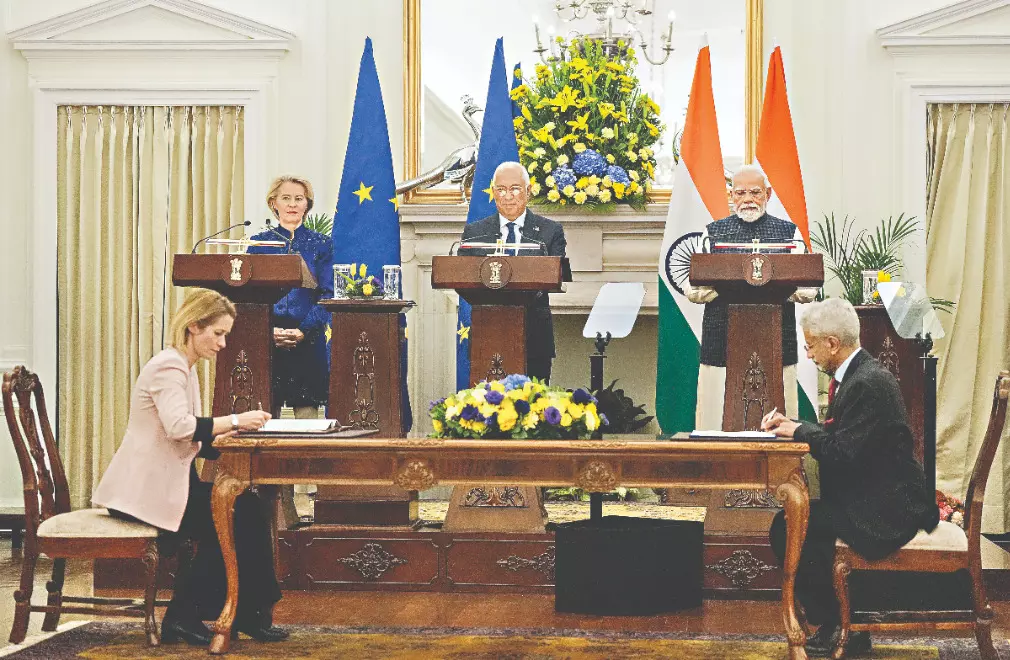
New Delhi, Jan. 27 -- India and the European Union on Tuesday sealed a comprehensive pact on mobility that will open up new opportunities for Indian students and professionals in Europe.
The agreement was concluded at the India-EU summit talks between Prime Minister Narendra Modi and European Commission President Ursula von der Leyen and European Council President Antonio Costa. "This (pact) will open up new opportunities in the European Union for Indian students, workers, and professionals," Modi said after the summit.
"We have a long-standing and extensive cooperation in science and technology. Today, we have decided to further strengthen these important linkages," he said in his media statement.
France, Germany and Italy are among the European nations that have migration and mobility partnerships with India.
The two sides also launched a strategic agenda to provide for cooperation in a range of areas for the next five years.
"In a complex global environment, this agenda will provide clear direction, advance our shared prosperity, accelerate innovation, strengthen security cooperation, and deepen people-to-people ties," the prime minister said. At a media briefing, Foreign Secretary Vikram Misri elaborated on the importance of the mobility pact. "This is the first such mobility-related agreement that we are concluding at EU level. For the EU, this is the first with any partner," he said.
The foreign secretary said the pact "will facilitate and streamline safe, regular migration, support skill development, and ease the movement of highly skilled workers, students, researchers and seasonal workers". A joint statement said the leaders highlighted that education and people-to-people ties have emerged as vital enablers of the India-EU strategic partnership. "They welcomed the conclusion of the India-EU comprehensive framework of cooperation on mobility, in line with the national competences of EU member states and India and domestic legislation of both parties," it said. The leaders also commended the launch of the first pilot European Legal Gateway office, as a one-stop hub to provide information and support the movement of workers, starting with the information and communications technology (ICT) sector. "They reaffirmed their commitment to enhancing collaboration on safe, regular and orderly migration, including through circular pathways, for highly skilled workers, students, researchers, and seasonal workers in shortage occupations, whilst also strengthening cooperation on countering irregular migration," the statement noted.
Aspiring to deepen educational and academic collaboration, the two sides agreed to launch an education and skills dialogue to promote skills development, facilitate recognition of qualifications and learning periods abroad, and support systemic collaboration in higher and vocational education, it said.
Published by HT Digital Content Services with permission from Millennium Post.