
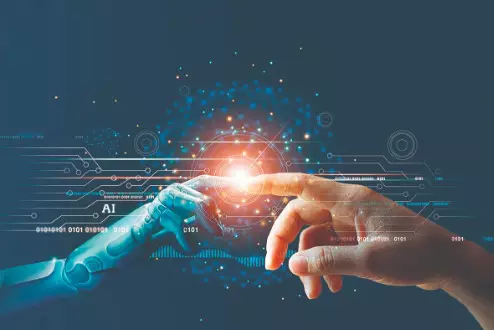
New Delhi, Jan. 14 -- With each passing day, organisations are increasingly embedding AI into day-to-day work. In fact, AI literacy has become one of the most important factors in hiring in the rapidly changing job market. According to Nasscom and Indeed's recently released annual Future of Work report 2025 titled 'Work Reimagined: The Rise of Human - AI Collaboration', nearly all HR leaders (97%) anticipate that by 2027, the nature of work will be shaped by humans working alongside AI rather than engaging with it only intermittently. This signals a shift from AI being a supplementary tool to becoming an integral part of everyday roles, workflows, and decision-making processes.
AI is re-shaping job market
The report finds that 20-40% of work across technology organizations is already being done through AI across functions. 45% of the respondents highlighted that over 40% of the software development is done by AI, followed by 39% and 37% in intelligent automation and BPM, respectively. At the same time, the report also underscores that AI is not independent; more than half of respondents highlighted incomplete and low-quality outputs, reinforcing the need for human oversight to remain critical.
This emerging model of humans and AI working together is reported as the next phase of transformation, where success depends on how effectively AI will augment human capabilities, empower employees, and align with organizational purpose.
Hiring shifts toward skill-based hiring
The report highlights that 85% of hiring managers see an increase in skills-based hiring, along with 98% highlighting the need for hybrid and multidisciplinary skills. For entry-level talent, organizations expect job-ready candidates, with assessments shifting toward live projects, hackathons, case-based questions, portfolios and a greater focus on measurable outcomes.
AI agent adoption
The report also indicates rapid momentum behind Agentic AI, where over 95% of respondents highlighted that they are using or planning to use AI agents. Among which, more than 65% feel that AI agents are better than humans owing to their ability to process high volumes of data and better quality of work. For jobseekers, this indicates a transformation with an uneven distribution of pressure. Organizations have already started taking measures to address these challenges. Every seven in 10 HR leaders are focusing on upskilling, more than half focusing on modernizing systems. With respect to AI adoption, 79% prioritize internal reskilling as a dominant strategy. Job redesigning is also becoming increasingly critical, shifting humans toward judgment, creativity, and accountability, while AI handles scale and speed. Here, HR leaders are playing a central role with 83% already working towards redesigning work and adding AI-specific roles.
Published by HT Digital Content Services with permission from Millennium Post.