
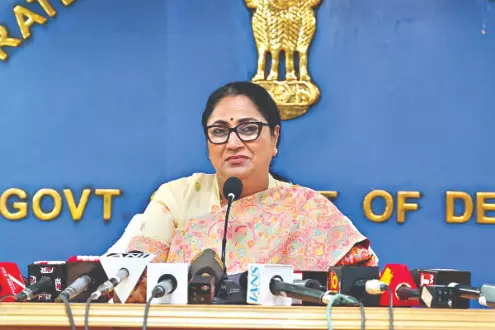
New Delhi, Feb. 11 -- In a major push to modernise public transport, Chief Minister Rekha Gupta on Wednesday announced the approval of Metro Phase V(A), a Rs 12,014.91 crore project that will add three new corridors spanning 16 kilometres with 13 stations. The expansion, targeted for completion in 2028, is expected to ease congestion, improve air quality, and strengthen connectivity across the national capital while aligning with Prime Minister Narendra Modi's vision for future-ready mobility.
Sharing details, Gupta said the project advances the Prime Minister's "7-C Vision" for transportation, "Common, Connected, Convenient, Congestion-free, Charged, Clean, and Cutting-edge mobility." Emphasising the environmental impact, she noted that strengthening public transport is essential for achieving protection goals and net-zero emissions, adding that the expansion will help make Delhi "cleaner, more efficient, and globally competitive."
Calling the decision an investment in the city's future, the Chief Minister said the new corridors will reduce traffic congestion and help control pollution while providing citizens with a "clean, efficient, and integrated transportation system." She also reaffirmed the government's commitment to working closely with the Centre to build a citizen-focused network aligned with the vision of a "Viksit Bharat."
The three approved corridors are RK Ashram Marg to Indraprastha (via Central Vista), Tughlakabad to Kalindi Kunj, and Aerocity to Indira Gandhi Domestic Terminal-1. Of the 13 stations, 10 will be underground and three elevated, enabling seamless interchange with the existing network and improving connectivity between the airport, commercial hubs, and residential areas.
The 9.913-km RK Ashram Marg-Indraprastha corridor, costing Rs.9,570.40 crore, will pass through the Central Vista area and connect key administrative and cultural zones. Major locations include Shivaji Stadium, Central Secretariat,
India Gate, War Memorial-High Court, Bharat Mandapam, and Indraprastha. Around 60,000 employees and nearly two lakh daily commuters are expected to benefit.
A 2.26-km Aerocity-IGD T-1 link, estimated at Rs.1,419.64 crore, will offer faster airport access and reduce reliance on taxis, while the 3.9-km Tughlakabad-Kalindi Kunj corridor, costing Rs.1,024.87 crore, will enhance connectivity in South and South-East Delhi.
Meanwhile, the Magenta Line (Line-8) is set to become the longest Delhi Metro corridor at approximately 89 kilometres once extensions are completed from Botanical Garden to Inderlok. The fully driverless line will feature 21 interchange stations and 65 stations overall, including 40 underground stops, significantly improving cross-city travel.
Officials said the corridor's extensive interchange network is expected to "reduce travel time, decongest major corridors, and provide seamless, end-to-end connectivity across the city," while engineering landmarks such as the highest station at Haiderpur Badli Mor and the deepest at Hauz Khas underscore its technological excellence.
Published by HT Digital Content Services with permission from Millennium Post.