
New Delhi, Jan. 9 -- Delhi-NCR shivered through the coldest morning of the winter aseason on Friday as the minimum temperature at the capital's base station Safdarjung dropped to 4.6 degrees Celsius, while cold wave conditions tightened their grip across large parts of north, northwest and eastern India, with sub-zero readings reported from Kashmir and Odisha.
In Delhi, the 4.6 degrees Celsius minimum was 2.3 degrees Celsius below the seasonal normal, marking the lowest minimum temperature recorded so far this winter.
The chill intensified as several parts of the city also reported trace rainfall in the early hours, adding to the wintry bite. Safdarjung and Lodhi Road recorded trace rainfall during the last 24 hours till 8.30 am, while Ayanagar received 0.8 mm of rain. No rainfall was recorded at Palam and the Ridge station during the same period.
Station-wise temperatures showed wide spread of cold conditions in the national capital. While Safdarjung recorded 4.6 degrees, Palam logged 5.0 degrees Celsius (1.5 degrees below normal) and Lodhi Road registered 5.2 degrees Celsius (0.8 degrees below normal). The Ridge station reported a minimum of 5.4 degrees Celsius (1.2 degrees below normal). Ayanagar, among the listed stations, recorded one of the sharpest dips with a minimum of 4.8 degrees Celsius, also 1.2 degrees below the seasonal average.
The Regional Weather Forecasting Centre said drizzle is likely at a few places in Delhi, naming Akshardham, Lodhi Road, Nehru Stadium, R K Puram, Defence Colony, Lajpat Nagar, Tughlakabad, IGNOU, Ayanagar and Deramandi among the areas expected to see light precipitation.
Despite the sharp fall in temperatures, the India Meteorological Department said cold wave conditions in the capital are yet to become severe. "It is a chilly morning but no cold wave conditions are threatening yet," an IMD official said. The maximum temperature in Delhi is expected to hover around 17 degrees Celsius.
The latest reading follows a series of cold mornings in the city. Thursday marked the third coldest morning of the season with a minimum temperature of 5.8 degrees Celsius at Safdarjung, 1.1 degrees below normal. Earlier this winter, the second-lowest minimum temperature was recorded on December 4 and 5 at 5.6 degrees Celsius, followed by December 1 when it stood at 5.7 degrees Celsius.
Delhi also experienced its first cold day of the season on January 6, when the maximum temperature plunged to 15.7 degrees Celsius, 3.3 degrees below normal, while the minimum was 7.6 degrees Celsius. Cold day conditions continued on Wednesday with a maximum of 16.7 degrees Celsius (2.3 degrees below normal) and a minimum of 8.6 degrees Celsius. Under IMD criteria, cold day conditions are declared when the minimum temperature remains below 10 degrees Celsius and the maximum temperature falls 4.5 to 6.4 degrees Celsius below normal, while cold wave conditions are declared when the minimum temperature drops by 4.5 to 6.4 notches below normal.
Beyond Delhi, the cold spell extended across multiple states. In Jharkhand, cold wave conditions prevailed in at least 13 districts as temperatures dipped below 10 degrees Celsius, the IMD said. Khunti recorded the state's lowest minimum temperature at 1.5 degrees Celsius, followed by Daltonganj at 3.2 degrees and Bokaro at 3.3 degrees.
Explaining the conditions, Abhishek Anand, deputy director of the IMD centre in Ranchi, said, "North-westerly winds continue to prevail in the tropospheric levels over Jharkhand, causing the cold wave conditions in several districts." The districts that recorded sub-10 degrees were Bokaro, Deoghar, East Singhbhum, Koderma, Hazaribag, Latehar, Daltonganj (Palamu), Lohardaga, Pakur, Ranchi, Seraikela, Simdega and West Singhbhum.
The IMD also issued alerts for the state. An 'orange' alert (scattered cold wave) was announced for seven districts - Garhwa, Palamu, Latehar, Chatra, Lohardaga, Gumla and Hazaribagh - while a 'yellow' alert (isolated cold wave) was issued for Bokaro, Ramgarh, Ranchi, Khunti, Simdega and West Singhbhum. The bulletin said cold wave conditions were likely to persist in these districts until 8.30 am on Saturday.
In Haryana and Punjab, temperatures fell below 5 degrees Celsius at several locations. Sirsa was the coldest in Haryana at 4 degrees Celsius, while Narnaul recorded 4.5 degrees. Other minimum temperatures included Bhiwani at 5 degrees, Hisar at 5.1 degrees, Karnal at 5.8 degrees, and Rohtak at 6 degrees. Ambala registered 6.4 degrees and Faridabad 6.8 degrees Celsius.
In Punjab, Bathinda recorded the lowest minimum temperature at 4.4 degrees Celsius, with Gurdaspur at 4.8 degrees, Amritsar at 6.3 degrees, Ludhiana at 6.2 degrees, and Faridkot at 7.6 degrees. Patiala reported 5.4 degrees Celsius, while Chandigarh, the common capital of Punjab and Haryana, logged a low of 6.1 degrees Celsius.
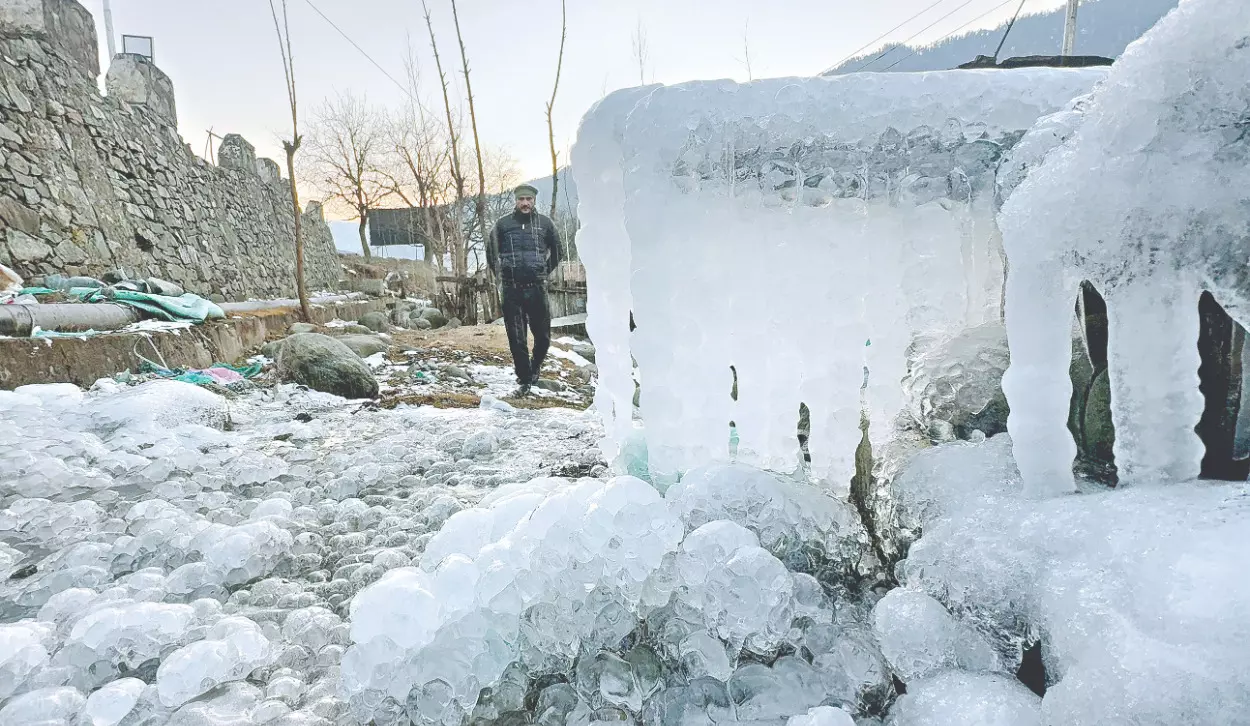
The cold deepened further in Kashmir, where parts of Dal Lake froze in Srinagar after the city recorded its coldest night of the season. The minimum temperature in Srinagar settled at minus 6.0 degrees Celsius on Thursday night, down from minus 5.1 degrees Celsius the previous night. Officials said the temperature was 4.1 degrees below the seasonal normal.
Pahalgam recorded the lowest temperature in Jammu and Kashmir at minus 7.6 degrees Celsius, even as it rose by one degree from the previous night. Gulmarg recorded minus 7.2 degrees Celsius, two degrees higher than the previous night. Sonamarg registered minus 5.4 degrees Celsius, while Qazigund settled at minus 6.2 degrees Celsius, the season's coldest there. Kokernag recorded minus 3.2 degrees and Kupwara minus 5.8 degrees Celsius.
The valley is currently in 'Chilla-i-Kalan', the 40-day harshest phase of winter that began on December 21 and will continue until January 30, a period known for the highest probability of snowfall. However, officials said the plains have not received snowfall so far this season. The IMD has forecast that weather is likely to remain dry but cloudy till January 21, with night temperatures expected to fall significantly until January 10, after which they may rise by one to two degrees.
Further east, Odisha also reported extreme cold as the mercury dropped to minus 1 degree Celsius at Upar Barha Kamuda in the core area of Similipal National Park, the lowest recorded temperature in the state, according to the Forest Department. IMD readings showed G Udaygiri at 2.6 degrees, Rourkela at 3.6 degrees, and Jharsuguda at 4.6 degrees Celsius. Phulbani recorded 5 degrees, while Daringbadi registered 6 degrees Celsius.
Bhubaneswar Meteorological Centre Director Monorama Mohanty said the twin cities of Bhubaneswar and Cuttack recorded minimum temperatures of 9.4 degrees and 8.6 degrees Celsius, respectively. She added that 25 places across Odisha recorded temperatures at or below 10 degrees Celsius, with parts of Koida in Sundargarh blanketed in frost. The IMD said cold wave conditions would continue in parts of Jharsuguda, Sundargarh, Cuttack, Khurda and Angul till Saturday.
The IMD, in its All India Weather Summary and Forecast Bulletin, said cold wave conditions are likely to persist over parts of north and northwest India, including Delhi-NCR, in the coming days, keeping large areas under sustained wintry stress.
Published by HT Digital Content Services with permission from Millennium Post.