
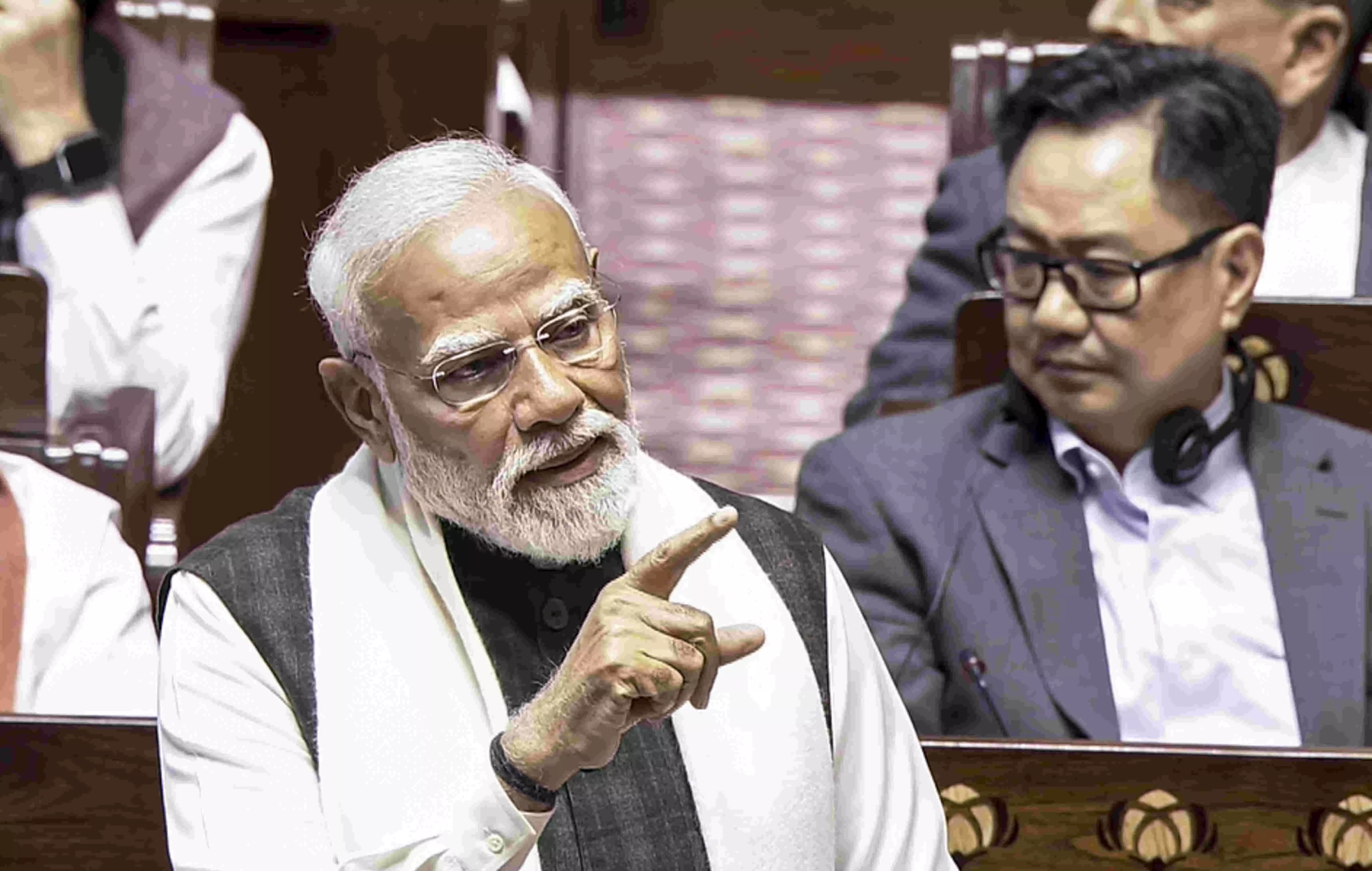
New Delhi, Feb. 5 -- Prime Minister Narendra Modi on Thursday delivered a combative, nearly 100-minute reply to the Motion of Thanks on the President's Address, using the occasion to mount a sweeping attack on the Congress and other Opposition parties even as members of the Opposition created repeated disruptions and ultimately staged a walkout in the Rajya Sabha. He said the Opposition party is unable to digest its successive electoral defeats and his rise, and asserted that it will never be able to "dig his grave" as the blessings of crores of Indians are his "protective shield". The debate, which was marked by procedural standoffs and political acrimony in both Houses of Parliament, highlighted the poor engagement between the government and the Opposition. Meanwhile, in a rare turn of events, the Lok Sabha passed the Motion of Thanks earlier in the day without a reply from the Prime Minister, breaking parliamentary convention amid vociferous protests.
Beginning his remarks in the Upper House amid loud sloganeering, Modi accused the Congress of being unable to accept its "successive electoral defeats" and his continued political ascent, asserting that no amount of hostile slogans could harm him because "the blessings of crores of Indians, especially mothers and sisters, are my protective shield." He declared, "Naare kitne hi laga lo, kabr tum nahi khod paoge," in a pointed riposte to chants heard from Opposition ranks.
The Prime Minister expressed regret over the disruptions during the President's Address, describing them as an affront not only to Droupadi Murmu, whom he referred to as a "poor tribal woman President," but also to the office of the President and the Constitution itself. "They have no right to talk about the Constitution," he said, alleging that the Opposition's conduct reflected contempt for democratic institutions.
Modi singled out Rahul Gandhi's recent description of Union Minister Ravneet Singh Bittu as a "traitor," calling it an insult to the entire Sikh community and accusing the Congress of harbouring "deep-rooted hatred for Sikhs." He said that "insulting people is part of the Congress culture," and extended his critique to the Trinamool Congress government in West Bengal, accusing it of protecting "ghuspaithiyas" or infiltrators who, he claimed, were depriving local youth of jobs and tribals of their land. Such policies, he said, were "pushing the future of people into darkness."
In a broader political indictment, Modi alleged that the Congress had failed to provide a developmental vision for the country and had instead "filled their own coffers while serving the interests of only the shahi family."
He went so far as to accuse the party's first family of "stealing" Mahatma Gandhi's surname, calling theft their "ancestral profession."
Targeting the Congress's self-styled "Mohabbat ki Dukaan" narrative, Modi said it rang hollow when juxtaposed with slogans like "Modi, teri kabr khudegi." "What kind of 'Mohabbat ki dukaan' is this that dreams of digging the grave of a fellow citizen?" he asked, adding that such rhetoric revealed frustration and "deep-seated hatred."
He argued that the Opposition's hostility stemmed from his policy decisions, including the abrogation of Article 370 in Jammu and Kashmir, measures to curb insurgency in the Northeast, intensified action against Naxalism, and military strikes against terrorist targets in Pakistan, including Operation Sindoor. According to Modi, these actions had provoked resentment among parties that viewed the prime ministership as an "ancestral right."
Contrasting his approach with that of past Congress leaders, Modi recalled remarks attributed to Jawaharlal Nehru and Indira Gandhi, who he said once described India's population as a "problem." "What kind of leader treats their own people as problems?" he asked, asserting that his government viewed citizens as the nation's greatest strength.
On governance and the economy, the Prime Minister listed achievements over the past 11 years, citing high growth, low inflation, and the prospect of India becoming the world's third-largest economy. He said more than two lakh startups had been promoted under his administration, taking a swipe at the Congress by saying it could not "give a lift to their family's startup," an apparent reference to Rahul Gandhi.
Modi also highlighted recent trade agreements with the European Union and the United States, describing them as "future-ready" and saying they had boosted global confidence in India's stability. "The deal with the US is a good omen for the world. Today when we speak of deals we speak with pride, whereas in the past, deal meant Bofors," he remarked.
He framed India as being on a "Reform Express," asserting that the country would achieve the goal of becoming a developed nation by 2047, with the second quarter of this century being "vital" to building a Viksit Bharat. "India will no longer miss the bus, it will lead from the front," he said, countering Opposition criticism about delays in infrastructure and welfare implementation.
Parallel to Modi's speech, procedural turmoil unfolded in the Rajya Sabha. As soon as the Prime Minister rose to speak, Opposition MPs demanded that Leader of Opposition Mallikarjun Kharge be allowed to address the House first. Chairman CP Radhakrishnan declined, prompting chants of "tanashahi nahi chalegi," "Let LoP speak," and "we will not tolerate insults." Modi continued speaking amid the noise and quipped that Kharge, "considering his age, can sit and raise slogans."
Minutes later, Opposition members walked out of the House, assembling at the Makar Dwar to reiterate their protest. Speaking to the media, Kharge said, "They are not allowing us to speak. Lok Sabha and Rajya Sabha are two pillars of democracy; you cannot destroy one and speak in the other." CPI(M) MP John Brittas said the Opposition only sought "two minutes" for Kharge to register their protest over Rahul Gandhi not being allowed to complete his speech in the Lok Sabha.
DMK MP Tiruchi Siva echoed this, saying Parliament was not being taken into confidence and that the Leader of Opposition was not being respected. Opposition parties had earlier staged a walkout in the pre-lunch sitting on the same grounds, with Radhakrishnan ruling that issues from the Lok Sabha could not be debated in the Upper House.
Published by HT Digital Content Services with permission from Millennium Post.