
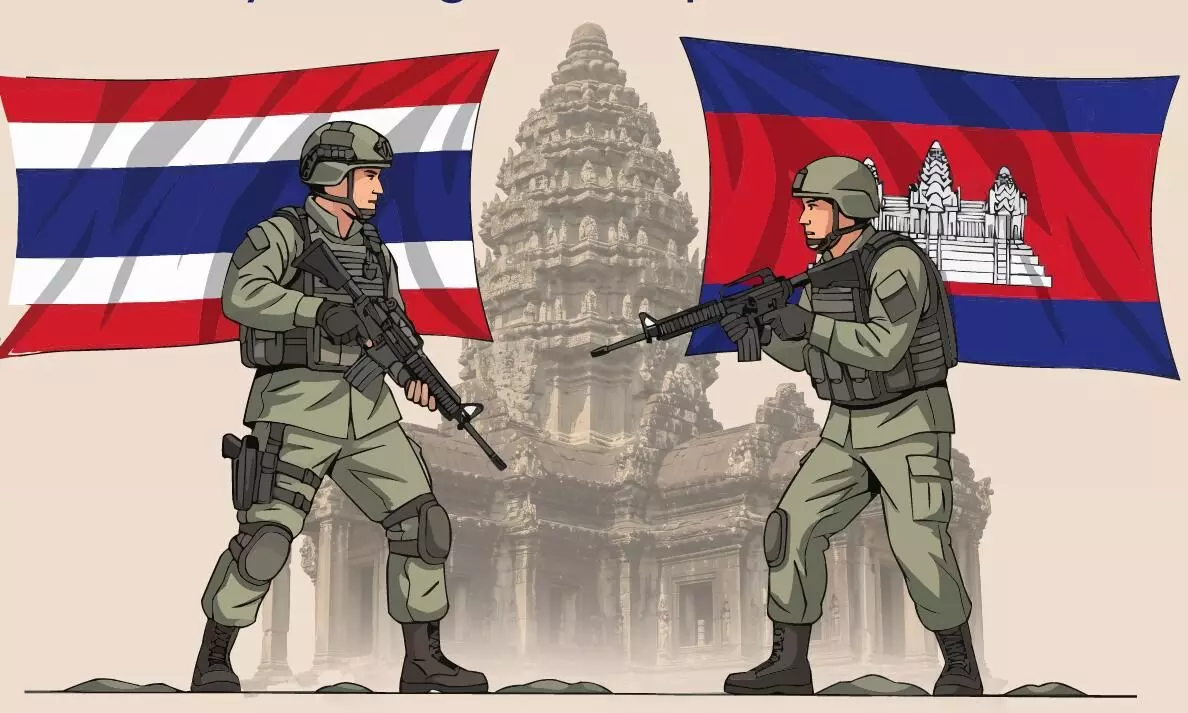
New Delhi, Dec. 20 -- A fatal clash between Cambodia and Thailand has erupted yet again in early December, barely six weeks after the peace deal brokered by US President Donald Trump on October 26, 2025. Alongside the ceasefire signing, the United States signed trade and cooperation agreements on critical minerals (including rare earth elements) with Thailand, Cambodia, and Malaysia. On November 11, Thailand suspended the deal and launched an air strike against Cambodia on December 8. The century-old border dispute between these two Southeast Asian countries, over the Khmer temples along the border, which are claimed by both sides, stems from maps drawn when Cambodia was under French colonial rule, and which Thailand says are inaccurate. The border clashes intensified as the fighting entered the second week. The Thai military reports "tense" clashes at key disputed temple sites, including Prasat Ta Krabey and Prasat Ta Muen Thorn. Cambodia alleged that Thai forces, including fighter jets, continued to strike targets across their disputed border. As fighting between the two countries spread to coastal areas of a disputed border region, Thailand's military said it was considering blocking fuel exports to Cambodia.
In July this year, 43 people were killed and 3,00,000 displaced, in the worst fighting along the border in a decade between the Thai and Cambodian troops. The US president took an initiative to broker a peace deal and threatened to withhold trade privileges from the two countries unless they stopped fighting. He followed the same tactics to stop India Pakistan war during 7-10 May. Thailand and Cambodia entered into a ceasefire agreement in Malaysia on October 26 in the presence of Trump. However, his peace deal faltered within two weeks when fighting erupted in the border in early November and soldiers were injured in a landmine explosion near the Cambodian border in Sisaket province. On November 11, the Thai prime minister, Anutin Charnvirakul, told reporters: "Today, we consider that the deal that we made in order to bring peace is now over".
Political dividends of war
Analysts argue that the present Thai-Cambodian crisis has offered the leaders of the belligerent countries huge political dividends. The deadly border clashes can serve as a public diversion from mounting problems at home. While Bangkok and Phnom Penh each insist they are only returning fire to defend themselves, political analysts say Thailand and Cambodia's leaders are reaping political dividends at home, pushing prospects for peace into the distance. Cambodian politics is dominated by the Hun family for the past four decades, crushing any genuine political opposition and wiping out most independent media. In 2023, Hun Manet succeeded his father, Hun Sen, as prime minister after an election widely seen as rigged. A war with Thailand helps, the "dynastic dictatorship" with little political legitimacy, for engineering public support for the rulers. War also helps distract Cambodians from the international blame and sanctions the country is facing over the globe-spanning scam industry it hosts, along with the vast money laundering and human trafficking networks that lubricate it, analysts argue.
Thailand is also in a deep political crisis. The nationalist fervour whipped up by the border clashes has helped the Thai military rebuild its own waning popularity, and aided conservative elites in "drumming down" support for the rival Shinawatra family, observes Paul Chambers, a visiting fellow with the ISEAS-Yusof Ishak Institute, based in Singapore.
The Shinawatra family, a Thai-Hakka Chinese family, is a very influential family in Thai politics, which has immensely influenced Thai politics since the late 1990s. After founding the Thai Rak Thai Party in 1998, the Shinawatra family has been the driving force behind a populist political juggernaut that won five general elections. Most of its administrations and prime ministers were ousted in either military coups or court verdicts. Three members of the Shinawatra family have served as Thailand's Prime Minister: Thaksin Shinawatra (2001-2006), his sister Yingluck Shinawatra (2011-2014), and his daughter Paetongtarn Shinawatra (2024-2025). Thaksin was ousted by a coup, Yingluck by a court ruling, and Paetongtarn was removed by the Constitutional Court. She was removed from office for mishandling a leaked phone call with Hun Sen in June aimed at easing border tensions. The forced exit brought Paetongtarn's entire administration crashing down.
Since then, Thailand's new prime minister, Anutin Charnvirakul, has faced mounting challenges of his own. Critics have accused his administration of reacting too slowly to floods that killed more than 160 people last month, and to the money laundering and human trafficking spilling into Thailand from the scam centers surrounding it in Cambodia, Laos and Myanmar. Last week, Anutin Charnvirakul, announced that he was "returning power to the people", moving to dissolve parliament and clear the way for elections earlier than previously anticipated.
Chinese military technology is shaping security dynamics in Southeast Asia
Thailand and Cambodia rely heavily on arms from China, which has cultivated close strategic and economic ties with the two Southeast Asian states. China's share in Southeast Asia's growing arms market has increased in the past two decades. From 2004 to 2023, Southeast Asian countries spent more than USD 42 billion on weapons. Russia was the largest arms supplier in terms of value - cornering 25 per cent of the Southeast Asian arms market - although its share dwindled in later years. For Beijing, arms sales are used to dilute Washington's security role in the region. China's arms sales to Thailand are a case in point. Although Thailand was a US ally, Bangkok has turned to China for military equipment such as tanks and air defence systems. In fact, Thailand has acquired more arms (in terms of value) from China than the United States.
Both the belligerent nations are using Chinese-built tanks, guns, and rockets. While Thailand uses Chinese VT-4 main battle tanks, the Cambodian military has begun using Chinese QBU-10 anti-material rifles against Thai forces. Anti-materiel rifles are large-caliber sniper systems designed primarily to destroy material targets, not just enemy manpower. Cambodia has heavily deployed rifles and rocket artillery systems to keep the superior Royal Thai Army at bay. They relied on Chinese PHL-03 Multiple Launch Rocket Systems (MLRS) along with the Russian BM-21 rocket launchers. Thailand has been using its F-16 Fighting Falcon fighter jets to destroy enemy positions. These aircraft are using US-made Mark 82 bombs with precision-guided glide navigation systems.
Chinese military technology is shaping security dynamics in Southeast Asia. China has supplied VT‑4 tanks to the Royal Thai Army, based on a 2017 agreement. Chinese weapons are fuelling both sides of the border war. It is also alleged that after 'Operation Sindoor', China is testing its weapons in the ongoing Thai-Cambodia war. In May this year, during the Indo-Pak war, China got the opportunity to test its weapons against Russian and French-built missiles and jets. Pakistan's arsenal is dominated by Beijing supplies, which got tested against India's Rafales and S-400 air defence systems, among others. Similarly, the ongoing conflict between Thailand and Cambodia has offered Beijing an opportunity to analyse how its rockets and missiles can perform against the US war machine.
Strategic importance of Mainland Southeast Asia
Mainland Southeast Asia (historically known as Indochina and the Indochinese Peninsula) - the continental portion of Southeast Asia that includes the countries of Cambodia, Laos, Myanmar, Thailand, Singapore, Vietnam as well as Peninsular Malaysia, is a geo-strategically important region as it lies east of the Indian subcontinent and south of Mainland China and is bordered by the Indian Ocean to the west and the Pacific Ocean to the east. To curtail US influence in the Indo-Pacific region, Beijing has long viewed mainland Southeast Asia as its own "backyard" and has sought to establish economic and military dominance in this resource-rich region.
China's Belt and Road Initiative (BRI) has been instrumental in developing large-scale infrastructure projects across Southeast Asia -especially in the Lower Mekong region, which includes the countries of Myanmar, Thailand, Laos, Cambodia and Vietnam. The China-Laos Railway, which connects Vientiane with Kunming, the China-Myanmar Economic Corridor (CMEC), a 873-kilometre high-speed rail (HSR) line linking Bangkok and Nong Khai on the border with Laos, the 3.8-billion-dollar Dara Sakor investment zone in Cambodia, are a few notable examples, promoting regional connectivity and trade. Most importantly, the BRI projects are transforming Lao PDR from a land-locked country to a land-linked hub connecting Thailand, Cambodia, Malaysia and Vietnam.
China's engagement with Vietnam has historically focused on enhancing cross-border connectivity between its inland provinces and Southeast Asia through the Greater Mekong Subregion (GMS) project established in the 1990s by the Asian Development Bank. The GMS project, which includes China, Vietnam, Cambodia, Thailand and Laos, became an integral part of the BRI. The China-Indochina Peninsula Economic Corridor (CICPEC), one of six land-based corridors within BRI, represents the culmination of regional integration efforts. Building directly on the foundations of the GMS project, this corridor overlays and extends the GMS framework, leveraging existing infrastructure and cooperative frameworks to deepen cross-border connectivity and economic integration in Southeast Asia, writes Jensen and Chen-Florea (2025).
War against the scam industry
Besides the ongoing war in the Thai-Cambodia border and civil war in Myanmar, a more difficult war is being fought in the lower Mekong region of mainland Southeast Asia, against notorious gangs who control illegal activities like human trafficking, production and distribution of synthetic drugs, illegal mining and scam industry. Online scam centers were initially concentrated in Cambodia, with additional trafficking hubs later uncovered in Laos and Myanmar. People-smuggling from Vietnam to the European Union has emerged as a focus issue in recent years. Satellite imagery has unveiled a massive scale of more than 2,400 sites for unregulated in-situ leach (rare earth), heap leach (gold, copper, nickel, manganese) and alluvial mining (gold, silver, tin) activities on or alongside 43 rivers in mainland Southeast Asian countries of Myanmar, Laos and Cambodia. The main "war" involving drugs in the region is the fight against trafficking from the Golden Triangle (Myanmar, Thailand and Laos), with Cambodia serving as a major supplier of cannabis, meth, and heroin. Digital scams in Myanmar have evolved into a multi-billion-dollar "cyber-slavery" industry centered in fortified compounds along the country's lawless border regions with Thailand. Myanmar declares a "zero tolerance" policy for cyberscams. The Central Bureau of Investigation (CBI) of India has gathered evidence indicating that the "slave compounds" operating in Myanmar and neighbouring areas have emerged as major hubs for the execution of digital arrest frauds. The agency has filed a charge sheet against 13 accused persons in one such major digital arrest case.
Myanmar, which is India's gateway to mainland Southeast Asia, is under grave political instability due to prolonged civil war. The military dictator is totally dependent on China for economic and armed assistance. The stateless Rohingya people of Myanmar, who have migrated to Bangladesh, have created a humanitarian crisis in the Indian sub-continent. Though the Mekong Ganga Cooperation (MGC) initiative ( where Cambodia, Laos, India, Myanmar, Thailand, and Vietnam as members), completed twenty-five years of existence in November 2025, India has failed to leverage MGC to attain any significant achievement- diplomatic or strategic, in the region.
Published by HT Digital Content Services with permission from Millennium Post.