
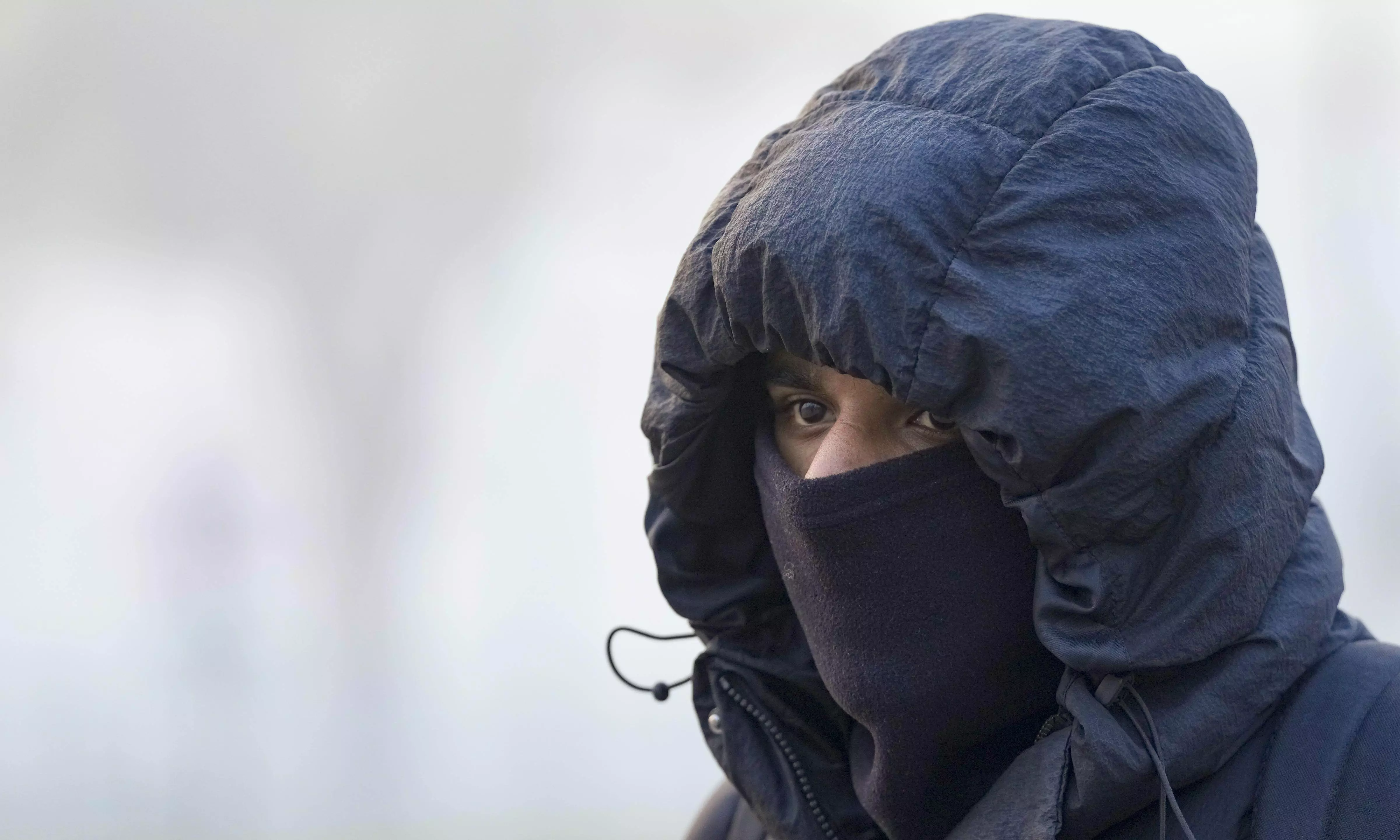
New Delhi, Jan. 10 -- Delhi recorded the coldest morning of the winter on Saturday, with conditions expected to worsen into a cold wave over the next two days. The city woke up to its chilliest January morning since 2024, with the minimum temperature at the Safdarjung Observatory settling at 4.2 degrees Celsius - the lowest reading of the ongoing winter season so far. The maximum temperature remained below normal at 19.7 degrees Celsius, the India Meteorological Department (IMD) said. The IMD has issued a yellow alert for Delhi for moderate to dense fog and warned of cold wave conditions on Sunday and Monday, with dense to moderate fog likely during morning hours as temperatures continue to drop across the region.
According to the IMD, cold wave conditions are declared when the minimum temperature falls about 4.5 to 6.4 degrees below normal, depending on local climatology. A sharp dip in temperatures was recorded across Delhi's weather stations on Saturday. Station-wise maximum temperatures showed Safdarjung at 19.7 degrees Celsius, Palam at 17.2 degrees Celsius, Lodi Road at 18.8 degrees Celsius, the Ridge at 17.9 degrees Celsius and Ayanagar at 19.0 degrees Celsius. Minimum temperatures reflected the intensity of the cold spell, with Safdarjung recording 4.2 degrees Celsius, Palam 4.5 degrees Celsius, Lodi Road 4.7 degrees Celsius, the Ridge 5.3 degrees Celsius and Ayanagar also at 4.5 degrees Celsius. Saturday's readings made it the coldest winter morning for the month in three years. The previous coldest January day was observed on January 15, 2024, when the minimum temperature had plunged to 3.3 degrees Celsius, triggering cold wave conditions across the national capital. On Friday, the minimum temperature was recorded at 4.6 degrees Celsius. Earlier, on December 4 and 5, the mercury had settled at 5.6 degrees Celsius, while on December 1, the minimum temperature stood at 5.7 degrees Celsius.
Meanwhile, Delhi's air quality deteriorated further, with the Air Quality Index (AQI) touching 346 at 4 pm, slipping into the "very poor" category as unfavourable meteorological conditions continued to restrict the dispersion of pollutants. Chandni Chowk recorded the worst AQI at 395, close to the "severe" category. Data showed that 27 stations were in the "very poor" category and 11 stations in the "poor" category, according to the Central Pollution Control Board's Sameer app. The CPCB defines AQI levels between 301 and 400 as very poor and 401 to 500 as severe. The Decision Support System said transport emissions contributed 10.84 per cent to local pollution, followed by Delhi and peripheral industries at 11.089 per cent, residential sources at 6.044 per cent and road dust at 0.95 per cent. As per the air quality warning system, air quality is likely to remain in the "very poor" category till January 13, with cold and calm conditions worsening pollution levels. In the morning hours, the AQI was also in the very poor category at 366.
Published by HT Digital Content Services with permission from Millennium Post.