
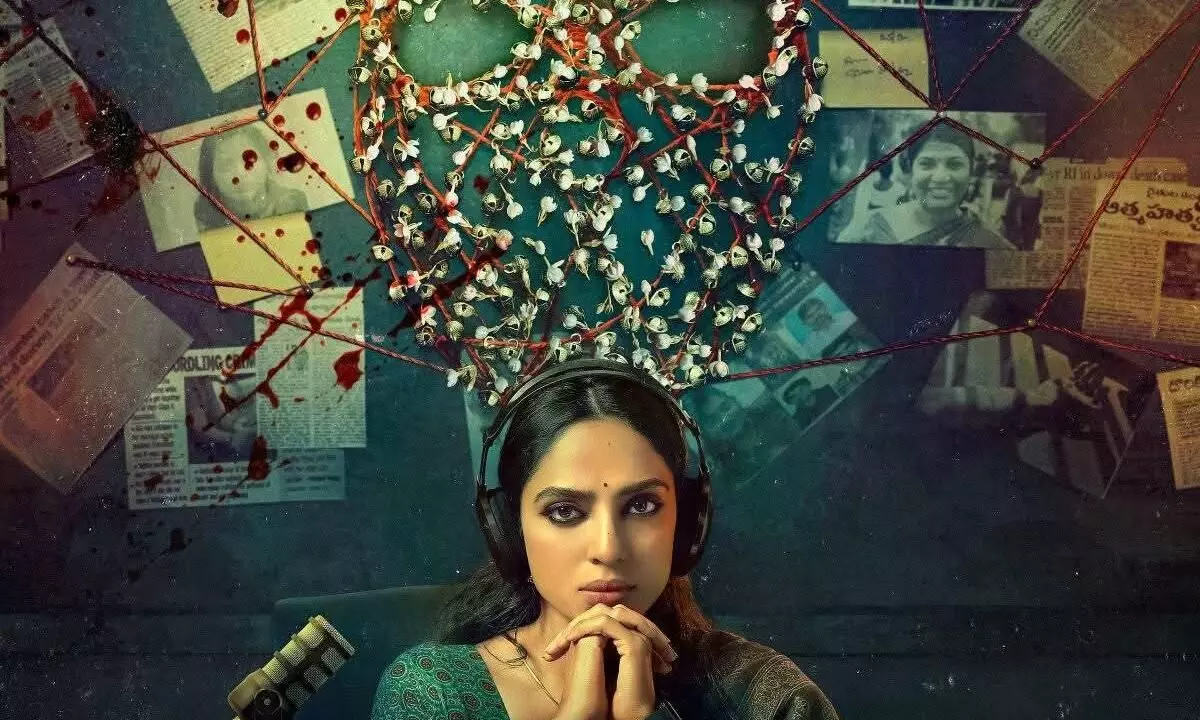
Film, Jan. 25 -- Cheekatilo
Director: Sharan Koppishetty
Producer: D. Suresh Babu
Production Company: Suresh Productions
Writers: Sharan Koppishetty, Chandra Pemmaraju
Lead Cast: Sobhita Dhulipala
Language: Telugu (with Hindi, Tamil and other dubbed audio tracks on OTT)
Platform: Amazon Prime Video
A moment from the trailer captures the film's tone with quiet precision. Sobhita's character, unsettled and seated at her desk in a blazer, is casually crowned by her intern. The gesture is celebratory, almost awkward. The space does not respond. The film does not frame the contrast as irony or triumph. It simply moves on, leaving the moment unresolved.
That withholding is central to 'Cheekatilo'. The title loosely translates to 'in the dark' and the film lives up to it structurally. Meaning is rarely illuminated directly. It accumulates slowly, sometimes ambiguously.
The film trusts the viewer to notice shifts without being guided toward them.
The story tracks a journalist negotiating authority and credibility, but the film avoids giving its environments emotional instructions. Rooms remain neutral. They don't underline moments or soften characters. While individual stories may reach limits, the environments and systems around them remain unchanged.
Art director Pranay Naini's approach keeps spaces from performing for the camera. This is most visible in the podcast room, which avoids the stylised, aspirational look common to such settings. Basic furniture and even lighting keep the space visually quiet, allowing attention to rest on voice and the act of listening. As episodes are recorded and replayed, the room becomes a constant, reinforcing the film's interest in how stories are constructed rather than how they are presented.
Interrogation spaces follow the same logic. One setup resembles a record room, where authority feels procedural rather than aggressive. Another introduces a slight spatial imbalance through wall depth and distance. The shift is subtle, but it affects how scenes play.
The viewer may not consciously register the design choice, but the body responds to it. A sense of constraint arrives before dialogue explains why. This mirrors how control quietly moves toward systems that frame and contain narratives.
Across the film, symbolism is never used as shorthand. Objects are not placed to explain meaning. Instead, meaning builds through texture, wear and repetition. Colours remain muted and controlled, keeping attention to behaviour rather than interpretation.
Minimalism, however, comes with a clear trade-off. The design rarely intervenes to heighten emotion, even at moments where the narrative might traditionally do so. This restraint can feel demanding, but it also sustains pressure more consistently than overt signalling.
What holds these choices together is consistency. The film never abandons its visual logic, even as the narrative deepens. Cinematography benefits from spaces that don't demand coverage and sound gains prominence because the rooms stay visually quiet.
In 'Cheekatilo', tension doesn't arrive dressed up. It settles into rooms that look ordinary enough to ignore. The film trusts these spaces to hold scenes without assistance and that decision shapes almost everything that follows.
Darshim Saxena is a screenwriting graduate from FTII, Pune, with over eight years of experience in content and brand communication. She is interested in craft-led approaches to film analysis
Published by HT Digital Content Services with permission from Millennium Post.