
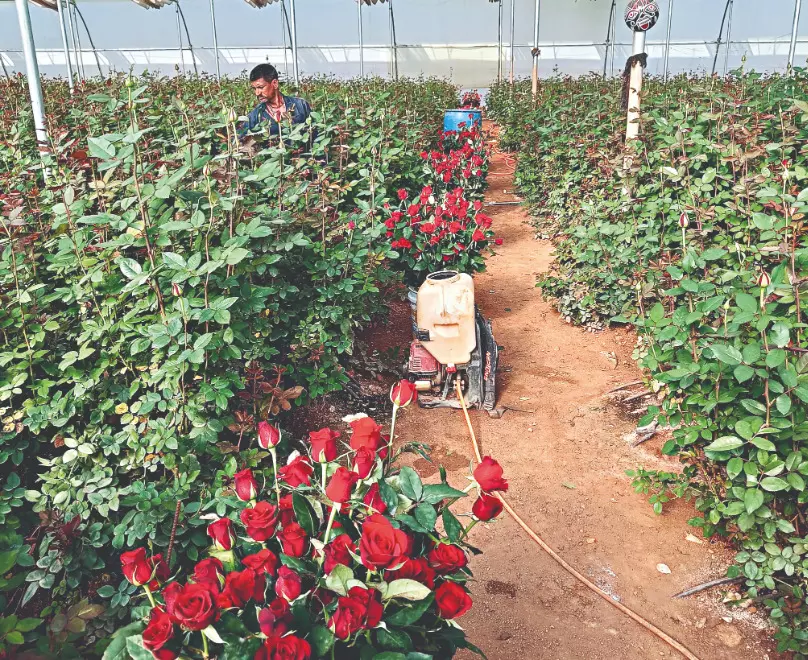
Bhopal, Dec. 7 -- Guna district in Madhya Pradesh, where parched earth once yielded modest harvests, is fast transforming into the country's emerging 'District of Roses'. With annual incomes touching Rs 12-15 lakh per acre, polyhouse-based rose cultivation is offering farmers returns nearly 12 times higher than traditional crops.
The idea, introduced by district Collector Kishore Kanyal, the initiative, 'Guna District of Roses', launched with 20 acres, has now expanded to 50 acres, turning arid fields into high-tech polyhouse clusters cultivating premium rose varieties.
The district's push has already borne results-two polyhouses secured first and second prizes at the All India Rose Exhibition in Bhopal earlier this year, placing Guna on the national floriculture map.
District Collector Kanyal, who has led the initiative from the front, says the project is closely aligned with the Viksit Bharat@2047 vision. "We have charted a five-year roadmap to expand protected rose cultivation to 500 acres by 2030, empowering farmers with high-tech horticulture and strengthening rural economies toward self-reliance," the Collector told Millennium Post. For many families, he says, "These aren't just flowers; they're tickets to dignity."
The economics underline the shift. While traditional farming yields barely Rs 1.11 lakh per acre annually, polyhouse roses fetch Rs 14-15 lakh, driven by 5-6 lakh stems per acre sold at Rs 5-6 each in major cities across the state and the country, including Jaipur, Udaipur, Delhi, Indore, Bhopal and Gwalior.
The district administration is planning to provide farmers with a dedicated platform to export premium-quality roses to markets in Europe and the Middle East.
Annual operational costs stand at Rs 10-11 lakh, with revenues of Rs 24-25 lakh, ensuring payback within 18 months.
Setting up a one-acre polyhouse costs Rs 46 lakh, but government subsidies covering 50% reduce the farmer's burden to Rs 23 lakh. Banks have already sanctioned 23 loans due to proactive outreach by the district administration.
"We aim to build a district-wide rose cluster catering to premium cut-flower markets year-round," said KPS Kirar, District Horticulture Officer. "This isn't just about roses; it's about transforming Guna into a floral powerhouse."
Leveraging the district's natural advantages, the Collector introduced this initiative. Guna's low humidity, 18-30degC temperature range, and sandy-loam to red soils further enhance rose productivity.
Educated youth are also joining the shift, led by engineer-turned-farmers Shubham Chauhan, Animesh Shrivastava, Amber Loomba, and Sushil Dahifale.
The district administration has backed the initiative with fairs, exposure visits, and technical training at NIPHT Talegaon, winning the SKOCH Silver Award 2025 for "A Floral Revolution via Polyhouses."
Strengthening women's empowerment, SHGs are now handling packaging operations, while solar and digital solutions have been introduced to bridge power and market gaps.
The initiative was praised by NITI Aayog during a workshop on innovations held in Ranchi, Jharkhand.
Published by HT Digital Content Services with permission from Millennium Post.