
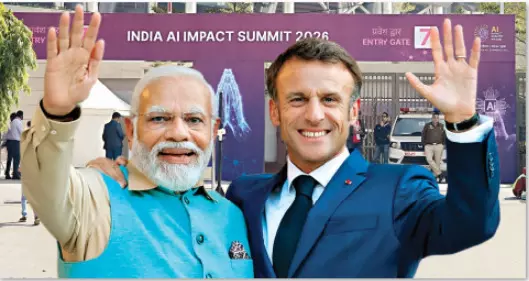
New Delhi, Feb. 15 -- French President Emmanuel Macron's visit to India for the Artificial Intelligence Impact Summit (February 19-20) is expected to extend well beyond discussions on cutting-edge technology. Both New Delhi and Paris are keen to use the occasion to deepen and diversify an already strong strategic partnership. For President Macron, the AI agenda carries personal and diplomatic weight. Recalling the AI Summit held in Paris in February 2025 - co-chaired with Prime Minister Narendra Modi - he described it as a triumph of French diplomacy: "The whole world came to Paris."
The Delhi Summit now offers India a critical platform to help shape the global AI agenda. As host, India is expected to foreground the concerns of developing economies and emphasise that AI's transformative potential must be aligned with inclusive growth, sustainable development, and climate-sensitive policies. The summit's organising philosophy - centred on the three sutras of people, planet and progress - will reportedly be operationalised through seven thematic "chakras" or working groups. These deliberations will build on the experience of recent global forums, including the UK AI Safety Summit, the AI Seoul Summit and France's AI Action Summit.
President Macron's visit also acquires added strategic resonance this year. India holds the BRICS presidency, while France chairs the G7. Both countries share a clear discomfort with a fragmented global order and have consistently argued for cooperation, rather than rivalry, between multilateral groupings. Macron articulated this succinctly last month when he observed that the G7 should not become an "anti-China" or "anti-BRICS" bloc, nor should BRICS define itself in opposition to the G7. India, as BRICS Chair, he noted, is uniquely positioned to build bridges - a sentiment Paris strongly endorses.
Shared Values, Strategic Depth
The India-France partnership rests on shared democratic values, a commitment to multilateralism, respect for international law, and robust people-to-people ties. Over the years, this has translated into steadily expanding trade, investment and institutional cooperation. The relationship received fresh momentum at the 38th India-France Strategic Dialogue, co-chaired in New Delhi in January by NSA Ajit Doval and Emmanuel Bonne, diplomatic adviser to the French President. The dialogue reviewed cooperation across defence, security, space, technology and civil nuclear energy, while also identifying opportunities for joint development under Make in India and Atmanirbhar Bharat.
Defence remains a cornerstone of the strategic partnership. France's willingness to share advanced technologies and support indigenous capability-building has made it one of India's most reliable defence partners. Opportunities for co-development and co-production span fighter aircraft, helicopters, naval platforms, submarines, artillery systems, radars, electronic warfare and secure communications. Crucially, there is now a realistic pathway for deeper integration of Indian defence MSMEs and private players into French supply chains through offsets, vendor development and joint ventures - helping Indian firms upgrade standards and access global markets.
India-based maintenance, repair and overhaul (MRO) hubs for aircraft, aero-engines, naval platforms and defence electronics are another promising area. Such facilities could serve not only domestic needs but also regional and third-country operators. Emerging domains - AI-enabled defence systems, cyber and electronic warfare, autonomous platforms, advanced materials and propulsion technologies - are also poised to benefit from bilateral collaboration, with the AI Summit providing a timely catalyst.
Beyond Defence: A Broader Canvas
Cooperation between India and France extends well beyond defence. Space collaboration between ISRO and CNES has a long history and can now be scaled further in areas such as earth observation, climate monitoring, navigation and telecommunications. This cooperation can also strengthen India's position in the global aerospace value chain, including the manufacture of aerostructures, avionics, landing gear, propulsion systems and composites for French OEMs.
Drones represent another fast-evolving area of partnership. Joint R&D, manufacturing of combat and surveillance UAVs, and collaboration on anti-drone technologies and biomimetic systems are already under way, involving organisations such as DRDO and Indian private-sector players. These efforts align closely with India's push for indigenous innovation.
Beyond strategic technologies, there is scope for deeper engagement in sports and sports infrastructure, creative industries, tourism, hospitality, and higher education. Joint research, co-funded R&D projects and applied innovation partnerships between Indian and French institutions and companies can add a strong economic dimension to the relationship.
AI may be the centrepiece of President Macron's visit, but its real significance lies in the wider set of engagements it can trigger. The visit underscores how technology diplomacy, when anchored in shared values and strategic trust, can open pathways across defence, industry, innovation and culture - giving the India-France partnership a distinctly future-facing edge.
Views expressed are personal. The writer is the Director General, FICCI
Published by HT Digital Content Services with permission from Millennium Post.