
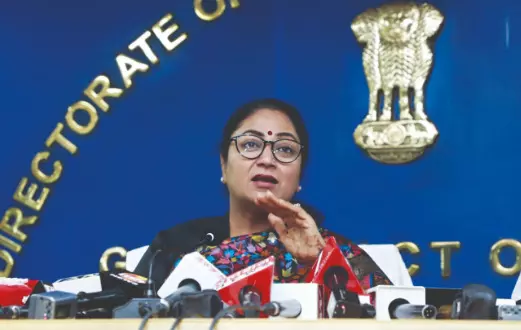
New Delhi, Dec. 28 -- As 2025 draws to a close, the BJP government in Delhi, back in power after nearly three decades, presents a mixed report card. While Chief Minister Rekha Gupta's administration moved swiftly on select welfare and healthcare commitments, residents across the city say 2026 must focus on fixing Delhi's most basic civic needs, including clean air, clean water, smooth roads, effective garbage management and a rejuvenated Yamuna.
Soon after taking office, the government rolled out the Ayushman Bharat health insurance scheme and launched Atal Canteens, providing Rs 5 meals to construction workers, daily wagers and slum residents. "This is one promise that truly helped people like us," said Mahesh, a daily-wage worker in Sangam Vihar.
Several headline promises remain pending. The Mahila Samriddhi Yojana, promising Rs 2,500 monthly assistance to economically weaker women, has yet to be implemented. "We voted hoping this would bring some financial stability," said Reena Sharma, a garment worker. "We are still waiting."
On governance outreach, Gupta personally led weekly Jan Sunwai sessions at Mukhyamantri Jan Sewa Sadan, while administrative restructuring resulted in two new districts, taking Delhi's total to 13.
Air pollution, however, continues to haunt the capital. Despite measures such as the "no PUCC, no fuel" rule, anti-smog guns, mechanical sweeping and mist sprayers, air quality remained in the severe category for much of winter. "Every year there are new rules, but the air becomes worse," said Rohit Verma, a resident of Anand Vihar. Environmental expert Anjali Mehra noted that "short-term enforcement must now give way to structural, year-round solutions."
Healthcare saw visible investment. There are now 238 operational Ayushman Arogya Mandirs, with over 200 more planned. The government finalised 12 MRI and 24 CT scan machines for public hospitals and intensified screenings for TB, cervical cancer and anaemia, with over 75,000 cases screened. Eleven hospital projects are expected to add more than 10,000 beds.
Infrastructure spending remained central, with a Rs 1 lakh crore Budget for 2025-26. The government secured Rs 800 crore under the Central Road and Infrastructure Fund and set a target to repair 500 km of roads by March 2026. Still, potholes remain a daily complaint. "My scooter hits potholes every day. Roads need permanent solutions, not patchwork. We always have the fear of meeting with accident." said delivery executive Salim Ansari. Water and the Yamuna remain politically and emotionally charged. The government unveiled a drainage master plan to reduce flooding and announced a one-time surcharge waiver on water bills to recover dues. Yamuna cleaning was revived through a 45-point action plan involving multiple agencies, with projects worth over Rs 1,800 crore. "We hear about action plans every year, but the river still smells," said Sunil Kumar, a resident near the Yamuna floodplains. "If the Yamuna improves, half of Delhi's pollution problem will be solved." Garbage management through bio-mining at landfill sites continued, but residents near Ghazipur and Bhalswa say relief is slow. "Garbage mountains are still part of our skyline," said local resident Pooja Singh. As Delhi steps into 2026, expectations are unequivocal. "Clean air, clean water, garbage-free streets and pothole-free roads are not luxuries. These are basic human needs," said Mehra. "The government has laid some groundwork in 2025. People now expect visible, everyday improvements."
For Chief Minister Rekha Gupta, the coming year may well determine whether early intent translates into lasting change on Delhi's streets, rivers and air.
Published by HT Digital Content Services with permission from Millennium Post.