
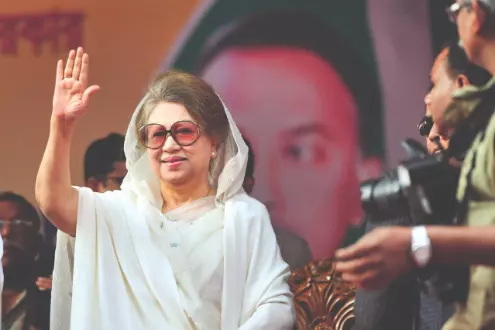
New Delhi, Dec. 8 -- Former Prime Minister and Chairman of the Bangladesh Nationalist Party (BNP), Khaleda Zia, is extremely critical and is currently hospitalised in Dhaka. There are numerous speculations on her health, and the BNP seems to be in a quandary. Amid these developments, her son and de facto party supremo, Tarique Rahman, who has been in exile in the UK for the last so many years, is being facilitated by the interim government to come back to Dhaka at the earliest to meet his precariously ill mother. Technical glitches obstructing his travel are being sorted out. It is thought that Tarique is not in possession of a Bangladesh passport, and therefore, the government is contemplating giving him a travel document to facilitate his travel. He is also believed to be flying back to Dhaka at the earliest to handle party affairs, especially when the forthcoming elections are a little more than two months away, needing the party a clear-cut direction to steer the ship, which seems to be in choppy waters.
It is intriguing to see that the Yunus-led Bangladesh government is going the extra mile to ensure that Khaleda Zia is medically best attended to, as her condition is rapidly worsening. A team of foreign doctors, including some from China, is already in Dhaka for her treatment. It may also be pertinent to point out here that for Khaleda Zia's treatment, the Indian Prime Minister, as a gesture of goodwill, offered all kinds of help, which was indeed a step forward for further improvement of relations between India and Bangladesh. The Chief Advisor, Muhammad Yunus, paid a visit to Khaleda Zia in the hospital primarily to ensure that she gets the best. The administration has also undertaken an exercise for take-off and landing facilities of the armed forces' helicopters near a makeshift helipad near the hospital, apparently to ensure the smooth visits of VIPs.
In another striking development, which catches the eye, is the award of a Very Very Important Person (VVIP) status to Khaleda Zia, which gives the facility of the best medical treatment. She is also provided with the best security cover by the elite Special Security Force (SSF), which is exclusively meant to give protection only to the President of Bangladesh, the Prime Minister of Bangladesh and any person designated as a VVIP by the Government of Bangladesh. All these show that Khaleda is viewed as the most important person in Bangladesh today.
From the upcoming elections and related politics' point of view, this may be a shot in the arm for a demoralised BNP, which, of late, was perceived to be in disarray in the absence of any charismatic leadership or any worthwhile roadmap. The performance of the student wing, Jamaat Islami Chhatra Shibir (ICS), had been exceedingly strong in the recently held student elections, which has dampened the spirits of the BNP. In the meantime, according to a survey published by the US-based International Republican Institute (IRI), if the elections are held next week, the BNP will get only 33 per cent of the votes and the Jamaat around 29 per cent. This also predicts 6 per cent vote for the National Citizen Party (NCP), 5 per cent for Islami Andolan Bangladesh and only 4 per cent for the Jatiya Party (JP). Hypothetically, this survey shows that BNP and Jamaat are running neck-to-neck in the closely contested elections that may ensue.
Political analysts also reckon that should anything untoward happen to Khaleda Zia, the sympathy vote may swing in her favour, giving the BNP a decisive edge over its political adversaries. Election watchers in Bangladesh also assess that the BNP and NCP are together on the ground, as the NCP necessarily does not have any grassroots support from the electoral angle.
Under the circumstances, Khaleda's health and future outcome remain crucial and central to Bangladesh politics and elections as well. The government's all-out support for her treatment and hastened steps to facilitate Tarique's return also indicate that the government is seen to be inclined towards the BNP, and the BNP leader Khaleda Zia, before hospitalisation, was regularly meeting leaders of the interim government and, more importantly, the military chiefs, as her base in the Cantonment has always been relatively strong.
Meanwhile, in a different development, a Dhaka court convicted and sentenced (December 1) ousted Prime Minister Sheikh Hasina to five years' imprisonment, her sister Sheikh Rehana to seven years, and Rehana's daughter Tulip Siddiq to two years for the Purbachal plot allocation scam. Judge Robiul Alam of the Dhaka Special Judge Court-4 pronounced the judgment. The court additionally fined all three Tk1 lakh each, ordering them to serve six more months behind bars in default. Earlier, the case was lodged against a total of 17 people over irregularities in the allocation of a plot. The court also convicted and sentenced 14 other accused. This has further demoralised AL cadres, as it may be recalled that earlier, on November 27, Dhaka Special Judge Court-5 convicted and sentenced Sheikh Hasina to 21 years' imprisonment in three identical cases. It also sentenced her son, Sajeeb Wazed Joy, and daughter, Saima Wazed Putul, to five years' imprisonment each in the respective cases filed against them over plot allocations. The court had found 22 out of the total 23 accused guilty in those three cases and sentenced them to varying jail terms.
Other than Khaleda's ongoing health crisis and the judgments awarded to Tulip and others, recent developments in Bangladesh also included a report of the National Independent Investigation Commission formed to probe the 2009 Bangladesh Rifles mutiny, which was submitted to Muhammad Yunus very recently. The highlights of the report carry erstwhile Prime Minister Sheikh Hasina and other Awami League (AL) leaders as responsible for the massacre. The timing of the declaration of this report is significant. Some anti-India elements have also started insinuating India's name in the Bangladesh Rifles Revolt (BDR) uprising, an accusation which does not stand to reason, and the government of Bangladesh would do well to scotch such insinuations and allegations at this stage lest the fabricated contents are exploited to the advantage of vested and hostile quarters. Ahead of the elections, these issues seem to be choreographed for political and electoral reasons, and if allowed to prevail, they may mar the credibility of the elections, causing a dent in the impartial working of the interim government.
Views expressed are personal. The writer is a retired IPS officer, Adviser NatStrat, and a former National Security Advisor in Mauritius
Published by HT Digital Content Services with permission from Millennium Post.