
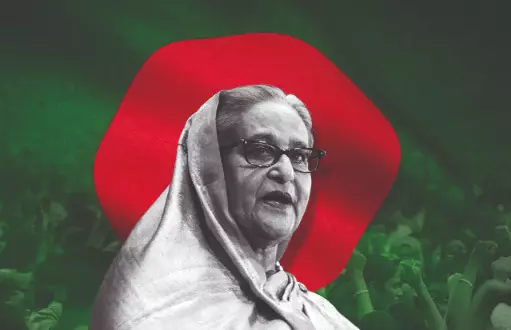
New Delhi, Dec. 1 -- The International Crimes Tribunal (ICT) in Bangladesh sentenced (November 17) then Prime Minister of Bangladesh, Sheikh Hasina, and former Home Minister Asaduzzaman Khan Kamal to death on charges of crimes against humanity committed during the uprising of July and August last year. The 3-member tribunal, which pronounced the verdict, stated that all three - then Prime Minister Sheikh Hasina and then Home Minister Kamal - exercised command responsibility over killings, torture, and the use of lethal force during the 2024 protest agitations.
The tribunal cited "solid" documentary and electronic evidence to show that ex-Prime Minister Hasina was directly complicit in the loss of so many lives. It's been over a week now since the death verdict was handed down, and there have been outpourings of reactions from the world over on this judgment. A majority of the political parties in Bangladesh, including the Bangladesh Nationalist Party (BNP), the Jamaat-e-Islami (JeI), the National Citizen Party (NCP), and their affiliates, have expressed relief and satisfaction over the outcome, as have the near and dear ones of those who died in the use of force. Hasina, on her part, has described the verdict as driven by political vendetta. Hasina's son has also expressed similar thoughts, along with Awami League (AL) cadres both within and outside the country.
What are the immediate implications in the aftermath of this judgment, especially for India? The first and foremost is that more pressure is expected from Bangladesh on India to extradite Hasina. India's stand on this issue has been consistent and steady. So, for now or even later, India doesn't seem to be extraditing Hasina, whatever pressure Bangladesh mounts on India. It's purely a legal and ethical stand. The stand is unwavering and based on sound reasoning.
Elections in Bangladesh are due in February next year - hardly three months away from now. Those in the poll fray, aspiring and desperate to get back to power like the BNP, Jamaat, etc., are indeed happy with the exclusion of AL from contesting the elections. They reckon that in this eventuality, they might sweep the polls as there is no one to challenge them in the absence of a formidable opponent. On the other hand, independent poll analysts confidently suggest that in case AL participates in the elections, it is bound to win despite the impressions their adversaries are carrying that once a death sentence is awarded to Hasina, AL is doomed forever. It's tragic for the fledgling democracy of Bangladesh that a party is illegally disenfranchised and not allowed to contest the polls. In fact, the democratic values are stifled. For now, sadly, no possibility of any revival of democratic values seems visible.
As soon as the verdict was announced, there was a sense of jubilation in a section of people who seemed aggrieved and had lost their brethren in the 2024 uprising. Many were allowed to march towards Sheikh Mujib's residence on Road 32, Dhanmondi, Dhaka, to ransack the historic house, which had come under brutal attack some months ago, witnessing unfortunate vandalism and systematic attempts to erase the remains of history. This time, however, the authorities appeared alert and foiled attempts to damage the founding father's house.
The outcome of the judgment also saw violent clashes and a few political assassinations. There was mounting tension in the districts of Gopalgunj and adjoining pockets where Hasina and AL's writ still runs. These strongholds will continue to challenge the law-and-order authorities for a long time to come. It perhaps requires some healing touch, political maturity and skilled negotiations for some semblance of restoring political order, which has stood visibly eroded for the last over one year.
One thing seems more than clear: this time, the election campaigning will have its major focus on the Hasina death verdict. The BNP will try to highlight the "ills" of the Hasina government in the last 15 years, comparing it with the "progress" report of the BNP during its rule from 2001 to 2006 and earlier from 1991 to 1996. Jamaat, which is still not clear whether it would participate in the elections, will play its own card by continuing to castigate Hasina and the AL for hanging the war criminals responsible for killings and complicity with the Pakistan Army in genocide. Jamaat Amir has already issued statements to these effects, justifying and welcoming the death verdict pronounced on Hasina, even going a step further by directly blaming India - stating that it has extracted its pound of flesh from Bangladesh all these years for its contribution to the liberation of Bangladesh. So, the hatred and venom remain; hence, polarisation ahead of the elections is more than visible. With the passage of time and election tempo catching up, intensified and acerbic anti-India statements are likely in the coming months emanating from Jamaat and BNP.
Factoring all these developments and the likely happenings, it's time for Bangladesh to introspect that it's time now to put an end to any recurrence on the lines of a bloody past. The unfortunate country saw spillage of so much blood during the liberation war - though it was for a noble cause - but the killings of Mujib and his family in August 1975, followed by two incidents of coup and counter-coup in November the same year, are the most grotesque in the history of Bangladesh, when the newly born country was hardly four years old. Later, the assassination of President Zia-ur-Rahman in May 1981, and then the hangings of war criminals, saw a series of deaths.
There has to be an all-inclusive Bangladesh now with parity for one and all, and partnership - especially with all its South Asian neighbours - with equal footing is the need of the hour. India has already stretched out its hand towards Bangladesh for continued friendship. It's time to put the effects of the death sentence behind us and move forward for peace and prosperity. Geopolitics is changing fast. India and Bangladesh have the promise to collaborate in almost all fields, forgetting any angst, for a better future for both. Shouldn't Bangladesh expect - and deserve - a better and peaceful future?
Views expressed are personal. The writer is a retired IPS officer, Adviser NatStrat, and a former National Security Advisor in Mauritius
Published by HT Digital Content Services with permission from Millennium Post.