
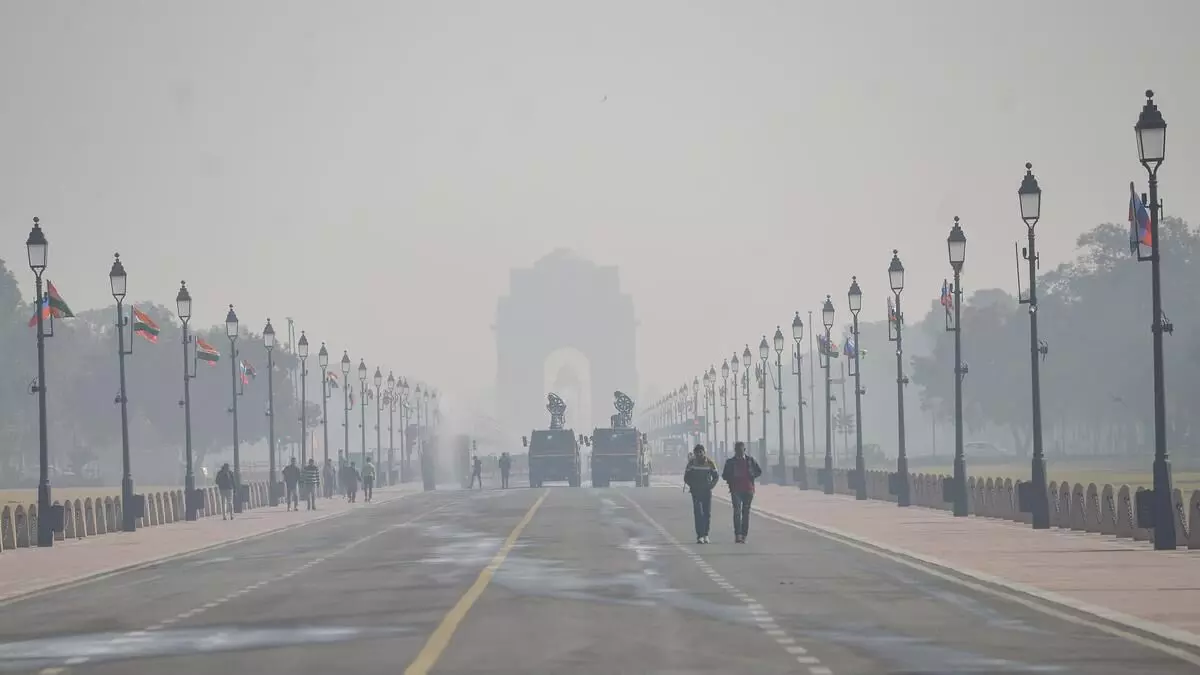
New Delhi, Jan. 24 -- After nearly three-and-a-half months -- 103 days to be exact -- Delhi's air quality on Saturday returned to the 'moderate' category, with the average AQI recorded at 192, as rainfall brought some respite from the prolonged spell of hazardous air.
According to an analysis by the Centre for Research on Energy and Clean Air (CREA), the last time the capital recorded 'moderate' air quality was on October 13, 2025, when the Air Quality index (AQI) stood at 189.
Between October 1 and October 13, Delhi witnessed nine days of 'moderate' air quality, before pollution levels deteriorated sharply.
CREA's analysis showed that October 14, 2025, onwards, hazardous air pollution levels were recorded in the city, with 26 days of 'poor' AQI, 66 days of 'very poor' AQI, and 10 days of 'severe' readings.
"Even Saturday's improvement to the 'moderate' range offers limited relief, as this category is known to cause breathing discomfort for people with lung disorders, asthma and heart disease," the analysis said.
However, the relief seems to be short-lived. The Air Quality Early Warning System has forecast that Delhi's air quality is likely to remain in the 'poor' category for the next two days, while the prediction for the subsequent six days suggests conditions will range from 'poor' to 'very poor'.
As per CREA data, the cleanest air quality since October 1, 2025, was recorded on October 8 when the AQI improved to the 'satisfactory' category, logged at 81.
In contrast, the worst air quality was recorded on December 14 last year when the AQI surged to 461, placing Delhi's air quality in the 'severe' category.
The improvement was largely attributed to Friday's rainfall -- the first spell in 2026 and the highest January rainfall in two years -- leading to a sharp dip in temperatures and clearing of airborne pollutants.
On Friday, the AQI had remained in the 'poor' category, at 282, despite the rainfall.
Prior to that, the city had experienced around 10 consecutive days of 'very poor' to 'severe' air quality, with AQI levels oscillating between 322 and 440.
Station-wise data on Saturday showed sharp variations across the capital.
NSIT Dwarka at 9 pm recorded the best air quality with AQI at 97, in the 'satisfactory' category, while Anand Vihar registered the worst, 217, in the 'poor' category.
As per the CPCB's Sameer app, at 9 pm, 35 monitoring stations were in the 'moderate' category, while two were in 'poor' and one was in the 'satisfactory' range.
According to the Central Pollution Control Board (CPCB), an AQI between 0 and 50 is classified as 'good', 51 to 100 'satisfactory', 101 to 200 'moderate', 201 to 300 'poor', 301 to 400 'very poor' and 401 to 500 'severe'.
Published by HT Digital Content Services with permission from Millennium Post.