
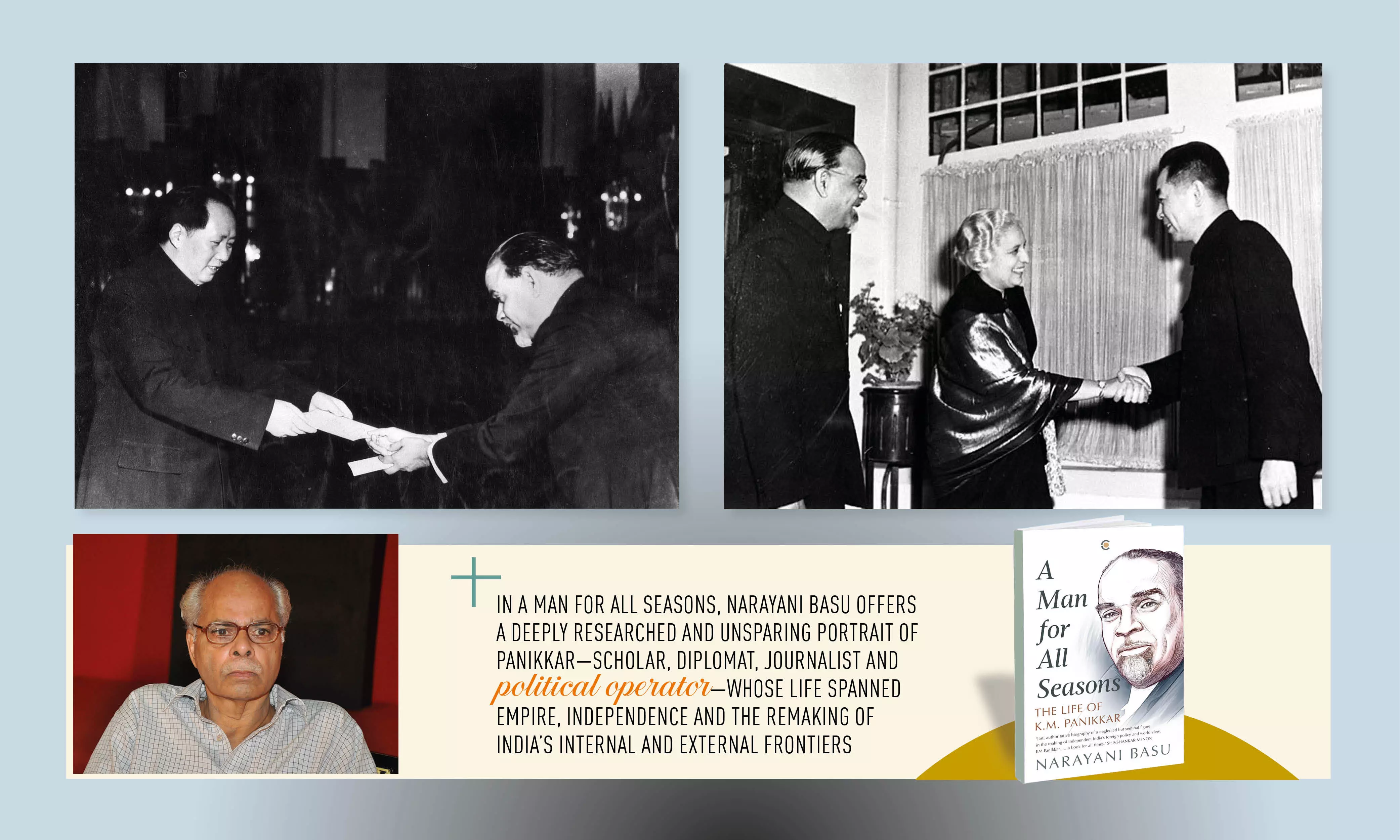
New Delhi, Jan. 24 -- KM Panikkar (KMP) could not have asked for a better Boswell to document his life, for Narayani Basu has dug into details that even KMP may have forgotten in his very rich, eventful and variegated life from 1894 to 1963-a period that saw him move from the backwaters of Travancore to a salient role in India's foreign and domestic policy as the country's first ambassador to both Nationalist and Communist China, and as a key member of the States Reorganisation Committee (SRC), which marked the restructuring of the internal boundaries of independent India.
Narayani Basu's biography, A Man for All Seasons: The Life of K. M. Panikkar, could just as well have been titled A Man with All the Reasons. It is indeed a comprehensive account of one of India's most multifaceted, controversial and sometimes misunderstood men of many parts: a polyglot scholar, diplomat, maritime historian, Malayalam litterateur, journalist, Gandhi's emissary, Dewan to princes, and a man with a roving eye. Ms Basu takes the reader on a roller-coaster ride across the diverse "avatars" of Panikkar's life.
We begin with his childhood in Kavala, detailing his family's traditional background and the early intellectual environment that shaped his pluralistic worldview. His earliest and fondest memories are of his grandmother, Kunjipilla Gowri-a gentle, lovable woman who adored her Madhava, read him stories from the Ramayan and Mahabharat, and instilled in him a love for Malayalam. Early attempts at teaching him arithmetic under the tutelage of his uncle Ayappa Panikkar failed miserably; he was often tied to a pillar for youthful pranks that included writing odes to young village belles.
He was then dispatched to Trivandrum, the capital of the ultra-conservative Travancore state, where rulers believed they were descendants of gods and guarantors of Hindu orthodoxy, with caste-based restrictions at their peak. Yet change was in the offing. Matrilineal inheritance norms were being challenged through the Malabar Marriage Act of 1896 and the Travancore Wills Act of 1899. Under the influence of Kerala Varma, primary schooling had been universalised; Nair supremacy was under attack; the Ezhavas were demanding equality; and the stranglehold of Sanskrit in education was being challenged by the Dravidian format.
While caning was a regular feature of Madhava's growing-up years, his love for poetry, philosophy and argument was strengthened by the intellectual environment at his elder brother's home in Trivandrum, which functioned as a salon for the town's aspiring intellectual, legal and political elite. Yet, even as he excelled in language and literature, science and mathematics overwhelmed him, and it was only after great difficulty that he cleared matriculation on his second attempt. This paved the way for his passage to Oxford in 1914 as a young, impressionable man of twenty.
At Oxford, he befriended the Suhrawardy brothers, John Mathai, Dewan Chimanlal, B. K. Mallik, Hasanand Datija, V. K. Raman Menon and K. P. S. Menon, among others. The Indian Majlis at Oxford also included students from Burma and Ceylon; its meetings opened with the stirring lines of Vande Mataram and ended with a hymn of Allama Iqbal. Congress politics and pan-Islamist ferment among Muslims following the overthrow of the Ottoman Caliph were high on the agenda. The three issues uppermost in the minds of these young men were Home Rule in India, universal adult franchise, and the impending war.
Soon, Panikkar began writing for Annie Besant's Commonweal, Natesan's Indian Review, and Bhasha Vilasam (in Malayalam), where he argued that the Dravidian metre was equally-if not more-powerful than the Sanskrit idiom to which language pundits had long succumbed. By 1916, he wrote "Greater India" for Ramananda Chatterjee's The Modern Review, examining Hindu cultural influences extending from the Indian subcontinent to Southeast Asia. He won a handsome prize of Rs 100 for the best essay for The Indian Emigrant, in which he expanded his concept of Greater India to include not merely the sacred geography of Jambudweep, but also territories where the Indian diaspora had established roots.
On his return to India in 1919, he married Gouri, the daughter of Ayappa Panikkar, and took up his first teaching position at Aligarh Muslim University. There, he wrote the seminal essay The Native States and Indian Nationalism, in addition to Indian Nationalism: Its Origin, History and Ideals. In these works, he argued that India had been a cultural entity since Vedic times and, coming as he did from a princely state, insisted that any plan for constitutional and political reform must take the princely states into consideration.
However, he was not cut out for AMU-or vice versa-his friendship with the Raja of Mahmudabad notwithstanding. In 1923, he left the security of academia to join Swarajya, the paper founded by Tanguturi Prakasam (Andhra Kesari), as assistant editor. That year also witnessed the Vaikom Satyagraha and the Congress session at Kakinada, where the party passed the resolution declaring temple entry the birthright of all Hindus.
The following year, Panikkar went as Gandhi's emissary to Amritsar to assist the Akali Shromani Sabha, persuading Akali leaders to focus on broader community issues rather than the individual case of Nabha's forced abdication. In the process, he convinced two key interlocutors to establish a national newspaper in Delhi under the banner Hindustan, which later evolved into the Hindustan Times. Besides powerful editorials, the paper ran exposes on government profligacy and scandals involving Maharajas. Unsurprisingly, KMP had to quit in February 1925.
Unemployed at 31, he returned to England to train as a barrister. Newspaper writing and his appointment as an examiner for the Indian History paper of the ICS sustained him financially and even funded a trip to Europe. There, Panikkar met artists, art historians and freedom fighters from across the world and engaged in torrid affairs with Germaine, Juliette and Veiller-Durray-none of which find mention in his rather bland Paris memoirs. Full marks to Ms Basu for portraying KMP as he truly was: a brilliant man with a roving eye, yet one who exercised old-world discretion and charm in his extramarital affairs.
Meanwhile, his book An Introduction to the Study of the Relations of Indian States with the Government of India was published in London and caught the attention of Colonel Kailash Nath Haksar, Prime Minister of Jammu and Kashmir, who was then in London as part of the Chamber of Princes delegation discussing the future of paramountcy before the committee headed by Sir Harcourt Butler.
On his return voyage to India in 1927 aboard the SS Ajmer-with Jawaharlal and Kamala Nehru and a young Indira as co-passengers-Panikkar wrote the 160-page monograph The Working of Dyarchy in India. In the interim, he accepted Haksar's offer to join the service of Maharaja Hari Singh, ruler of the twenty-one-gun salute state of "Riyasat-e-Jammu-wa-Kashmir-wa-Ladakh-wa-Tibet-ha" (the official name of J&K), thus beginning the next two decades of his life in the service of India's princes.
Published by HT Digital Content Services with permission from Millennium Post.