
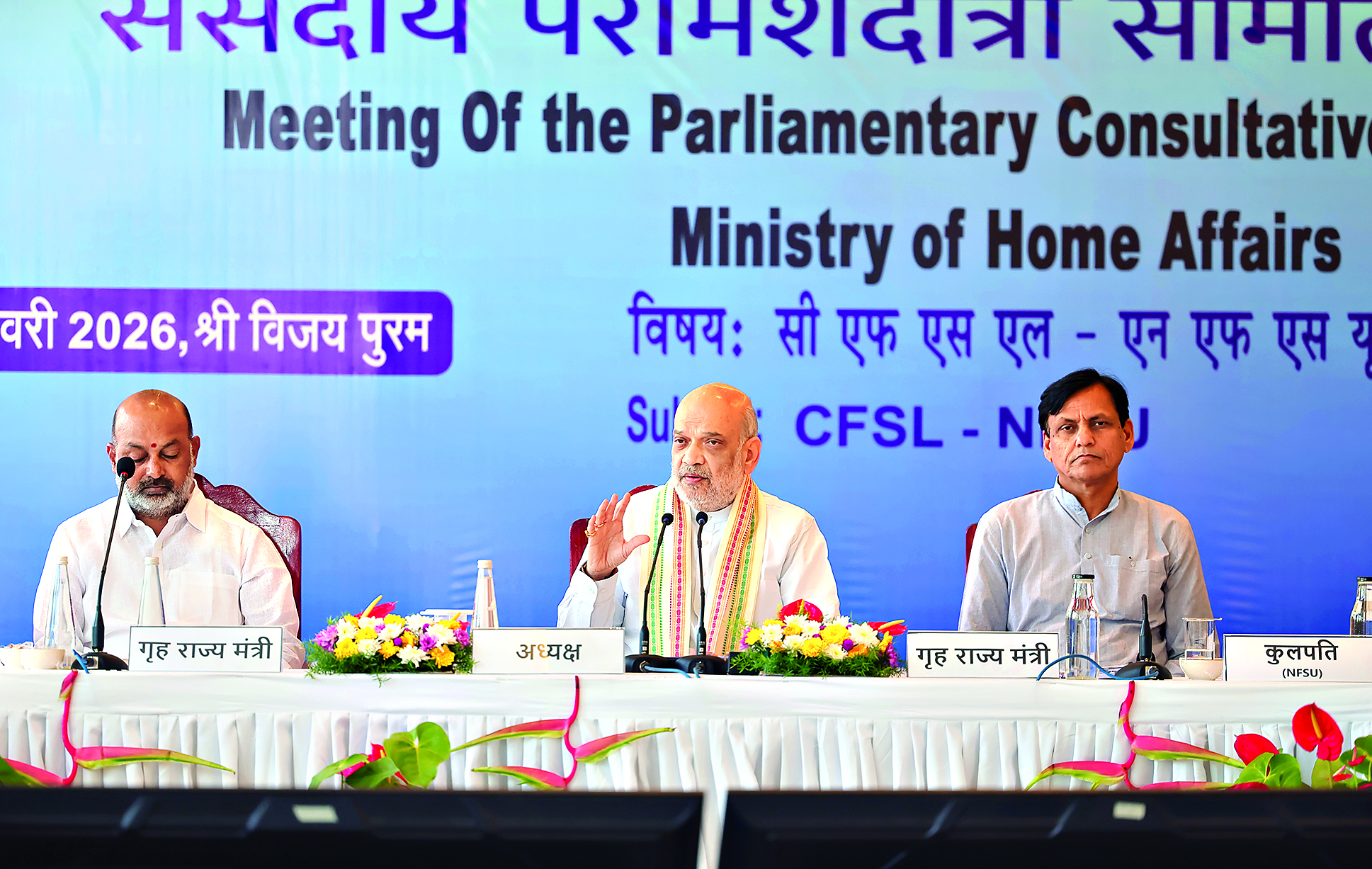
ANDAMAN AND NICOBAR, Jan. 3 -- Union Home and Minister of Cooperation Amit Shah chaired a meeting of the Parliamentary Consultative Committee of the Ministry of Home Affairs at Sri Vijaya Puram, focusing on the functioning and expansion of the Central Forensic Science Laboratory (CFSL) and the National Forensic Sciences University (NFSU). The meeting was attended by Ministers of State for Home Affairs Nityanand Rai and Bandi Sanjay Kumar, committee members, the Union Home Secretary, the Vice Chancellor of NFSU, the Director General of the Bureau of Police Research and Development and senior officials. Addressing the committee, Amit Shah said that since 2019, 12 meetings of the Parliamentary Consultative Committee have been held, producing constructive outcomes. He said it is Prime Minister Narendra Modi's vision that after the full implementation of the new criminal laws, justice should be delivered in a time-bound manner. "By 2029, we aim to establish a system in which the entire judicial process, from registration of FIR to the Supreme Court, is completed within three years," he said, adding that the Ministry is closely monitoring reforms through a 360-degree review mechanism.
The Home minister said the government began strengthening forensic capabilities as early as 2020, even before the new criminal laws came into force in July 2024. He noted that faster investigations and improved conviction rates are already evident, citing cases in West Bengal and Bihar where judgements were delivered within 62 and 50 days, respectively. Shah said earlier challenges included technology gaps, weak chain of custody, shortage of skilled professionals, inadequate forensic laboratories and lack of nationwide standards. He said under the new framework, forensic laboratories will directly submit reports to courts, while both the Centre and states will invest Rs 30,000 crore over the next five years to build a robust forensic infrastructure. Highlighting digital reforms, Shah said e-Summons, e-Sakshya, e-FIR and Zero FIR have improved access to justice, particularly for women and the poor. Forensic visits have been made mandatory in serious cases punishable with seven years or more.
Published by HT Digital Content Services with permission from Millennium Post.