
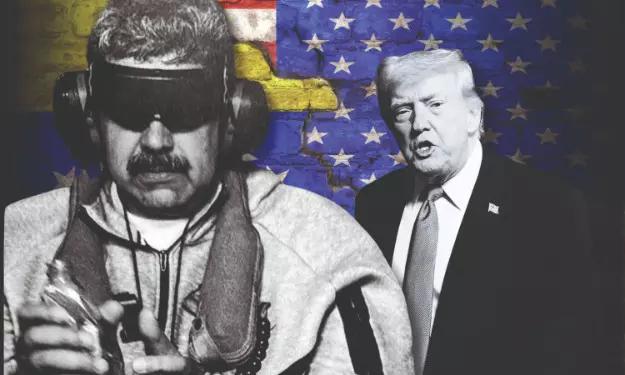
New Delhi, Jan. 4 -- The United States attacked Venezuela by air and by special forces (Delta Force) operations in the early hours of January 3, 2026. They captured the Venezuelan President Nicolas Maduro and his wife and flew them out of Venezuela. The operation marks a major escalation in the long‑simmering U.S.-Venezuela confrontation, with immediate regional and global implications.
Explosions rocked Caracas at 2 am local (12.30 pm IST today, 3 Jan 26), targeting Fort Tiuna (main Caracas army base), La Carlota airbase, communications antennas at El Volcan, and La Guaira port in Miranda/Aragua states. Venezuela declared an emergency; it decried the "military aggression," reports civilian/military hits and unclear casualties. The U.S. Federal Aviation Administration issued a NOTAM banning U.S. civil aviation over Venezuelan airspace.
Strategic Context
The attack caps months of U.S. military build‑up in the Caribbean under "Operation Southern Spear," which had already involved dozens of strikes on alleged drug‑trafficking boats and the seizure/blockade of Venezuelan oil tankers linked to Iran and sanctioned crude.
Washington has long treated Maduro as illegitimate and had outstanding indictments for narcotics and corruption; the raid operationalises those legal warrants through force, blurring lines between law enforcement and interstate war. The strikes appear to follow a classic decapitation strategy: precision attacks on command, air and communications nodes, coupled with a special‑forces snatch operation aimed at regime change.
Legality
The US strikes on Venezuela on January 3, 2026, violate Article 2(4) of the UN Charter, as they constitute a use of force against Venezuelan territorial integrity without UN Security Council authorisation or valid self-defence under Article 51. Legal experts and UN voices overwhelmingly deem the action unlawful, though US officials invoke narco-terrorism threats.
Immediate International Reactions
Close US adversaries Russia, Iran and Cuba have strongly condemned the strikes as an "act of armed aggression" and "state terrorism," calling for urgent UN Security Council action and warning against regime‑change by force. Left‑leaning governments in Latin America (e.g., Colombia's Gustavo Petro, Cuba) have denounced the bombing and demanded emergency meetings of the UN and Organisation of American States (35 members), while right‑leaning leaders such as Argentina's Javier Milei have publicly welcomed Maduro's reported removal. Some European states, including Spain, have urged de‑escalation and called for adherence to international law and dialogue, signalling discomfort with overt regime change but stopping short of immediate sanctions on Washington. In Washington, Trump allies have framed the operation as a decisive move against a "narco‑dictatorship," and at least one Republican senator has suggested active combat operations are now concluded following Maduro's alleged capture.
Internal Impact on Venezuela
Removal or capture of the head of state does not automatically translate into regime change; much depends on whether the armed forces' senior command fragments or coalesces around an alternative leadership (e.g., Diosdado Cabello, Padrino López, or opposition figures like Maria Corina Machado). If the military splits, Venezuela could face competing claims to authority (exile or detained Maduro vs. interim leaders vs. opposition). OR, a rapid escalation into urban conflict, especially in Caracas barrios and around military installations, with militias/colectivos and security units fighting for control. A humanitarian deterioration is likely: power outages have already been reported in parts of southern Caracas, flight bans and port strikes will disrupt supplies, and any protracted fighting could trigger new refugee flows into Colombia, Brazil, the Caribbean and beyond.
Implications for USA
Washington has now crossed from coercive sanctions and proxy/maritime operations into overt use of force on the mainland of a Latin American state, reviving memories of earlier US interventions (Grenada, Panama), but on a far more complex scale. Even if active bombing pauses, the U.S. is now deeply implicated in whatever political order emerges in Caracas. Managing post‑strike stabilisation, reconstruction, and legitimacy will be far harder than the military operation conducted so far. The operation will likely harden anti‑U.S. narratives across parts of Latin America, feeding into arguments for greater strategic autonomy, diversification toward China/Russia, and strengthening of regional institutions without U.S. leadership.
Global Geopolitical and Economic Implications
Russia and Iran may respond asymmetrically-through cyber operations, arms transfers, or expanded presence in neighbouring states-rather than direct military engagement, though even limited deployments (advisers, air defense) would raise escalation risks. Energy markets will price in heightened risk around Venezuelan crude, especially exports routed via grey channels to Asia, but the direct effect on global oil supply may be moderate in the short term, given existing sanctions and already‑reduced Venezuelan output. At the UN and in broader international law discourse, the case will intensify debates over the legality of unilateral regime‑change strikes without UN Security Council authorisation; as well as the use of counter‑narcotics/terrorism rationales to justify cross‑border military action against sovereign governments.
Issues to Watch Next
The stance of key swing states such as Brazil and Mexico which will heavily shape whether this episode becomes a one‑off shock or a catalyst for durable strategic realignment in Latin America. Any follow‑on U.S. moves: additional strikes, deployment of limited ground or advisory forces, expanded naval blockade, or rapid shift to a "mission accomplished" narrative and focus on extradition/trial of Maduro in U.S. courts. Confirmation and independent verification of Maduro's status and location, as Venezuela's state media may contest or withhold acknowledgement of his capture. Whether a coherent interim Venezuelan authority emerges (military junta, opposition‑led transitional council, or a contested dual‑power structure), and how quickly major regional actors recognise or reject it.
Consequences for India
On the energy front, India would be minimally hit, since it is not heavily reliant on Venezuelan crude (post-2024 sanctions dip). ONGC Videsh's ~$600M investments could face risk, but frozen dividends predate strikes; oil traders could add a higher-risk markup to crude benchmarks.
Views expressed are personal. The writer is Former Security Advisor, Ministry of Home Affairs, GoI
Published by HT Digital Content Services with permission from Millennium Post.