
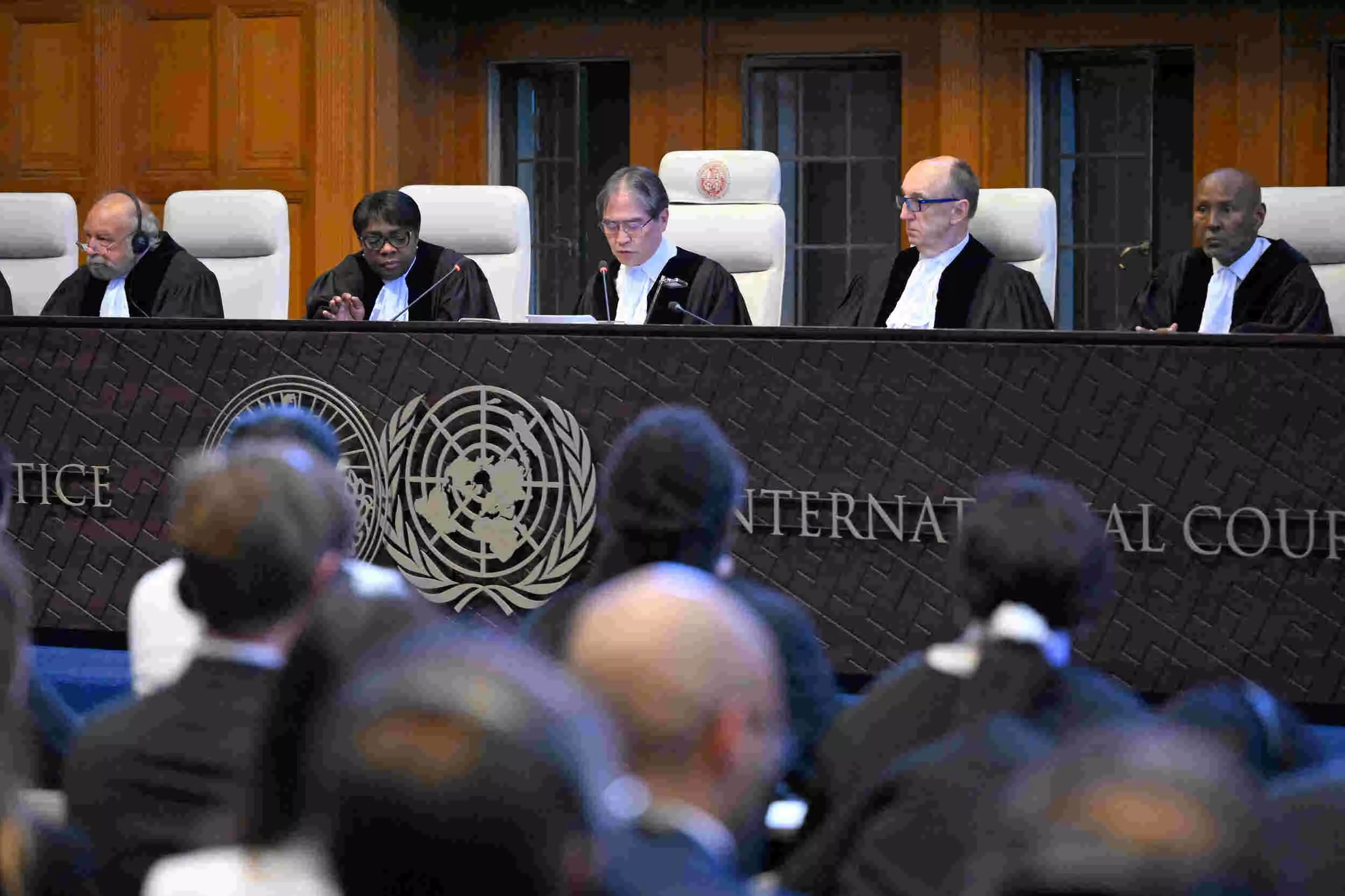
New Delhi, Dec. 6 -- The advisory opinion of the International Court of Justice (ICJ), pronounced in July 2025, which made the State legally responsible for its greenhouse gas emissions and allowed individuals to seek reparations in the event of damages caused by anthropogenic climate change, has caught the attention of governments around the world. It has also upheld the principle of 'common but differentiated responsibility' which has been mouthed ad nauseam by developing countries in all Conference of Parties (COP) meetings held over the years. Let us discuss the advisory opinion of the ICJ in more detail.
The ICJ Advisory Opinion
The case was first put together by some students of the University of South Pacific in Fiji, which coalesced into the Pacific Islands Students Fighting Climate Change (PISFCC). These students began their work in 2019 and made their case before the countries in the Pacific Islands. They also reached out to youth organisations in other parts of the world. In 2021, the Government of Vanuatu championed their case, got an endorsement from the 18 countries of the Pacific Islands Forum and moved a resolution supported by 105 countries in the UN General Assembly in March 2023. The resolution was to refer the matter to the ICJ, requesting an Advisory Opinion. While deciding on the reference, the ICJ looked at the UNFCCC, the Kyoto Protocol, the Paris Agreement and various UN agreements on Biodiversity, Desertification, Ozone Depletion and Oceans. The ICJ Judges also met scientists in the Intergovernmental Panel of Climate Change (IPCC).
The salient features of the Advisory Opinion are summarised below:A rise in the concentration of Greenhouse Gas Emissions in the atmosphere has been brought about by anthropogenic means and mainly by the massive rise in the burning of fossil fuels: this is directly leading to global warming and climate change. This climate change is a direct threat to 'human well-being and planetary health'.
Countries have a legal duty to prevent 'significant harm to the environment', and developed countries or countries in Annex 1 of the UNFCCC must take additional obligations in the fight against climate change.
The ICJ upheld the principle of 'common but differentiated responsibilities' whereby developing countries also have obligations, but these are lesser than those of developed countries, keeping in mind the development needs of the former.
That there can be reparations for loss and damages arising from a breach of obligations or Nationally Determined Contributions (NDCs) made under the Paris Agreement. While the Paris Agreement states that the inclusion of loss and damages excludes compensation or damages, the ICJ ruling states that this language does not override international law and states' responsibilities to provide "restitution", "compensation" and "satisfaction" to those harmed by climate change. Further, the NDCs themselves must reflect ambitious targets of greenhouse gas reductions.
The ICJ recognised that the important metric is 'cumulative greenhouse gas emissions' and that it was possible to calculate any country's contribution to global emissions by taking into account historical and current emissions.
The ICJ opinion was particularly clear on fossil fuels, and the responsibility of States engaged in fossil fuel production, consumption, grant of exploratory licenses and fossil fuel subsidies. If any State failed to protect the climate system from the greenhouse gas emissions emanating from fossil fuels, it would be a wrongful act on the part of that State.
The ICJ opinion is quite bold and sweeping in its coverage. It is also very timely, and even though it is not binding, it will certainly provide a leg-up to the UNFCCC and the IPCC. Not only that, but the opinion also opens the door to a more concrete discussion on affixing responsibility to countries for their emissions. It will also lead to more work on 'reparations' and compensations, and a revisiting of the International Mechanism on Loss and Damages established in the COP19 in 2013 at Warsaw and the Loss and Damage Fund established in COP27 in 2022 in Sharm-El-Sheikh, Egypt.
The ICJ advisory opinion was a landmark event in international jurisprudence and very significant for the global climate change negotiations. While the opinion is not binding, it is hoped that there will be more fruitful negotiations in the coming Conference of Parties, particularly on issues such as Climate Justice, Climate Finance and Loss and Damage.
Published by HT Digital Content Services with permission from Millennium Post.