
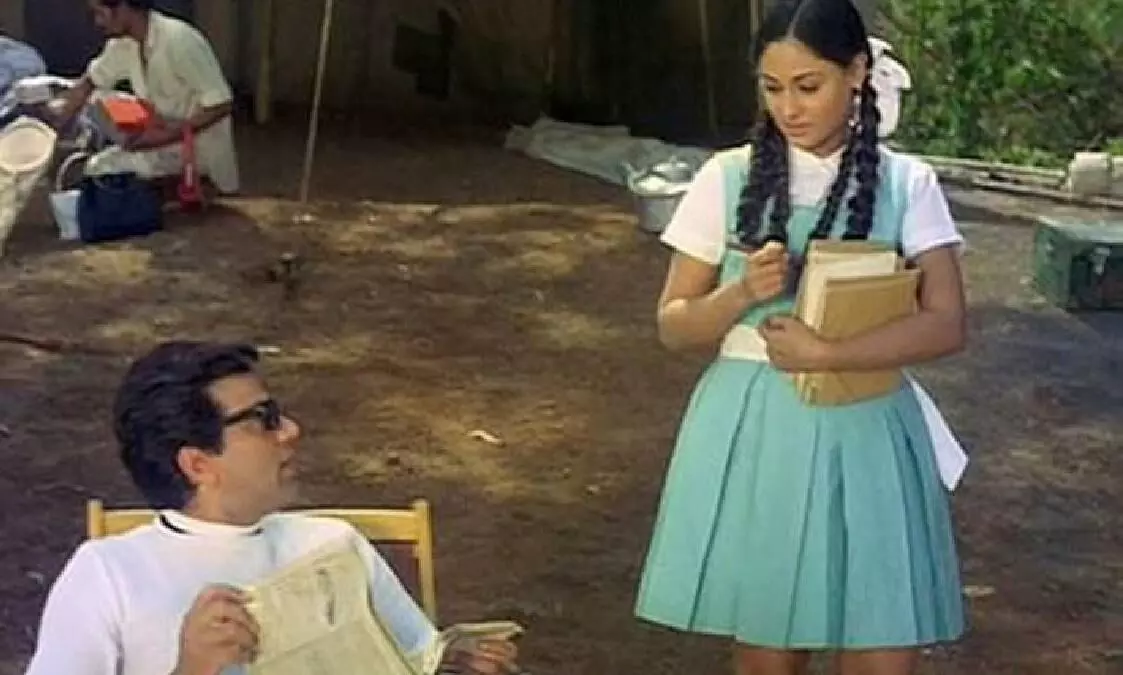
New Delhi, Dec. 7 -- In several of his past interviews, Dharmendra often said that 'Satyakam', 'Pratiggya' and 'Naya Zamana' are among his favourite films. And if you look closely, you'll spot one simple connection: Bengal. From Hrishikesh Mukherjee, his mentor who gave him classics like 'Satyakam', 'Chupke Chupke' and 'Anupama'; to Dulal Guha, whose 'Pratiggya' gave him the iconic 'Garam Dharam' image and to Pramod Chakravorty, who cast him again and again in 'Naya Zamana', 'Jugnu' and 'Dream Girl', Dharmendra's journey has always been tied to filmmakers, who had a connection with Bengal. In 2021, he even shared a throwback photo on 'Instagram' with Guha and Tanuja, remembering Guha as a 'genius director' and 'brother' and revealed that the three of them had once almost started a film production company.
Dharmendra's story actually begins with Bengal too. A handsome, young man from Punjab wins a talent contest judged by the legendary Bimal Roy and his life changes forever. In Roy's 'Bandini' (1963), Dharmendra played the soft-spoken prison doctor with such sincerity that people noticed him in a new way. 'Bandini' won the National Award for 'Best Feature Film' in Hindi and it was based on the Bengali novel 'Tamasi' by Jarasandha (Charu Chandra Chakrabarti). Then came Mukherjee's 'Anupama' (1966), where he played Ashok opposite Sharmila Tagore, an actress with Bengali roots and made audiences fall in love with a new kind of hero. That same year, he starred in 'Mamta', directed by Asit Sen, a remake of Sen's own Bengali classic 'Uttar Falguni' (1963), opposite iconic Bengali actress Suchitra Sen. And of course, we all know about the famous incident from the shooting: Dharmendra spontaneously kissed Suchitra on her bare back during a party scene and she stormed off saying she wouldn't finish the film. She was known for her strict 'Don't touch!' But after Dharmendra apologised, she returned and 'Mamta' went on to become a superhit.
In 1966, Dharmendra also entered Bengali cinema with 'Paari', directed by Jagannath Chatterjee, again based on a story by Jarasandha. It was also the first film in which he appeared alongside his idol, Dilip Kumar.
Then, in 1975, Mukherjee directed him in one of Hindi cinema's most loved comedies, 'Chupke Chupke', also starring Amitabh Bachchan, Sharmila and Jaya Bachchan. 'Chupke Chupke' was a remake of the Bengali classic 'Chhadmabeshi', starring Uttam Kumar and Madhabi Mukherjee. Sharmila recently said Dharmendra should have won the National Award for his performance. Jaya first met Dharmendra on the sets of 'Guddi', another Mukherjee film. Years later, on 'Koffee with Karan', she confessed she hid behind a sofa the first time she saw him, calling him a 'Greek God' in white.
Throughout his career, Dharmendra kept returning to filmmakers who carried the simplicity of Bengal's storytelling. Mukherjee remained his guiding force. Dharmendra always said, "All the films I did with Hrishi Da were special." His performance in Satyakam is considered one of the finest in Hindi cinema, the story of a man fighting to hold on to morality in a corrupt world. He also worked with Sen in 'Sharafat' and with Basu Chatterjee in 'Dillagi', which was based on a Bengali novella.
Dharmendra's chemistry with actresses with Bengal roots has its own charm. Of course, there's Sharmila, Suchitra and Jaya. With Tanuja, he gave films like 'Izzat', 'Baharen Phir Bhi Aayengi' (produced by Guru Dutt, also starring Mala Sinha) and 'Chand Aur Suraj'. With Moushumi Chatterjee, he starred in 'Phandebaaz' (directed by Samir Ganguly), 'Mera Karam Mera Dharam' (shot partly in Bengal's Murshidabad), 'Aag Hi Aag' (directed by Shibu Mitra) and more. With Supriya Chowdhury, he gave hits like 'Begana' (1963) and 'Aap Ki Parchhaiyan' (1964). "I should have played Basanti! Because I loved Dharmendra," Jaya said on the 'Koffee with Karan' show with Hema Malini sitting beside her.
Published by HT Digital Content Services with permission from Millennium Post.